

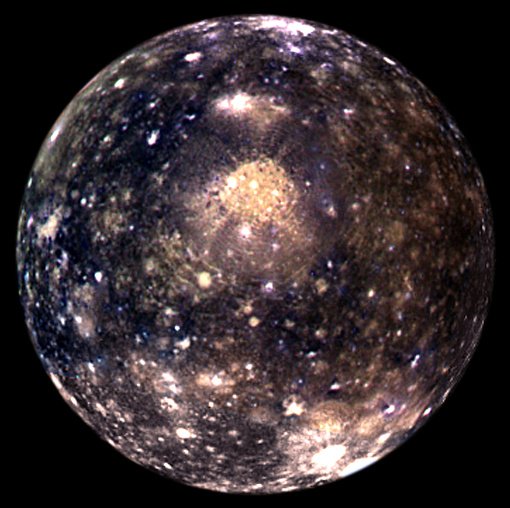
Callisto, the most distant of Jupiter’s four Galilean satellites, is a world of extremes: nearly the size of Mercury yet made mostly of water ice, heavily cratered yet suspected to harbor a subsurface ocean, and long dismissed as geologically dead yet offering some of the most spectacular terrain in the outer solar system.
A new profile by Daniel Johnson in Sky & Telescope takes a fresh look at this often-overlooked moon, just as Jupiter returns to prime evening observing positions for the summer months.
An Icy World the Size of Mercury
With a diameter of about 4,820 kilometers (2,995 miles), Callisto is nearly identical in size to Mercury and significantly larger than Earth’s Moon. But its composition tells a different story. While Mercury is dense and metal-rich, Callisto is a lightweight mixture of water ice and rock. Ice makes up more than half of the moon’s bulk, giving it only about one-third of Mercury’s mass and a surface gravity slightly weaker than our Moon’s.
Despite lacking “planetary heft,” Callisto’s surface is anything but dull. The moon is the most heavily cratered object in the solar system according to NASA, its surface scarred by billions of years of impacts with no active geology to erase them. But those craters are visually striking. True-color images from NASA’s Galileo spacecraft and the Voyager probes reveal a brown surface tinged with pinks and purples, studded with impact craters that give Callisto the appearance of a Christmas tree ornament.
Valhalla and Ice Spires
Among Callisto’s most dramatic features is the Valhalla region, a massive multi-ring impact basin analogous to the smaller Mare Orientale on Earth’s Moon. The force of the impact that created Valhalla deformed the surrounding ice-and-rock crust into wave-like structures, and closer views from Galileo revealed tremendous fault scarps and cliffs.
Even more exotic are Callisto’s ice spires. These towering spikes, likely formed by impact ejecta and subsequently eroded over eons, soar up to 100 meters (300 feet) above the surface. Galileo spacecraft images from 2001 showed these bright, sharp knobs scattered across the landscape, a testament to the moon’s violent history and the slow pace of change on a world without weather or plate tectonics.
A Hidden Ocean?
Despite its frozen, inactive surface, Callisto may hold a secret in its interior. Astronomers suspect the moon hosts an underground liquid water ocean, similar to Europa’s, based on irregularities detected in Callisto’s magnetic field. If confirmed, Callisto would join Europa, Ganymede and Enceladus as part of an emerging class of icy worlds where liquid water exists far from the Sun’s warmth, raising the tantalizing possibility of habitable environments beyond the classical habitable zone.
A Candidate for Human Exploration
Callisto’s distance from Jupiter gives it a unique advantage among the Galilean moons: safety. Jupiter’s powerful magnetosphere traps intense radiation, and the dosage decreases sharply with distance from the planet. Io, the innermost Galilean moon, receives the harshest bombardment. Europa and Ganymede experience progressively weaker radiation. Callisto, orbiting a relatively safe 2.9 million kilometers from Jupiter, receives the least radiation of any Galilean satellite, making it a potentially viable destination for human visitors.
A 2003 NASA study actually explored Callisto as a candidate for a human outpost in the outer solar system. While the agency ultimately did not pursue the concept further, the study highlighted that Callisto offers a unique combination of scientific interest and relative safety for crewed missions beyond the asteroid belt.
The view from Callisto’s surface would be spectacular. Because the moon is tidally locked to Jupiter, the giant planet would hang motionless in the sky for an observer on the nearside, while Io, Europa, and Ganymede would perform their slow 1:2:4 orbital dance around it like celestial clockwork.
How to See Callisto
For backyard observers, Callisto is surprisingly accessible. Jupiter is visible for much of the year along the ecliptic, appearing as a steady, bright star-like object. A pair of 7×50 binoculars or any small telescope will reveal the four Galilean moons as tiny points of light in a line straddling the planet.
Callisto is the farthest from Jupiter in terms of orbital distance, though a line-of-sight illusion can sometimes place it closer to the planet in the eyepiece. The moon completes one orbit in about 17 days, moving noticeably from night to night.
There is something profound about seeing Callisto with your own eyes. The photons that reach your binoculars or telescope left a world 4,820 kilometers wide, made of ice and rock, scarred by impacts billions of years old, possibly hiding an ocean beneath its frozen crust, and orbiting nearly 800 million kilometers from Earth. Not bad for a point of light.