

Published: June 02, 2026, 00:56 UTC
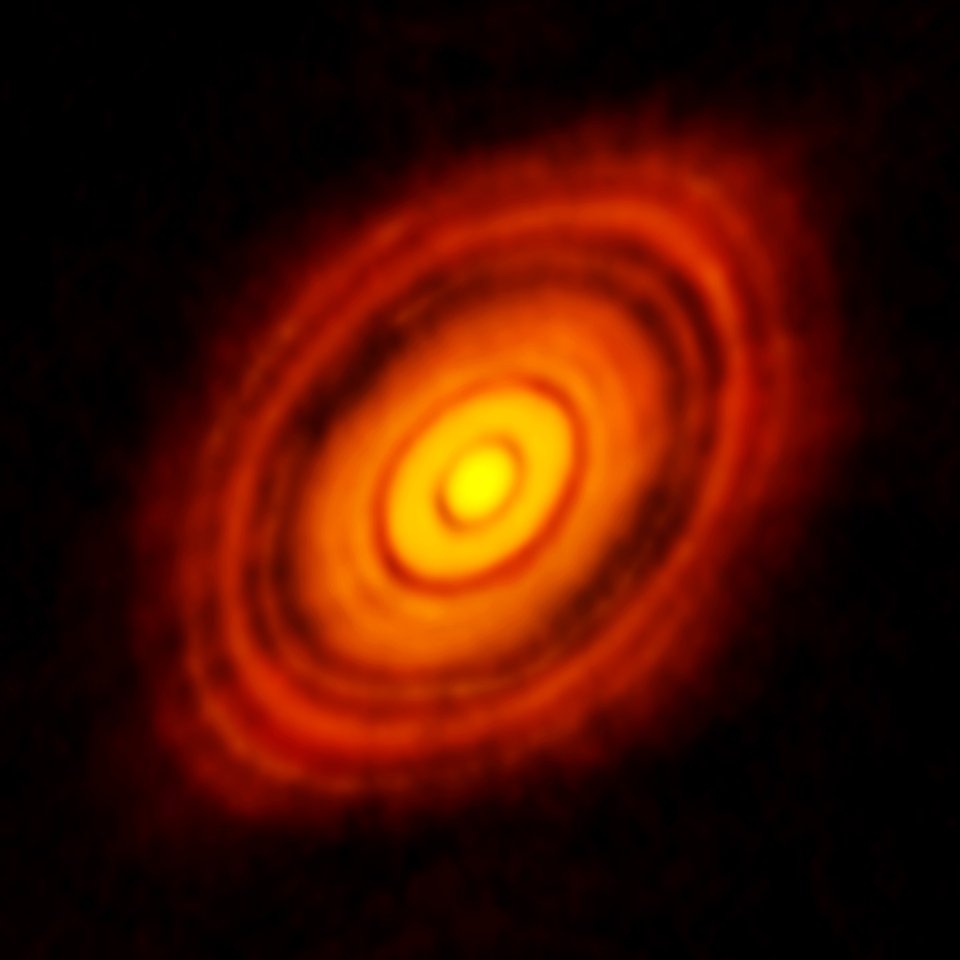
The most beautiful images in astronomy are often the most deceptive. When the Atacama Large Millimeter/submillimeter Array (ALMA) captures a protoplanetary disk — the swirling nursery of gas and dust around a young star — it reveals intricate patterns of concentric rings and gaps. For years, astronomers suspected these rings were carved by planets orbiting within the disk. But they had no way to prove it, or to measure the planets responsible.
A study published May 28 in The Astrophysical Journal changes that. Led by PhD student Amena Faruqi at the University of Warwick, the team has developed the first quantitative method to convert the properties of dust rings directly into planetary mass measurements — a technique they describe as reading planetary “fingerprints” in the rings around stars.
The Problem with Baby Planets
When a planet forms inside a protoplanetary disk, it doesn’t just sit there quietly. Its gravity perturbs the surrounding disk material, clearing a gap in the gas and creating a ring of dust at the outer edge of its influence. These structures are precisely what ALMA sees so spectacularly.
But here’s the problem: a forming planet is deeply embedded in this gas and dust. It’s invisible to every telescope we have. You can see the ring it carved, but you cannot see the planet itself.
“There are hundreds of ALMA images showing these beautiful ring patterns, and we’ve assumed they’re caused by planets,” says Faruqi. “But until now, we couldn’t turn that assumption into a measurement.”
The only way to directly image an exoplanet is if it’s large, bright, and far enough from its star — conditions that apply to perhaps a dozen known planets. For the thousands of other ring systems, astronomers needed a different approach.
Three Measurable Properties
Faruqi and her collaborators — Jessica Speedie (MIT/University of Victoria), Ralph Pudritz (McMaster University), and Dr. Farzana Meru (University of Warwick) — ran an extensive series of 2D hydrodynamical simulations of planet-disk interactions. They modeled planets ranging from 0.5 to 2.0 times the pebble-isolation mass (the threshold at which a planet’s gravity can hold onto the pebbles drifting through the disk) across three different disk geometries.
From the simulations, they identified three properties of a dust ring that scale predictably with the mass of the planet that carved it:
- Ring dust mass — the total mass of dust trapped within the ring
- Ring peak location — the radial position of the ring’s brightest point, which shows a linear relationship with the planet’s Hill radius (the sphere of gravitational influence around the planet)
- Ring width — how radially broad or narrow the ring is
The relationships are not simple linear functions across all planet masses. For planets below the pebble-isolation mass, both ring width and ring mass increase with planet mass. For planets above this threshold, the ring properties become indistinguishable — a limit that defines the upper range of the method.
The key insight is that these three properties, measured together, provide enough information to read the planet mass backwards from the image.
Testing on PDS 70
To validate their method, the team applied it to PDS 70, one of the few systems where planets have been directly imaged inside their protoplanetary disk. The system hosts two known planets: PDS 70 b and PDS 70 c.
Applying their ring-property calibration, the team recovered a mass for PDS 70 c of approximately 7.5 Jupiter masses — in strong agreement with independent estimates from direct imaging and spectroscopic methods. The convergence validated the approach.
“These bright rings are not just beautiful structures — they are essentially planetary fingerprints,” says Faruqi.
The team also applied the method to five disks from the exoALMA survey, producing new mass predictions for planets potentially lurking within them. Those predictions await direct confirmation — but the PDS 70 result suggests they’re reliable.
What This Unlocks
The immediate impact is practical. ALMA has imaged hundreds of protoplanetary disks, and the number grows every year. Most show ring structures. Most of those rings were assumed to be planetary in origin but could not be connected to specific planet masses.
This method changes that. Any ALMA observation of a dust ring can now, in principle, yield a mass estimate for the unseen planet that sculpted it. That transforms a descriptive catalog of “interesting ring patterns” into a quantitative population study of forming planets at various masses and orbital distances.
“This gives us a toolkit that turns ALMA’s extraordinary imaging power into a planetary weighing scale,” says Dr. Meru. “We can start asking questions about how planet mass correlates with orbital radius, disk properties, and stellar type in a way that simply wasn’t possible before.”
The open-access paper is available under DOI 10.3847/1538-4357/ae6272, with data from the hydrodynamical simulations provided for other researchers to apply the method to their own disk observations.
The Limits
The technique works best for planets below the pebble-isolation mass — roughly up to a few Jupiter masses. More massive planets produce ring structures that saturate the measurement. The method also depends on disk properties like aspect ratio and turbulence, which must be independently estimated or assumed.
But for the vast majority of forming planets — the ones too small to be seen directly but large enough to carve a measurable dust ring — this is the most direct way to weigh them yet devised. And it turns a spectacular but unreadable image into a readable scientific measurement.
Reference: Faruqi, A., Speedie, J., Pudritz, R. E., & Meru, F. (2026). “Reading between the Rings: Observed Dust Ring Properties as Probes of Planet Masses.” The Astrophysical Journal. DOI: 10.3847/1538-4357/ae6272. Open access.