

For the first time, astronomers have directly detected the ultra-dense molecular gas that fuels star formation in a typical massive galaxy from the peak era of cosmic star formation, providing the clearest view yet of how galaxies built their stars 10.5 billion years ago.
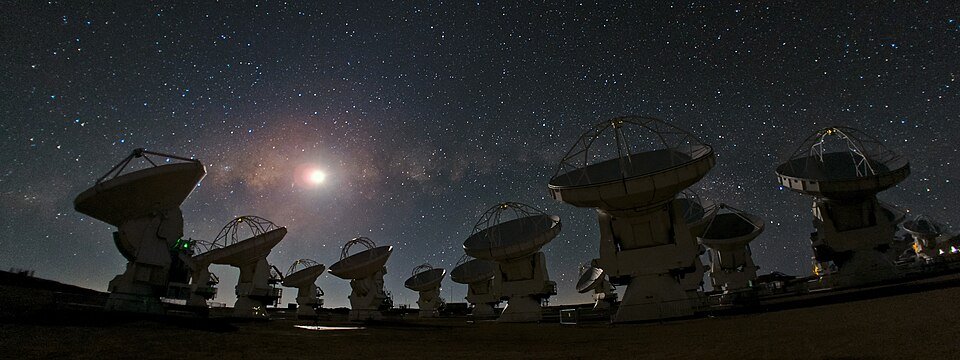
The detection, reported in a paper submitted to Astronomy & Astrophysics and led by Jianhang Chen of the Max Planck Institute for Extraterrestrial Physics (MPE), used the Atacama Large Millimeter/submillimeter Array (ALMA) to trace two high-density molecular tracers — HNC and CN — in the galaxy BX610 at redshift 2.21, corresponding to the cosmic noon epoch when the universe was roughly 3 billion years old.
“This is the first time these dense gas tracers have been detected in a massive main-sequence galaxy at this distance,” the authors write. Previous detections of dense gas at cosmic noon were limited to extreme populations: submillimeter galaxies, quasars, hyperluminous infrared galaxies, and gravitationally lensed systems. BX610 is different: it is a typical massive main-sequence galaxy, representative of the galaxy population that dominated the star formation budget at the peak of cosmic history.
### What ALMA Found
BX610 is a rotation-dominated disk galaxy with two prominent spiral arms and a possible stellar bar, as revealed by the James Webb Space Telescope. It is forming stars at a rate of 141 solar masses per year and contains about 120 billion solar masses of molecular gas.
The ALMA observations, totaling 19.2 hours of on-source time from three programs, detected emission from HNC (J=5-4) and CN (N=4-3) — molecules that trace gas at densities of millions of particles per cubic centimeter. This is three orders of magnitude denser than the bulk molecular gas traced by carbon monoxide (CO).
The dense gas is dramatically more concentrated than the overall molecular gas reservoir. While CO emission is spread across the galactic disk, 54 percent of the HNC and CN emission originates from the central region within just 1.2 kiloparsecs (about 3,900 light-years) of the nucleus. In contrast, only 21 percent of the CO emission comes from this central region.
Using radiative transfer modeling with the RADEX code, the team determined that the dense gas has a volume density of 2 to 4 million particles per cubic centimeter and a kinetic temperature of 50 to 80 Kelvin (minus 223 to minus 193 degrees Celsius). The measured HNC-to-CN line ratio of 1.05 is consistent with dense gas clouds in photodissociation regions — the transition zones where ultraviolet radiation from young stars interacts with surrounding molecular clouds — similar to what is seen in local starburst environments.
### No Hidden Supermassive Black Hole
The line ratio also provided a diagnostic for the presence of an active galactic nucleus. The HNC/CN ratio rules out a strongly buried AGN in BX610, consistent with earlier optical line diagnostics. This confirms that the intense star formation in the galaxy’s core is powered by the accumulation of gas rather than by feedback from a central supermassive black hole.
### Same Recipe as Local Galaxies
Despite being observed 10.5 billion years in the past, BX610’s star formation follows scaling relations established for local luminous infrared galaxies. The derived luminosity of HCN (converted from the HNC and CN measurements) falls directly on the far-infrared versus dense-gas luminosity relation calibrated for local LIRGs — suggesting that the fundamental physics of star formation has not changed over cosmic time.
“What controls star formation in galaxies?” is one of the central questions in astrophysics. The results support the view that star formation at cosmic noon — the era when the universe produced most of its stars — is primarily regulated by the availability of dense molecular gas. The combination of ALMA’s dense-gas detection and JWST’s imaging of spiral arms and a possible bar suggests that efficient cold gas inflows transport gas to galactic centers, where it condenses into the ultra-dense clouds that ultimately collapse into stars.