

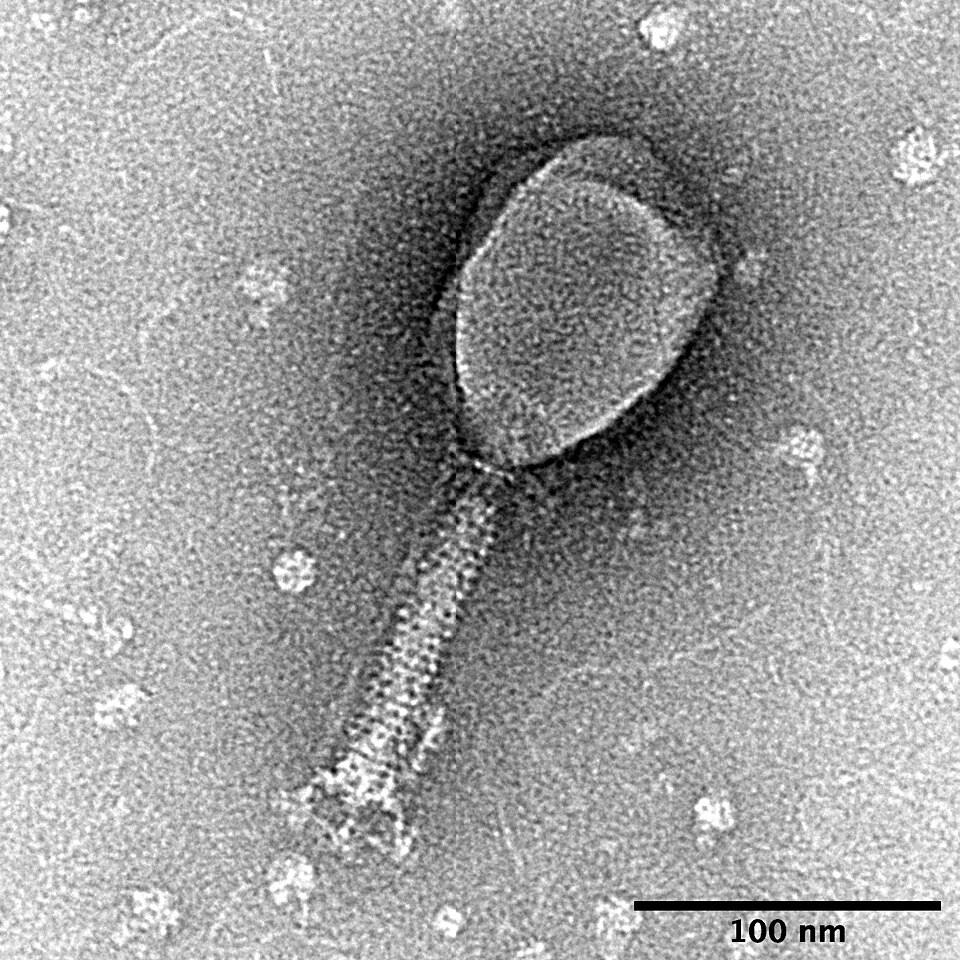
A team at Imperial College London has engineered bacteriophages, viruses that normally infect bacteria, to deliver a malaria antigen directly to tumor cells, redirecting pre-existing vaccine-induced immunity to destroy cancer. In mice with established colorectal tumors, the approach produced durable complete remissions in 44 percent of animals, with no detectable toxicity.
The work, published in Biomaterials (Volume 334, 2026), exploits a fact of modern medicine: billions of people have been vaccinated against infectious diseases, generating long-lived memory T cells that persist for years or decades. The idea is to make cancer cells look like those vaccine targets, so the immune system attacks them without needing to generate a new immune response from scratch.
How it works
The researchers used M13 filamentous bacteriophage, a virus that infects E. coli bacteria, engineered into a platform called TPA (Transmorphic Phage/AAV). The phage capsid displays an RGD4C double-cyclic peptide that binds to two integrins, αvβ3 and αvβ5, that are overexpressed on tumor cells and tumor vasculature but largely absent from healthy tissues.
Inside the phage, the researchers packaged a gene for Pb9, a CD8+ T-cell epitope derived from the Plasmodium berghei circumsporozoite protein (malaria). The construct also includes an H5WYG endosomal escape peptide (to enhance intracellular delivery of the payload) and a Grp78 tumor-activated promoter that restricts expression to cancer cells.
The key insight: the mice had been vaccinated with the Ad.ME-TRAP malaria vaccine (a human adenovirus serotype 5 encoding a multi-epitope string plus the TRAP antigen). This vaccination generated a pool of memory CD8+ T cells specific for the Pb9 epitope. When the engineered phage delivered Pb9 to tumor cells, those cells were flagged for destruction by the pre-existing T cells, which then released interferon-gamma, tumor necrosis factor-alpha, granzyme B, and perforin, triggering both intrinsic and extrinsic apoptosis pathways.
The results
In BALB/c mice bearing subcutaneous CT26 colorectal carcinomas, six tail-vein injections of the phage construct over 12 days (5 × 10¹⁰ transducing units per dose) produced over 40 percent durable complete cures, animals remained tumor-free for one year. Controls receiving the vaccine alone, the phage alone, or no treatment had zero percent cures. The approach was also validated in a second model, EF43.fgf4 mammary tumors.
The tumor specificity was remarkable. Pb9 transcripts were found only in tumor tissue, not in liver, kidneys, lungs, heart, or spleen. Blood biomarkers of liver and kidney damage (LDH, ALT, AST, BUN) were normal throughout treatment, body weight remained stable, and no systemic inflammation was detected. Anti-phage antibodies developed (a 2.5-fold increase) but did not block efficacy.
Why this is different
Conventional cancer immunotherapy approaches, checkpoint inhibitors, CAR-T cells, oncolytic viruses, either try to unleash an existing but suppressed immune response or engineer entirely new immune cells. This approach takes advantage of an immune response that already exists at high frequency (vaccine-induced memory T cells) and simply redirects it to the tumor.
Because the antigen cassette is swappable, the principle could be extended to any vaccine generating strong immune memory, influenza, COVID-19, or more robust vaccines. The group is in talks with the UK Medicines and Healthcare products Regulatory Agency (MHRA) to begin an early-stage human trial, hoped to start in 2027.
Source: Hajitou, A. et al. (2026). Redirecting pre-existing vaccine immunity to tumors via targeted bacteriophage. Biomaterials 334, 124286. DOI: 10.1016/j.biomaterials.2026.124286