

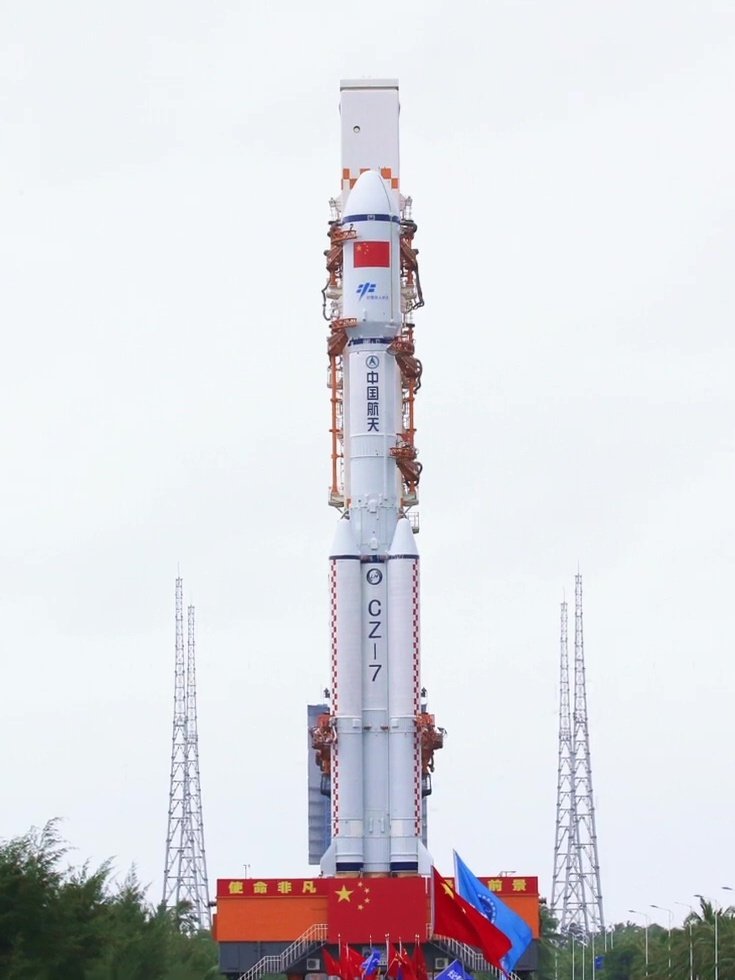
China is preparing for the debut orbital flight of its Long March 10B (CZ-10B) rocket, with a launch window opening July 10-13, 2026, and an ambitious attempt to recover the first stage at sea using a net-equipped barge.
The mission, launching from Commercial Launch Pad 2 at the Wenchang Commercial Space Launch Site on Hainan Island, represents a critical milestone for China’s space program. The Long March 10B is the commercial variant of a new family of rockets that will eventually carry Chinese taikonauts to the Moon.
A Rocket Built for Reusability and Lunar Ambitions
The Long March 10B is a two-stage, single-core medium-lift rocket developed by the China Academy of Launch Vehicle Technology (CALT) and commercialized through China Long March Rocket Co., a subsidiary of state-owned CASC. Standing approximately 70 meters (230 feet) tall with a 5-meter (16-foot) diameter core stage, it is designed to deliver at least 16 metric tons to low-Earth orbit.
The first stage is powered by seven YF-100K kerosene-liquid oxygen engines producing a combined sea-level thrust of roughly 8,750 kilonewtons. These engines can throttle to approximately 60 percent, enabling a controlled propulsive landing. The stage is equipped with grid fins for aerodynamic guidance and landing hardware for capture by a net system.
What sets the CZ-10B apart from its crew-rated sibling, the CZ-10A, is its upper stage: a methane-liquid oxygen engine, the YF-219, producing 140 tonnes of thrust. The CZ-10A uses a kerosene-fueled upper stage instead. The first stages of both variants are nearly identical, differing only in interface hardware.
The Recovery Attempt
After stage separation, the first stage will descend under grid fin control toward the recovery vessel Linghangzhe, a barge fitted with an arrestor net and support frame positioned downrange in the South China Sea. A drone will photograph the attempt under a contract awarded to a Wuhan-based firm.
This will be China’s third attempt to recover an orbital-class rocket first stage, following efforts by LandSpace’s Zhuque-3 in December 2025 and the Long March 12A in the same month. A successful recovery would be the first for CASC, China’s primary state aerospace contractor.
De-Risking for the Moon
The Long March 10B is the first of three related vehicles to fly, and its primary purpose is to de-risk the reusable first stage design for China’s crewed lunar program. The CZ-10A, which will be crew-rated for missions to the Tiangong space station and eventually the Moon, shares the same first stage design.
A successful recovery would validate the net-based barge system, grid fin control, engine re-ignition, and landing logic needed for the crew-rated version.
China’s lunar architecture calls for two Long March 10 launches for each surface mission: one carrying the Lanyue lunar lander and one carrying the Mengzhou crew capsule. The two spacecraft would rendezvous in lunar orbit before two taikonauts descend to the surface. China has stated its goal of landing astronauts on the Moon before 2030.
A Delayed but Crucial Step
The CZ-10B’s debut has been repeatedly pushed back. Originally targeting April 2026, the launch was delayed by hydraulic cylinder and piston issues with the transporter-erector at Commercial Launch Pad 2. A Shanghai-based firm was contracted for repairs, and the rocket’s erector was observed moving back to the pad on June 23.
The debut flight comes amid a banner year for Chinese launch activity. With 44 orbital launches through June 25, China is on pace to exceed 100 launches in 2026 for the first time, building on a national record of 92 orbital attempts in 2025.