

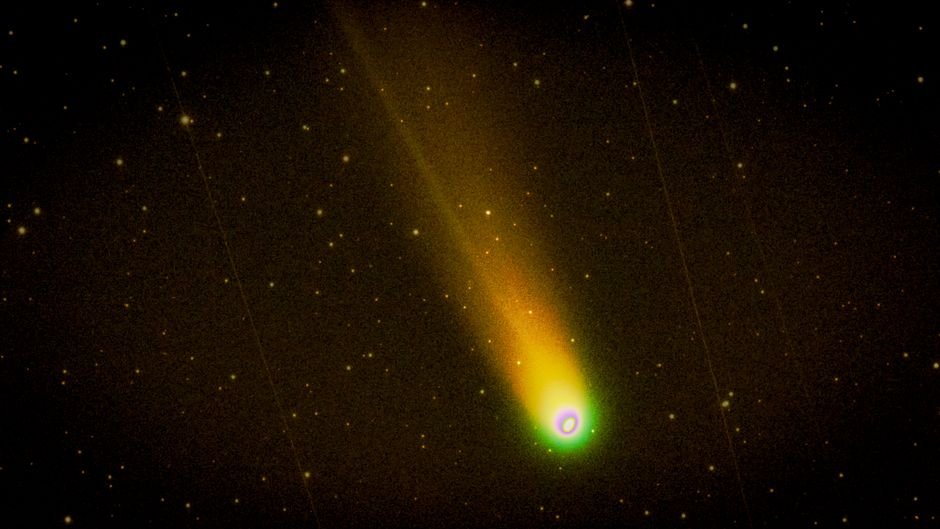
A recent study from the Planetary Science Institute reveals that the close passage of the star HD 7977 approximately 2.5 million years ago may have triggered a cascade of long-period comets into the inner solar system. Remarkably, the same comet shower may still be underway today.
The research, presented at the American Astronomical Society Division on Dynamical Astronomy, analyzed 112 ultra-long period comets with orbital periods exceeding one million years observed since 1989. The distribution of their orbits points to a distinct gravitational influence from a passing star rather than the usual background pull of the Milky Way.
HD 7977: A Sun-Like Visitor
HD 7977 is a G-type star approximately 1.07 times the mass of the Sun. Currently located in the constellation Cassiopeia, the star swept past our solar system during the early Pleistocene epoch, when Australopithecus africanus walked the Earth.
Refined calculations place its closest approach at 6,000 to 10,000 AU from the Sun, roughly 16 percent of a light-year. (For context, Voyager 1 is now about 171 AU from Earth.) At that distance, HD 7977’s gravitational pull dominated the outer edge of our solar system, exceeding the average background gravitational influence of the Milky Way galaxy.
A Comet Shower in Progress
The Oort Cloud, a vast reservoir of icy bodies extending from roughly 2,000 AU to 200,000 AU from the Sun, is the source of long-period comets. HD 7977’s passage jostled this reservoir, sending a stream of comets sunward that continues to this day.
“The distribution of comet orbits suggests we are living through an unusual time where HD 7977 has dominated the generation of new comets and not the larger gravitational field of the Milky Way, as it usually would,” said Nathan Kaib, a planetary senior scientist at the Université de Bordeaux. “This would mean we’re living through the late stages of a pretty rare and powerful comet shower.”
The study found that ultra-long period comets observed today show orbits consistent with HD 7977’s influence. Shorter period comets with repeating orbits are better explained by the galactic disk’s tidal pull.
Notable long-period comets that may be part of this shower include C/2023 A3 Tsuchinshan-ATLAS, which graced our skies in 2024, and C/2024 E1 Wierzchos, discovered in 2024 and featured in striking images earlier this year.
What It Would Have Looked Like
From Earth, HD 7977 at its closest approach of roughly 10,000 AU would have shone at magnitude -7, making it about 40 times brighter than Venus and easily visible in broad daylight. Our early hominid ancestors would have watched this star blaze across the ancient sky.
Caveats and Future Study
While the study provides a strong distribution match for ultra-long period comets, the match is not always perfect. Refining orbital influences over millions of years is inherently difficult, and subtle dynamics such as cometary jets and radiation pressure may also play a role. No exoplanets have been detected orbiting HD 7977.
HD 7977 stands out among known close stellar passages. Scholz’s Star, an M-type red dwarf, passed at about 52,000 AU some 70,000 years ago. Gliese 710, another red dwarf, is predicted to pass at roughly 10,500 AU about 1.3 million years from now. HD 7977 is unique among these as a Sun-like G-type star.
Future surveys promise to sharpen the picture. The Gaia mission, which ended in 2025, still holds unpublished datasets that may provide further insight. Current sky surveys such as Pan-STARRS and ATLAS are detecting fainter, more distant long-period comets than ever before, and the upcoming Vera Rubin Observatory’s Legacy Survey of Space and Time (LSST) will vastly expand detection capabilities, potentially confirming whether HD 7977’s ancient passage truly reshaped the cometary landscape we see today.