

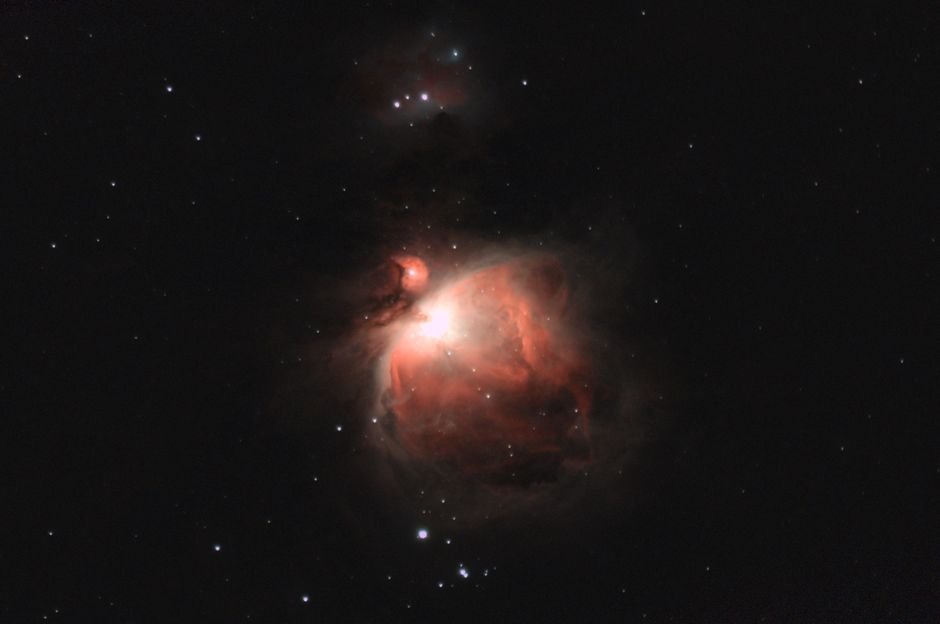
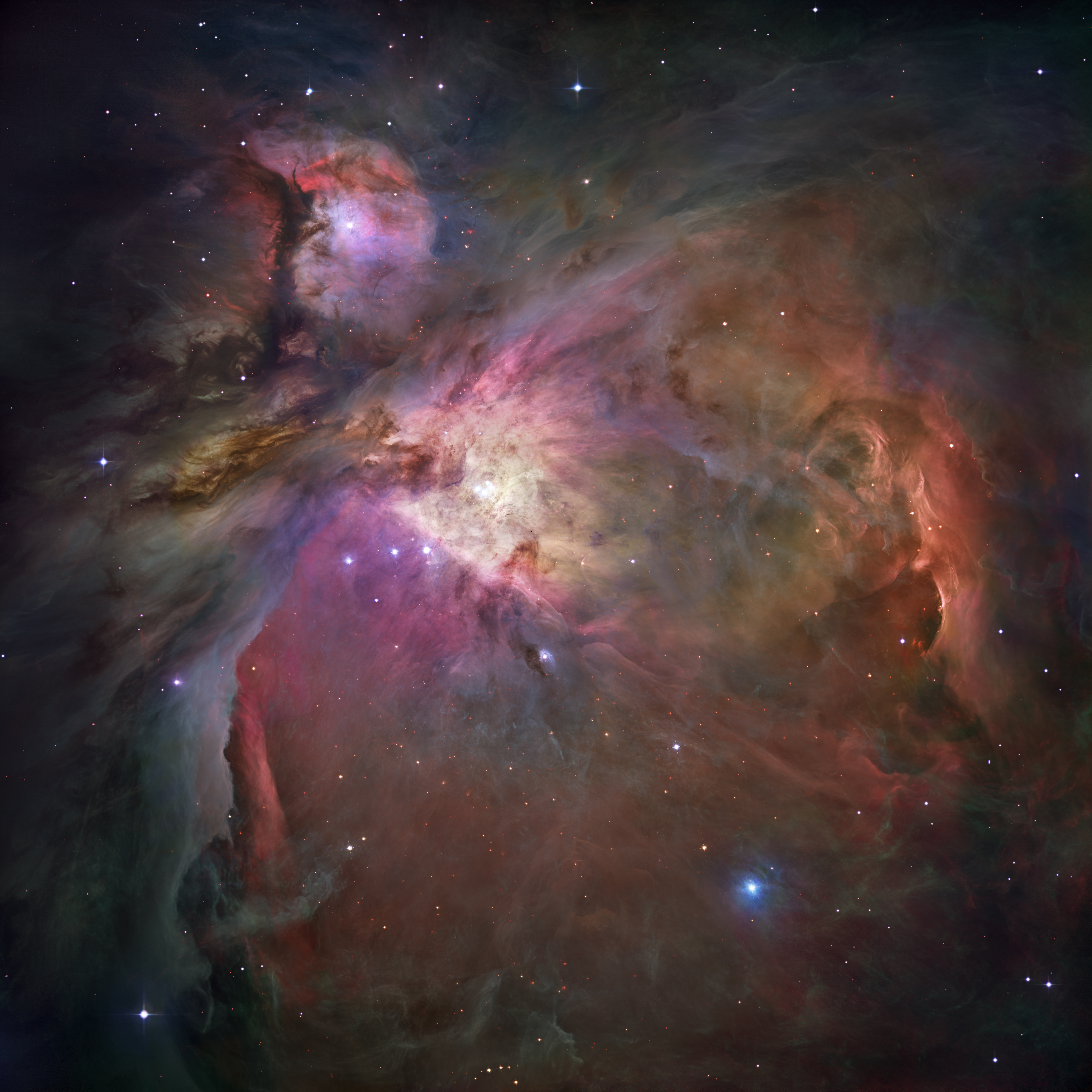
A team of astronomers has combined the power of the world’s largest single-dish radio telescope with a sensitive interferometer to uncover previously hidden structures within the Orion Nebula, the nearest massive star-forming region to Earth. The results challenge long-held assumptions about how newborn stars shape their surroundings.
Led by Juan Diego Soler of the University of Vienna, the researchers used China’s Five-hundred-meter Aperture Spherical Radio Telescope (FAST) and the Karl G. Jansky Very Large Array (VLA) in New Mexico to map neutral atomic hydrogen (HI) in the Extended Orion Nebula (EON) at unprecedented resolution. The study, published in Astronomy & Astrophysics, marks the first release from the Neutral Atomic Hydrogen in the solar neighborhood (NeAtHood) project.
A Double-Bubble Surprise
The team produced the sharpest maps ever made of HI in Orion, revealing two never-before-seen features. The first is a secondary bubble located at the top of the main EON shell, visible only in velocity-resolved maps. The second is a linear protrusion extending roughly 4 parsecs from the shell boundary, which the researchers have nicknamed the “Ghost.”
“The main and secondary EON bubbles might have been produced by two consecutive feedback events,” Soler said. “First, the main EON bubble is blown by the winds from Theta1 Orionis C. Second, another high-mass star leaving the Orion Nebula Cluster produces feedback, even shaping the second bubble.”
The elongated shape of the Ghost argues against a single supernova as the source of the nebula’s structure. Instead, it points to multiple episodes of stellar feedback from massive stars over time.
Mass Estimates Cut by a Factor of 10
Beyond the new structures, the observations produced a striking quantitative revision. The team calculated that the front hemisphere of the expanding shell in the EON contains roughly 100 solar masses of material, about ten times lower than previous estimates.
“Measuring mass is fundamental, because it tells us about the efficiency of these newly formed stars shaping their environment with wind and radiation,” Soler explained.
The combination of FAST’s unparalleled collecting area with the VLA’s interferometric resolving power was key. FAST, a 500-meter fixed dish in Guizhou province, China, captures faint HI emission across wide fields. The VLA’s 27 antennas, spread across the New Mexico desert, provide the angular resolution needed to pick out fine structural details. Together, they reveal dynamics that either instrument alone would miss.
Why Neutral Hydrogen Matters
Two-thirds of the Milky Way’s gas exists as neutral atomic hydrogen. It is the raw material from which molecular hydrogen, and ultimately stars, forms, and it traces the flow of energy and matter through the interstellar medium. Mapping HI at high resolution across a region as complex as Orion offers a direct observational test for simulations of star formation and feedback.
“These stunning observations serve as a reference for many modern astrophysical simulations investigating the evolution of gas and stars in the Milky Way,” said Daniel Seifried of the University of Cologne, a co-author on the study.
Claire Murray of the Space Telescope Science Institute added: “This study is an exciting demonstration of the power of latest-generation radio telescopes to uncover new pieces to the star formation puzzle.”
Orion Is Just the Beginning
The NeAtHood project plans to extend this technique to other star-forming regions, systematically mapping neutral hydrogen across the solar neighborhood. The methods developed for combining single-dish and interferometric HI data promise to reveal hidden structure and dynamics even in well-studied parts of the sky.
“Orion is only the beginning,” Soler said. “Our newly developed methods show how future interferometers will reveal the hidden structure and dynamics of the interstellar medium, even in regions that astronomers already believed they understood well.”
As the paper puts it: “Even in a well-studied region such as Orion, HI reveals something new in the heavens.”