

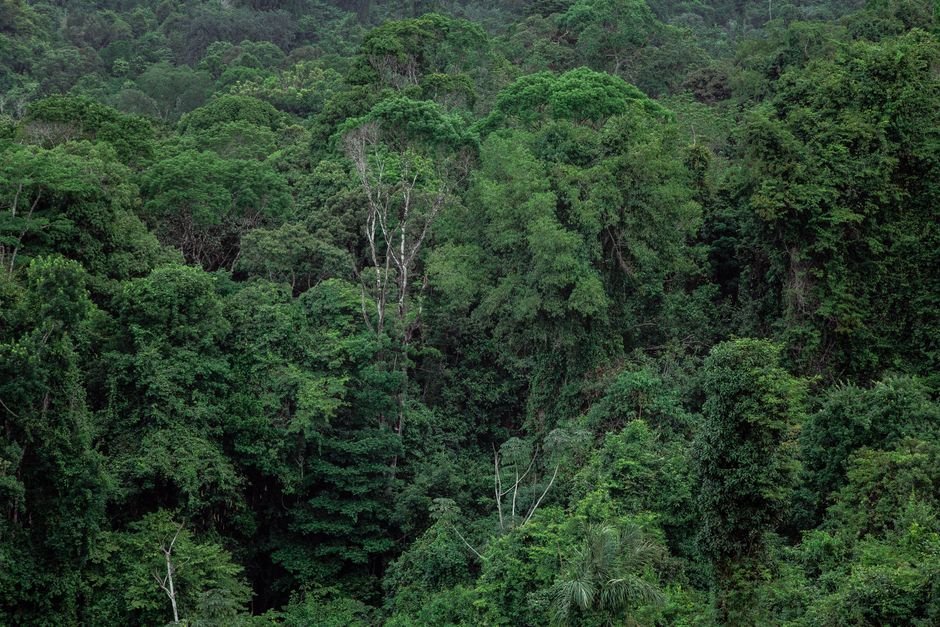
Tropical forests across South America stopped absorbing carbon dioxide during the 2015-2016 El Nino, according to a landmark study published in Nature Climate Change, and with a strong El Nino already underway in 2026, starting from record-warm oceans and record-high air temperatures, scientists warn this year could trigger losses on an unprecedented scale.
The study, led by Dr. Amy C. Bennett of the University of Leeds and involving more than 100 co-authors across the RAINFOR and PPBio research networks, analyzed more than 500,000 trees across 123 plots spanning six South American countries over three decades. It provides the most detailed picture yet of how an extreme climate anomaly affects the world’s largest tropical forest.
The numbers
Before the 2015-2016 El Nino, the forest plots were a net carbon sink, accumulating an average of 0.38 metric tons of carbon per hectare per year. During the El Nino, that balance fell to effectively zero, 0.02 tons per hectare per year, statistically indistinguishable from a flat line.
The shift was driven entirely by mortality. Carbon gains from tree growth and recruitment held steady at about 2.4 tons per hectare per year. But carbon losses from death jumped from 1.96 to 2.41 tons per hectare per year, a 23% increase. The annual mortality rate across all stems rose from 1.8% to 3.1%, a 72% increase.
Large trees were hit hardest. Trees with trunk diameters of 200-399 mm saw their mortality rate more than double, from 1.5% to 3.2% per year. Trees 400 mm and above saw mortality nearly double, from 1.4% to 2.7% per year. Trees with less dense wood, which are more vulnerable to hydraulic failure, died at significantly higher rates.
The mechanism: hydraulic failure
The data suggest that trees did not slowly starve. Growth rates did not decline during the El Nino, trees were still photosynthesizing. What killed them was hydraulic failure: intense atmospheric moisture demand snapped the internal water column through xylem cavitation, the same process that causes a soundless snap in a drinking straw when suction is too strong.
The drier forests at the edges of the Amazon basin were the most vulnerable. Every 0.5 degrees Celsius of temperature increase was associated with a 0.5% loss of aboveground carbon in these edge forests. Every additional 100 mm of water deficit was associated with roughly a 0.8% loss of aboveground carbon.
The Amazon holds roughly 123 billion tons of carbon, more than any other terrestrial ecosystem on Earth. A sustained loss of its carbon sink function would have profound implications for global climate targets.
Why 2026 is different
The study was published in September 2023, but its findings have taken on new urgency as the current El Nino intensifies. Several factors make 2026 uniquely dangerous for tropical forests.
Very strong El Ninos have doubled in frequency over the past 60 years compared with the prior 60 years. The current El Nino was confirmed by NOAA as already underway, and scientists note that never before has an El Nino begun when oceans were already so warm and air temperatures already so high. The edges of the Amazon, precisely the forests most vulnerable to hydraulic failure, have experienced some of the highest temperatures and most rapid warming the tropics have seen over the past three decades.
Compounding the risk, these forests have not fully recovered from recent multi-year drought before this new El Nino arrived. The combination of record heat, moisture stress, and un-recovered forests raises the possibility of carbon losses on a scale not yet observed.
The Conversation article accompanying the study’s repromotion notes that tropical forests risk permanently losing their function as carbon sinks if extreme climate conditions become the norm, a scenario that current emissions trajectories make increasingly plausible.
Sources
[1] Bennett, A.C., et al. “Sensitivity of South American tropical forests to an extreme climate anomaly.” Nature Climate Change, Vol. 13, pp. 967-974 (2023). DOI: 10.1038/s41558-023-01776-4
[2] Live Science. “Tropical forests stop absorbing carbon dioxide during El Nino events. This year could be the worst.” July 11, 2026. https://www.livescience.com/planet-earth/climate-change/tropical-forests-stop-absorbing-carbon-dioxide-during-el-nino-events-this-year-could-be-the-worst
[3] Bennett, A.C. “Tropical forests can stop acting as carbon sinks during El Nino, says research.” The Conversation, July 10, 2026. https://theconversation.com/tropical-forests-can-stop-acting-as-carbon-sinks-during-el-nino-says-research-212910