

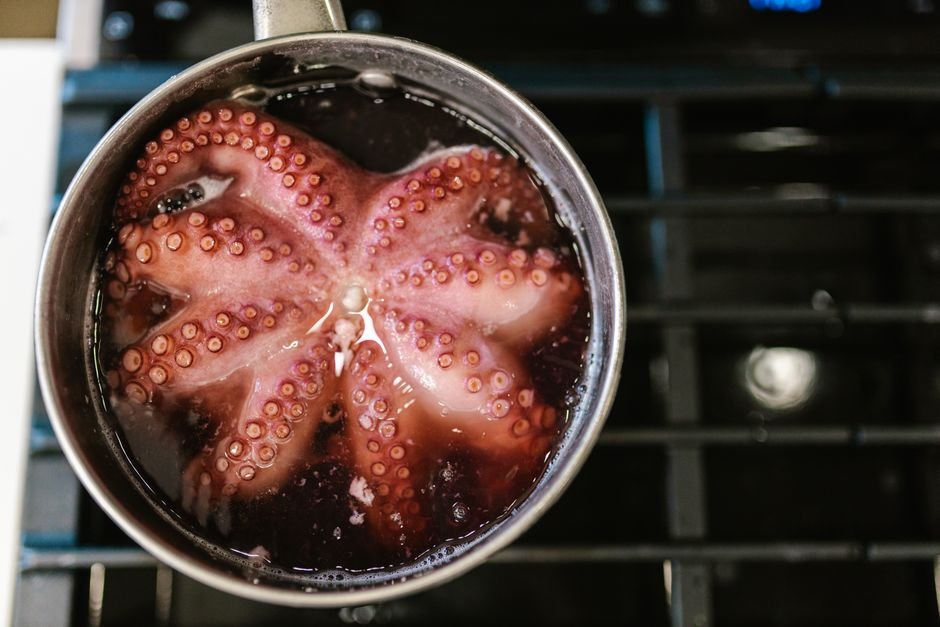
Octopuses have long fascinated biologists with their distributed nervous systems, camouflage capabilities, and tool use. Now researchers have uncovered a molecular quirk that may help explain another dimension of their biological exceptionalism: shallow-water octopuses carry a unique break in their ribosomal RNA that makes their protein-building machinery roughly twice as accurate as that of their relatives.
The discovery, posted as a preprint on bioRxiv and slated for publication in Current Biology, reveals a post-transcriptional cleavage in helix 88 (H88) of the 28S ribosomal RNA, a structural break present across roughly 15 species of Incirrate (shallow-water) octopuses but absent in all Cirrate (deep-sea) octopuses, squid, cuttlefish, and other mollusks tested. The break emerged around 100 million years ago, coinciding with the split between shallow-water and deep-sea octopus lineages.
How the break works
Ribosomes are the cell’s protein factories, translating messenger RNA into polypeptide chains by matching transfer RNA (tRNA) molecules to each codon. The process is fast but error-prone: wild-type E. coli ribosomes make mistakes roughly once every 1,000 to 10,000 codons.
The octopus H88 break alters the ribosome’s E-site (where tRNAs exit after delivering their amino acid), changing how the ribosome checks codon-anticodon pairings. The researchers showed that engineered E. coli carrying the octopus H88 break made roughly 50% fewer translation errors than wild-type E. coli, a two-fold increase in fidelity. The break reduced tRNA binding affinity for near-cognate (mismatched) codons by roughly four-fold compared with squid ribosomes, making the ribosome more stringent without requiring a speed trade-off.
That last point is key. In most organisms, accuracy comes at the cost of speed, a well-known speed-accuracy trade-off in translation. The octopus H88 break appears to decouple the two. The researchers measured that the octopus ribosome translates about 30% slower than squid or slug ribosomes, but that slowdown was independent of the H88 break. In E. coli carrying only the octopus break, translation speed remained unchanged while accuracy doubled.
Synergy with RNA editing
Octopuses make extensive use of RNA editing, rewriting their genetic messages after transcription to generate protein diversity. But edited messages carry inosine, a modified nucleotide that can confuse standard ribosomes, leading to misfolded proteins that aggregate into toxic clumps.
The researchers found that human ribosomes stall at inosine-containing codons. Squid ribosomes barrel through them promiscuously, producing heavily aggregated, misfolded proteins, roughly ten-fold more aggregation than at unedited messages. Octopus ribosomes, by contrast, selectively decode inosine-containing codons (preferring I:C pairing) and produce no increase in aggregation. The H88 break was essential for this clean handling.
Cryo-electron microscopy at 3.2-angstrom resolution showed that the H88 break alters base-pairing interactions in the ribosome’s A-site accommodation corridor, the channel through which tRNAs enter for codon reading. The structural change makes the ribosome more discriminating without slowing it down, and allows it to handle the unusual nucleotides produced by RNA editing without accumulating misfolded proteins.
Evolutionary context
The H88 break is perfectly conserved across Incirrate octopuses, with the nucleotide sequence TATG/CGTC at the break site present in every shallow-water species tested. Its absence in Cirrate (deep-sea) octopuses, a sister lineage that diverged at the same time, suggests that the break correlates not with octopus ancestry generally, but specifically with the expansion of complex behaviors seen in shallow-water species: hunting, camouflage, tool use, and elaborate social signaling.
The researchers note that the ability to produce high-fidelity proteins while tolerating extensive RNA editing may have been a prerequisite for the evolution of the large, distributed nervous system that makes octopus cognition so unusual. Errors in protein synthesis are particularly damaging in neurons, where misfolded proteins can accumulate over a lifetime.
Caveats
This work is currently available as a preprint on bioRxiv (DOI: 10.64898/2026.06.25.734654) and has not yet completed full peer review. The key finding, that the H88 break enhances translational accuracy in E. coli, is a heterologous system; whether the same quantitative effect holds in octopus neurons remains to be confirmed directly. The paper is accepted at Current Biology, suggesting it has passed editorial review but may not yet be in its final published form.
Sources
[1] Mitra, R., Han, R., Scott, T.J., et al. “Evolution of a core ribosomal innovation in octopus.” bioRxiv (2026). DOI: 10.64898/2026.06.25.734654
[2] Smith, J. “Daily briefing: Mutation lets octopuses make proteins with precision.” Nature (2026). https://www.nature.com/articles/d41586-026-02177-1
[3] Reardon, S. “Molecular quirk unique to octopuses makes them better at building proteins.” Science (2026). https://www.science.org/content/article/molecular-quirk-unique-octopuses-makes-them-better-building-proteins