

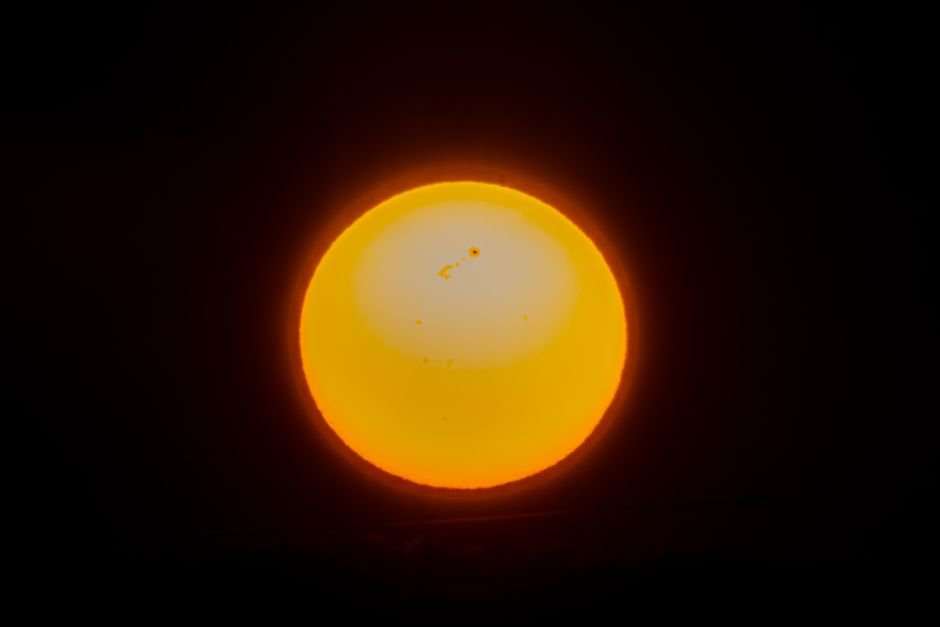
The Sun released a powerful X1.3-class solar flare on the afternoon of July 4, peaking at 4:41 p.m. Eastern Time (20:41 UTC), NASA’s Solar Dynamics Observatory confirmed. The flare originated from a newly emerged sunspot region designated AR4482 on the Sun’s southeast limb.
X-class flares are the most intense category on the solar flare scale, and the number provides finer detail: an X1.3 is roughly one-tenth the strength of the largest flares but still carries enough energy to disrupt communications on Earth.
The flare produced an R3 (Strong) radio blackout across the sunlit side of the planet, with high-frequency communications degraded for approximately one hour, most severely over North America and the Pacific Ocean. A Type II radio sweep, a signature of a shock wave propagating through the solar corona, was recorded at a shock velocity of roughly 2,714 kilometers per second, and the associated 10-centimeter radio burst (a “tenflare”) reached 890 solar flux units.
A coronal mass ejection (CME) became visible in the GOES CCOR1 coronagraph around 22:30 UTC. Because AR4482 is located on the southeast limb, near the edge of the solar disk as seen from Earth, the CME was not initially directed toward our planet. Forecasters noted that the geoeffective potential would increase as the region rotates toward disk center in the coming days.
Solar Cycle 25 context
The July 4 flare was the second X-class event in a week, following an X1.1 flare on June 30 from Active Region 4479. That earlier flare’s CME did hit Earth, producing a G3 (Strong) geomagnetic storm on July 4 with Kp=7, pushing aurora visibility as far south as Utah, Colorado, and Nevada in the United States, and across parts of northern Europe.
Solar Cycle 25 has been significantly more active than its predecessor, Cycle 24. To date, the cycle has produced at least 50 X-class flares, the most powerful being an X9.0 on October 3, 2024. The current X1.3 ranks approximately 35th to 45th among them, a reminder that even a relatively modest X-class flare can still disrupt critical infrastructure.
The Solar Dynamics Observatory, which captured the event in extreme ultraviolet light (colorized in red, white, and blue to highlight the extremely hot flare material), continues to monitor solar activity as part of NASA’s space weather research program.
Sources
- NASA Science Blog: “Strong Flare Erupts from Sun” (July 6, 2026). https://science.nasa.gov/blogs/solar-cycle-25/2026/07/06/strong-flare-erupts-from-sun-11/
- EarthSky: Sun news for July 5, 2026. https://earthsky.org/sun/sun-news-activity-solar-flare-cme-aurora-updates/
- SpaceWeatherLive: Top 50 Solar Flares of Solar Cycle 25. https://www.spaceweatherlive.com/en/solar-activity/top-50-solar-flares/solar-cycle/25.html
- SpaceWeekly / The Watchers (NOAA data): July 4, 2026 event report. https://spaceweekly.com/?p=802920