

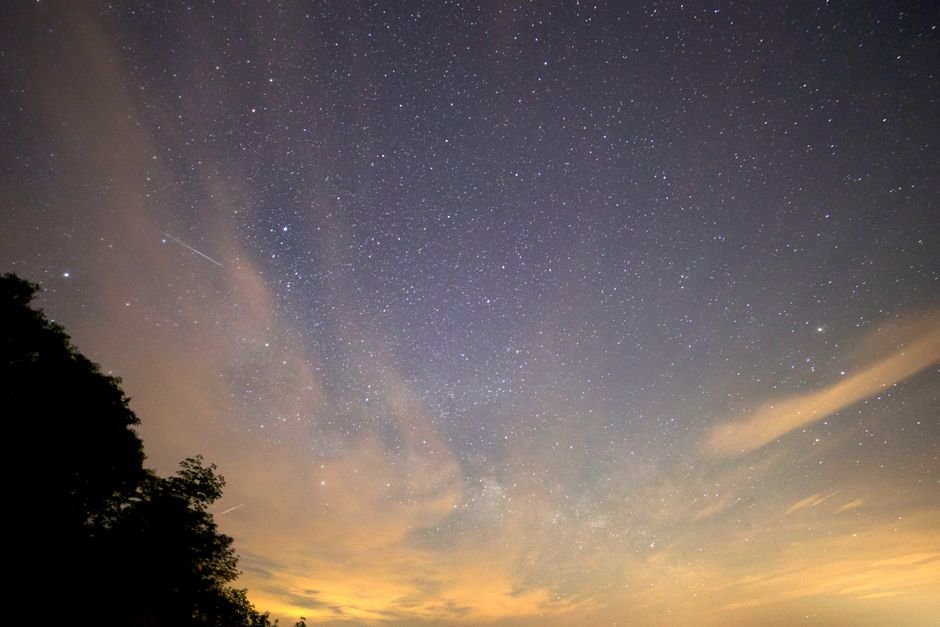
A meteor’s brief, destructive passage through Earth’s atmosphere was caught in the middle of a long exposure of the Great Lacerta Nebula, and the picture became NASA’s Astronomy Picture of the Day for August 3.
The image shows a dark starfield with a faint red nebula near the center, crossed by a bright horizontal streak filled with faint, many-colored wisps, according to the official description of the photograph. The streak appeared and disappeared quickly during the exposure. The picture was captured last month from Death Valley Observatories in Nevada, and is credited to Tom Burnett.
The physics of the streak is the point of the image. The meteoroid, likely a small pebble, creates its glow partly by heating and exciting the surrounding air in Earth’s atmosphere, but it also vaporizes itself, leaving wind-blown gas and dust whose colors offer clues to its composition. Those colors can act as a brief chemical fingerprint of the object that produced them, readable even after the meteoroid itself is gone.
The timing is fitting, because August is a good month for meteors. Three meteor showers are presently ongoing, although all three are currently competing for visibility with the glow of a bright gibbous Moon. The most active of the three, the Perseids, will be busiest in about 10 days, after the Moon has dimmed considerably. This year, the Perseid peak nearly coincides with not only a new Moon but, from some locations, one that totally eclipses the Sun, which would leave particularly dark skies for viewing.
The Perseids are considered the most popular meteor shower of the year, according to NASA’s meteor shower pages. They are swift, bright meteors that frequently leave long wakes of light and color, and they originate from debris left by comet 109P/Swift-Tuttle, which takes about 133 years to orbit the Sun once and last passed through the inner solar system in 1992. Its nucleus is about 26 kilometers across, nearly twice the size of the object thought to have caused the extinction of the dinosaurs. The shower is one of the most plentiful, with rates typically quoted at 50 to 100 meteors per hour under dark skies. Fireballs, brighter than magnitude minus 3, come from larger particles of cometary material. The radiant, the point in the sky from which the meteors appear to come, lies in the constellation Perseus. Viewing is best in the Northern Hemisphere during the pre-dawn hours, though meteors from the shower may be visible as early as 10 p.m.
Meteors are the visible remnants of leftover comet particles and bits of broken asteroids, which collide with the atmosphere and disintegrate, creating fiery, colorful streaks. The streak photographed across the Lacerta Nebula shows the same process up close: a small piece of interplanetary material meeting its end, and briefly announcing its composition in the process.