

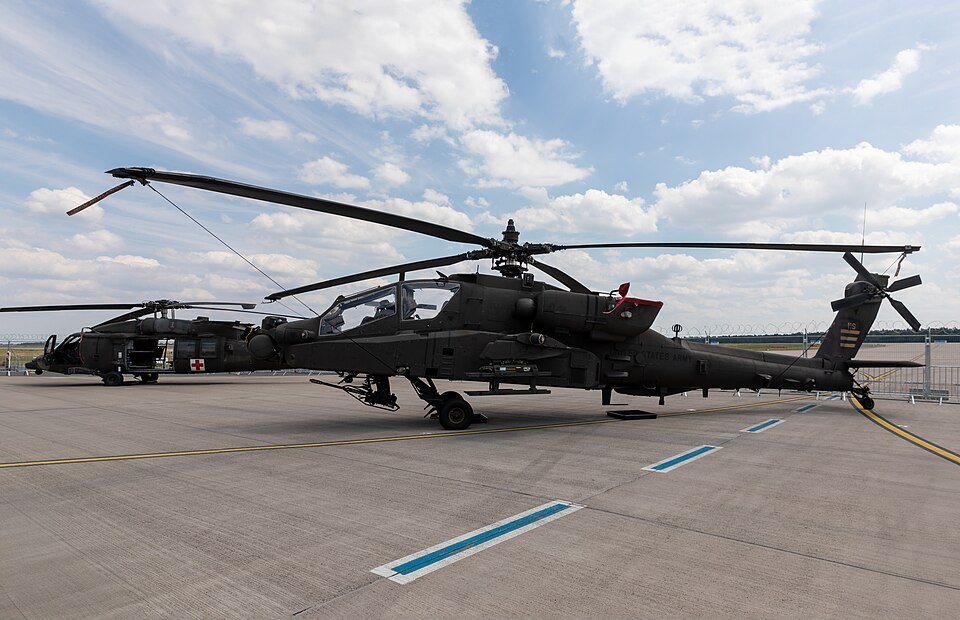
The United States launched new military strikes on Iran late Tuesday in retaliation for the shooting down of an American Apache helicopter near the Strait of Hormuz, while an unmanned Navy drone boat carried out the first known combat rescue of its kind to save the two crew members.
The sequence of events, unfolding over roughly 24 hours, has pushed the fragile U.S.-Iran cease-fire to the breaking point. President Donald Trump, who has spent weeks insisting a diplomatic deal with Tehran is imminent, ordered strikes after declaring that Iranian forces deliberately downed the AH-64 Apache over the strategic waterway.
“The two pilots involved, both are safe and uninjured,” Trump wrote on Truth Social. “Nevertheless, the United States must, of necessity, respond to this attack.”
U.S. Central Command said American forces began strikes at 5:00 p.m. Eastern Time on Tuesday, calling the operation “a proportional response to unjustified Iranian aggression.” A U.S. official told CBS News, the BBC’s U.S. partner, that it remains unclear whether the Iranian drone that struck the Apache did so deliberately or in error. A one-way Iranian attack drone brought down the helicopter, according to a U.S. official who spoke to Reuters on condition of anonymity.
The downing and the response come at a delicate moment. Israel and Iran had only just pulled back from a fresh exchange of missile fire over the weekend, the first such direct exchange since a truce in April. Trump publicly ordered both sides to stop shooting, warning they were jeopardizing negotiations between Washington and Tehran on a broader deal to end the regional war.
On Tuesday, Trump told reporters that the talks were in “the final throes” and that a deal could take “two or three days.” The Strait of Hormuz would reopen immediately after a deal was signed, he claimed.
Those assurances now ring hollow. Iran’s top negotiator in the peace talks, Mohammad Baqer Qalibaf, took to social media hours before the Apache incident to signal that Tehran’s patience was exhausted.
“We prefer the language of diplomacy, but we speak other languages far more fluently,” Qalibaf wrote. “Break your commitments, and we’ll switch to what we speak best.”
Iran’s Foreign Minister Abbas Araghchi struck a similar note, warning that foreign forces near Iranian territory were at “constant risk on account of their own human errors, plain accidents or potentially being caught in crossfire.” His prescription: “To reduce risk, best solution is for them to leave.”
The rescue of the Apache’s two crew members is a story in its own right, and one that military historians will likely note as a turning point in how the U.S. military conducts search and rescue at sea.
The AH-64 Apache went down near the coast of Oman on Monday evening. Within roughly two hours, a 7.3-meter (24-foot) unmanned surface vessel built by Saronic Technologies, a Texas-based defense startup, had located the pilots and brought them aboard. The autonomous boat then transported them to a second location on the water, where they were hoisted by helicopter to complete the rescue.
The drone boat, a Saronic Corsair, belongs to Task Force 59, the Navy’s first dedicated unmanned and artificial intelligence unit. Established in 2021 and based in Bahrain, Task Force 59 was created to integrate drones and AI into maritime security operations across the Middle East, with a focus on the Strait of Hormuz and the Suez Canal. The Corsair was sent to the region in March.
CENTCOM confirmed that rescue efforts were led by U.S. Naval Forces Central Command and the 82nd Airborne Division, with support from Air Force and Navy units including Task Force 59. The operation marks the first known combat rescue conducted by an unmanned surface vessel in American military history.
The implications extend well beyond this single incident. For years, the military has discussed the potential of autonomous systems to reduce risk to personnel in dangerous environments. The Corsair rescue demonstrates that the technology has reached operational maturity. In a conflict environment where pilots go down in waters patrolled by hostile coastlines, the ability to deploy an unmanned vessel that can locate, retrieve and transport casualties without putting additional lives at risk is a significant capability.
The rescue also underscores how rapidly the Navy’s experiment with unmanned systems has moved from testing to combat. Task Force 59 was initially seen as a fringe effort, a small unit experimenting with off-the-shelf drones in a region the Pentagon had largely turned its attention away from. Half a decade later, one of its vessels saved two soldiers from Iranian fire.
The broader question now is whether the Apache downing and the U.S. response will collapse the cease-fire entirely. Trump’s claim that a deal is days away has been repeated before, most recently before the weekend’s Iran-Israel exchange, and it has not aged well. Iran’s public posture is increasingly confrontational. The Strait of Hormuz, through which roughly a fifth of the world’s oil passes, remains a flashpoint.
And the Israeli dimension has not gone away. Even as the U.S.-Iran confrontation escalates, Israeli forces carried out strikes across southern Lebanon on Tuesday. Tehran had warned that any Israeli attack on southern Lebanon would trigger another wave of retaliatory strikes. The risk of a multi-front escalation, with the U.S., Iran, Israel and Iranian proxies all actively engaged, is as high as it has been since the war began.
The Apache downing, the drone boat rescue and the U.S. strikes are not separate stories. They are three acts of the same play. Act one: Iran shoots down an American helicopter. Act two: a robot boat pulls off a historic rescue. Act three: the United States retaliates with bombs. What act four looks like depends on whether Trump’s diplomatic calculus can survive contact with reality.