

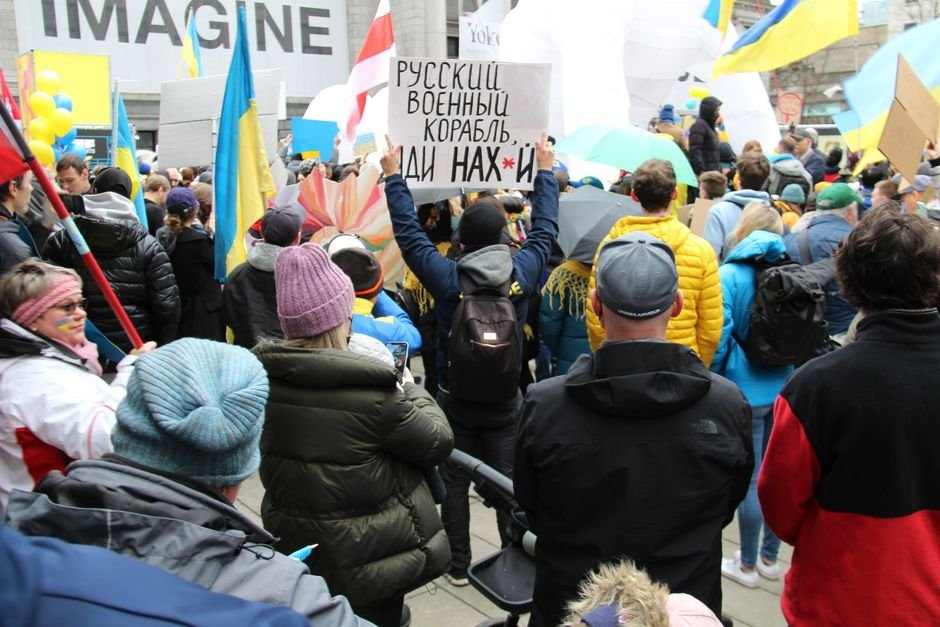
Thousands of Ukrainians took to the streets of Kyiv and other cities on Thursday to protest President Volodymyr Zelensky’s decision to fire Defense Minister Mykhailo Fedorov, the popular 35-year-old modernizer credited with turning Ukraine’s drone program into the war’s most effective weapon.
Protesters carried signs reading “Hands off Fedorov” and “Stop sabotaging victory.” They chanted “Shame!” outside government buildings. It was Ukraine’s second mass anti-government protest since the full-scale Russian invasion began in February 2022, and the reaction was raw.
Fedorov had been in the job for six months. In that time he redirected ministry funds away from salaries and toward military investment, pushed transparency in weapons procurement, and personally persuaded Starlink CEO Elon Musk to cut off Russia’s access to satellite communications. But his main achievement was the drone program, a force that intelligence officials now say is the primary reason Russian recruits survive only 20 to 30 minutes on the front lines.
Zelensky said he dismissed Fedorov because of a “growing rift” with General Oleksandr Syrskyi, commander of Ukraine’s armed forces.
“I’m just showing that if the sides can’t resolve an issue, I will have to resolve it,” Zelensky said.
Fedorov did not go quietly. He confirmed the conflict with Syrskyi and accused the general of blocking all his recent initiatives, including the drone reforms that were producing results on the battlefield.
“The war has changed completely,” Fedorov said. “Under this arrangement [with Syrskyi as commander], I personally do not know how the war can be won.”
The Financial Times reported that Fedorov had also angered powerful political and defense figures by refusing to give lucrative procurement contracts to their preferred companies. The war in Ukraine is a multi-billion-dollar industry, and the people who control the contracts hold real power. Fedorov tried to clean it up. He made enemies doing it.
Colonel Pavlo Yelizarov, deputy commander of Ukraine’s air force, resigned in protest, calling Fedorov’s dismissal “a great evil for the country’s defense capability.” He warned it would weaken Kyiv’s air defenses and lead to more fatalities.
Zelensky moved quickly to fill the vacancy. The interim defense minister is Major General Yevhen Khmara, the acting head of Ukraine’s Security Service. Parliament also approved a new prime minister: Sergii Koretskyi, the former head of Naftogaz, Ukraine’s state energy company. Zelensky argued that Koretskyi’s energy expertise is needed to counter Russian attacks on the power grid.
This is Zelensky’s second cabinet reshuffle in a year. The first was framed as a wartime renewal, clearing out Soviet-era holdovers and corruption-tainted officials. This one looks different. It looks like a feud between the civilian defense leadership and the military command, and the civilian lost.
The timing could hardly be worse. Ukraine is holding its own against a Russian army that has lost 1.4 million soldiers in four and a half years, but the advantage depends on innovation, on drones, on AI targeting, on the kind of agile procurement that Fedorov championed. Replacing him with a security service general raises questions about whether Ukraine will maintain that edge.
The protests on Thursday were not the kind of demonstrations that topple governments. But they were real. In a country that has been at war for four and a half years, people do not go into the streets over small things.
Fedorov’s dismissal has exposed a fracture in Ukraine’s war leadership. Zelensky says he is managing disagreements. The protesters say he is sabotaging victory. The war will decide which of them is right.
What is certain is this: Ukraine cannot afford to lose the technological advantage that has kept it alive. And firing the man who built that advantage, in the middle of a war, is a gamble that even some of Zelensky’s own supporters are not willing to accept quietly.