

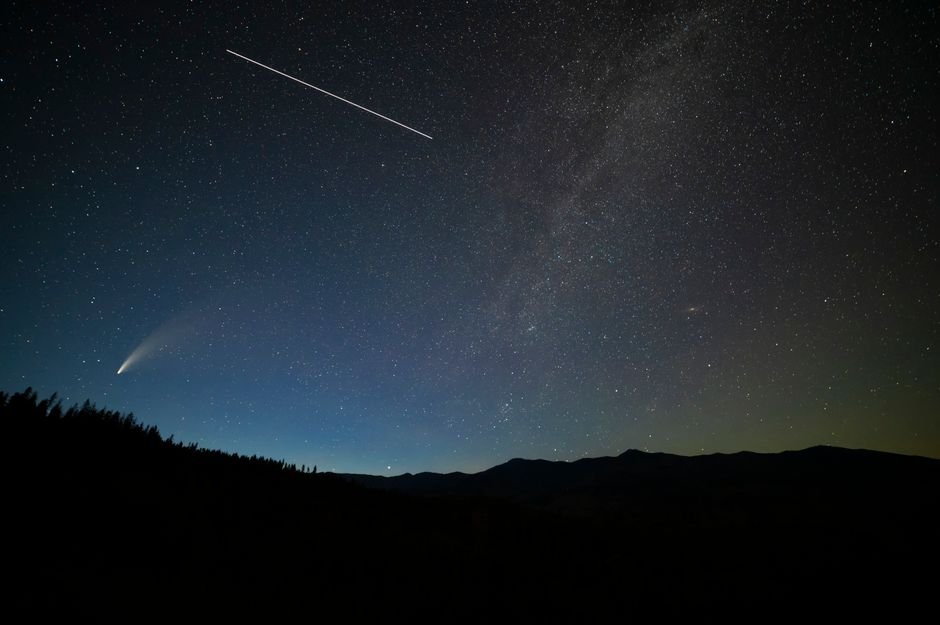
An object long classified as a near-Earth asteroid has been reclassified as a comet after NASA researchers detected nongravitational perturbations in its motion and confirmed the presence of a faint tail and coma.
The object, previously designated 1998 SH2, will now carry the additional comet designation P/1998 SH2. On August 28, 2025, it passed safely within 3 million kilometers (2 million miles) of Earth during its four-and-a-half-year orbit around the Sun.
The trouble started when NASA’s Deep Space Network planetary radar tried to track the object. It was not where expected, its motion showed small, unaccounted deviations from a purely gravitational trajectory.
“After we measured the nongravitational perturbations affecting the motion of 1998 SH2 and recognized they weren’t compatible with the object being an asteroid, we suspected the object could be an active comet,” said Davide Farnocchia, lead study author and navigation engineer at NASA’s Center for Near-Earth Object Studies (CNEOS) at JPL.
The team used optical astrometry to precisely measure the object’s position and determined that the perturbations were consistent with outgassing, ice heated by the Sun turning to gas and producing a small thrust. This cometary behavior cannot be explained by an inert, rocky asteroid.
To confirm, astronomers turned to three ground-based observatories: the Canada-France-Hawaii Telescope on Mauna Kea, the ESO Danish Telescope at La Silla in Chile, and the ESO Very Large Telescope at Cerro Paranal. All three revealed a weak but clear tail and coma, definitive evidence of an active comet.
“The images we collected from these observatories showed a weak but clear tail, thus confirming that 1998 SH2 is, in fact, a comet,” said Olivier Hainaut, ESO astronomer and co-author. “That’s how science works, you form a hypothesis, and you set out to test it.”
The finding has implications for planetary defense. Outgassing causes unpredictable orbital changes, making it harder to forecast an object’s future path. Detecting these small nongravitational perturbations can help distinguish dangerous comets from benign asteroids, providing an important diagnostic tool for risk assessment.
The object joins a growing population of so-called “dark comets”, objects that appear asteroidal but display cometary behavior. Since the first such discovery in 2016, about a dozen have been identified. Two populations exist: larger dark comets with highly elliptical orbits similar to Jupiter-family comets, and smaller ones that orbit closer to the Sun. Many larger dark comets may actually be regular comets with extremely faint tails, only detectable with powerful telescopes under ideal conditions, like 1998 SH2’s close approach.
NASA’s upcoming NEO Surveyor telescope, the first space survey telescope built specifically for planetary defense, will hunt for the hardest-to-find near-Earth objects, including dark asteroids and comets with low visible reflectivity.
The study was published in Nature Astronomy.