

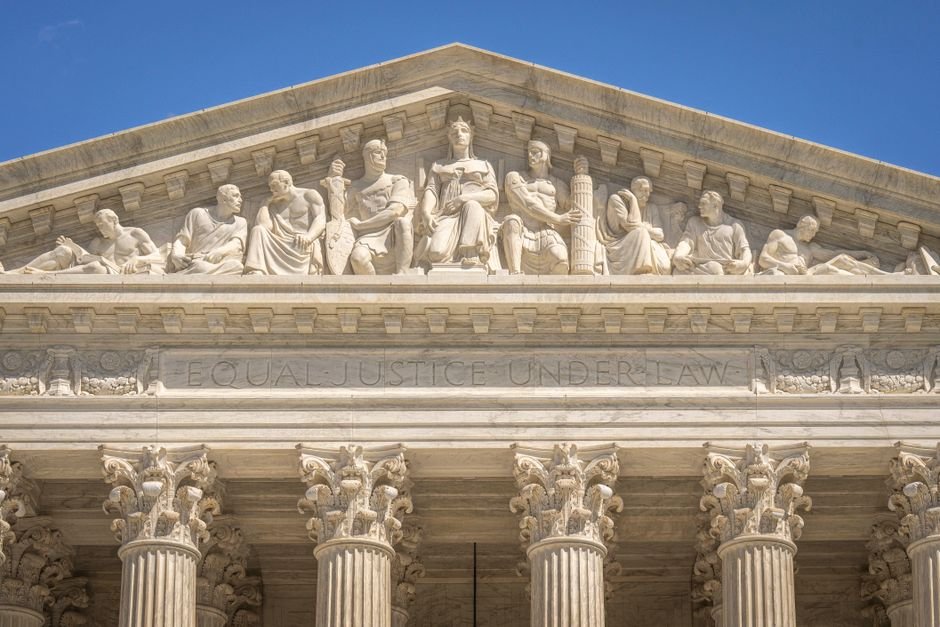
E. Jean Carroll is calling on Donald Trump to pay the $5 million a jury awarded her after finding the president liable for sexually abusing and defaming her. The call comes after the U.S. Supreme Court declined to hear Trump’s appeal, exhausting the president’s legal options in the case.
The Supreme Court rejected Trump’s petition on June 29 without comment, as it typically does when it declines a case. The decision brought an end to a legal battle that began in 2019, when Carroll first accused Trump of raping her in a Bergdorf Goodman department store dressing room in the mid-1990s. Trump denied the allegation, said he had never met Carroll, and claimed she fabricated the story to sell books.
A jury in May 2023 did not find that Trump committed rape but found him liable for sexual abuse and defamation. They awarded Carroll $2.02 million for the assault and $2.98 million for the defamation. A separate jury later ordered Trump to pay an additional $83.3 million for defaming Carroll in June 2019, when he first denied her claim. That larger award is still under appeal.
Carroll’s lawyers moved quickly after the Supreme Court’s decision. In a statement first reported by the BBC, Carroll’s legal team said it was “time for him to pay,” and that the president could no longer use the courts to delay what a jury decided years ago.
Trump’s lawyers had fought the verdict on several grounds. They argued that the trial judge, Lewis Kaplan, should not have allowed the jury to hear testimony from two other women who accused Trump of sexual misconduct. They also objected to the jury seeing the 2005 Access Hollywood tape in which Trump boasted about groping women. The 2nd U.S. Circuit Court of Appeals rejected both arguments, describing Trump’s conduct as “remarkably high, perhaps unprecedented” in its degree of reprehensibility.
The $5 million judgment is relatively small in the context of Trump’s finances. His reported income for 2025 was $2.2 billion, according to historians who called it an unprecedented windfall for a sitting president. The money is not the issue. What the case represents is the effective end of the president’s legal strategy of delay, denial, and appeals.
The case also raises a question that has shadowed Trump throughout his second term: whether the presidency shields a man from the consequences of conduct that predates his time in office. Trump’s lawyers argued for absolute immunity for statements he made as president. The courts rejected that claim. The 2nd Circuit noted that Trump had continued his attacks on Carroll for at least five years, making them “more extreme and frequent as the trial approached.” In one statement, issued two days into the trial, Trump said he would defame her “a thousand times.”
Carroll’s case is one of several legal threads that remain unresolved despite Trump’s return to the White House. The $83.3 million defamation verdict is still on appeal. Criminal cases in New York and Georgia have been effectively paused by the Justice Department’s policy against prosecuting a sitting president. The Carroll case is different because it is civil, it was finalized before Trump took office again, and the appeals process has now run its course.
Trump has used the courts to slow or stop every major legal proceeding against him. His approach is consistent: litigate every point, appeal every loss, and run out the clock. In the Carroll case, that strategy bought him three years from the original verdict to the Supreme Court’s refusal. But it did not work. The judgment stands, and the money must be paid.
The $83.3 million defamation award remains unresolved, and Trump may continue to appeal that judgment for some time. But the $5 million case is finished. If Carroll’s lawyers follow through on collection, they will likely seek to garnish assets or place liens on property. Trump has the means to pay. The question was never whether he could but whether he would be forced to.
The Supreme Court’s decision not to hear the case was not about the merits of Trump’s arguments. The court declines the vast majority of petitions it receives. But for Trump, who has spent years testing the proposition that a president is above the law, the outcome carries a clear message. No president, not even a sitting one, can evade a jury’s verdict indefinitely.