

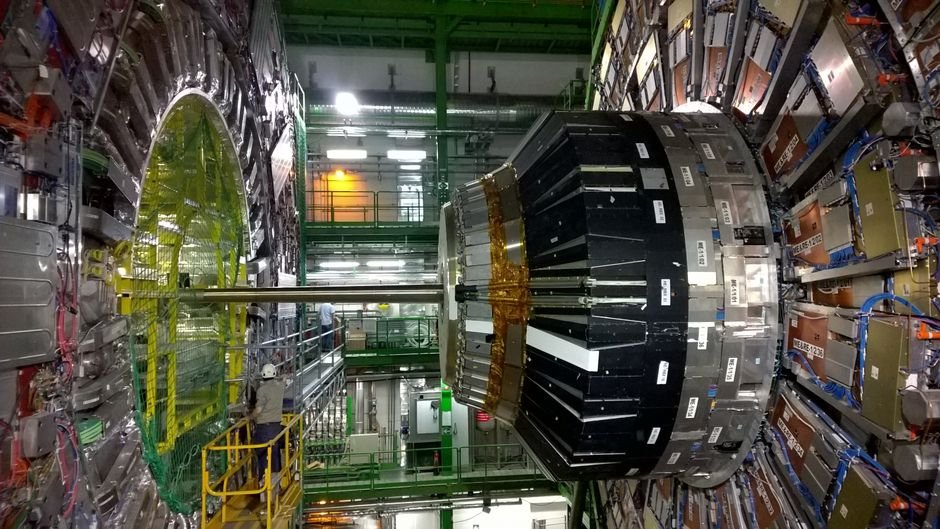
The ATLAS collaboration at CERN’s Large Hadron Collider has reported an excess in top-antitop quark production with a statistical significance exceeding 8 sigma, far above the 5-sigma threshold conventionally required for discovery. The result, published in Reports on Progress in Physics, points to the formation of “toponium”: a fleeting, quasi-bound state in which the heaviest known elementary particles embrace briefly before decaying.
Top quarks are the titans of the Standard Model. Each one weighs as much as an atom of gold, crammed into a volume smaller than a proton. At the LHC, they are produced in pairs when protons collide at 13 trillion electron volts. Near the energy threshold where that production begins (roughly 345 GeV, or about twice the top quark mass), theory predicts that the two quarks should feel each other’s presence strongly enough to form a transient bound state, much the way a proton and electron can form a hydrogen atom.
That prediction, rooted in the framework of non-relativistic quantum chromodynamics (NRQCD), has been around for decades. Finding it in practice, however, was long assumed to be experimentally impossible at a hadron collider, where the debris of each collision buries subtle effects in a storm of noise.
“It has only been made possible by recent efforts to connect quantum information theory and collider physics,” said Yoav Afik, an ATLAS physicist at the Enrico Fermi Institute at the University of Chicago.
The analysis exploited spin-correlation observables, a technique developed through earlier studies of quantum entanglement in top quark pairs, to enhance the sensitivity to the unique spin structure of the top-antitop system near threshold. Using 140 inverse femtobarns of Run 2 data, the collaboration measured the cross section for quasi-bound toponium states at 9.3 picobarns, about 45 percent larger than the baseline perturbative QCD prediction of 6.43 picobarns. The Standard-Model-only hypothesis (without toponium) was ruled out at 8.2 sigma observed, with 6.0 sigma expected.
The result was foreshadowed a year earlier by the CMS collaboration. In March 2025, CMS announced a first hint of a signal above 5 sigma at the Rencontres de Moriond conference in the Italian Alps. Over the following months, both experiments cross-checked the finding. By July 2025, ATLAS had independently confirmed the excess at 7.7 sigma, and the two collaborations presented joint results at the EPS-HEP conference in Marseille.
“The observation of a non-relativistic QCD effect that was thought to be too difficult to detect is a great triumph for the LHC experiment program,” said Gautier Hamel de Monchenault, CMS spokesperson at the time, in a 2025 statement.
The excess takes the form of a color-singlet, spin-singlet S-wave quasi-bound state, a configuration consistent with the pseudoscalar toponium particle that theorists have long predicted but never detected. The ATLAS cross-section measurement of 9.3 picobarns aligns well with CMS’s earlier measurement of 8.8 picobarns, differing only within their respective uncertainties.
“It is a very exciting finding that pushes our current understanding of top quark physics and its modelling to the extreme,” Afik said.
A central question remains whether the signal can be fully explained by Standard Model NRQCD effects, or whether an exotic contribution, such as an additional Higgs-like boson near 345 GeV decaying to top quarks, is also in play. John Ellis, a theoretical physicist at King’s College London and CERN, noted when the CMS result first appeared in 2025 that “the signal reported by CMS, if confirmed, could be due either to a quasi-bound top-antitop meson, commonly called ‘toponium,’ or possibly an elementary spin-zero boson such as appears in models with additional Higgs bosons, or conceivably even a combination of the two.”
The LHC’s ongoing Run 3, which has already collected more than twice the integrated luminosity of the Run 2 dataset used in this analysis, should provide the statistics needed to discriminate between these possibilities.
Baptiste Ravina, a senior research fellow at CERN, said: “With the newly collected Run 3 dataset, which is more than twice as large as the Run 2 dataset used in this first analysis, we will be able to scrutinize this excess in much greater detail and determine whether it can be described solely by non-relativistic QCD effects, or whether there is something more to it.”
Whether toponium or trickster, the result marks the first time a subtle threshold effect long considered beyond the reach of hadron collider physics has been brought into clear focus. Finding toponium half a century after the discovery of the charm quark, the event that gave birth to modern heavy-flavor physics, would, as Ellis put it when the first hints emerged, be an “unanticipated and welcome golden anniversary present” for particle physics.
Source
The ATLAS Collaboration. “Observation of a cross-section enhancement near the ttbar production threshold in sqrt(s)=13 TeV pp collisions with the ATLAS detector.” Reports on Progress in Physics, Volume 89, Number 5. DOI: 10.1088/1361-6633/ae60a0. Published 7 May 2026.