

SINGAPORE — The ballroom of the Shangri-La Hotel is not a place where people speak plainly. It is where defence ministers and generals meet to say threatening things in careful language, so that nobody has to admit they are talking about war.
But this year, the polite fiction frayed. Japan stood at the podium and accused China of building a “huge arsenal.” China, which spent the week before the summit calling Japan a “grey rhino” of remilitarisation, sent only a mid-level delegation — for the second year running — and demanded Japan apologise for World War Two.
And standing between them, telling everyone to spend more on weapons, was the United States — fighting a war in Iran, holding friendly talks with Xi Jinping, and asking allies to pay their own way.
Nobody said the word “betrayal.” But it hung in the air.
What Happened
On Sunday, May 31, the last day of the summit, Japan’s Defence Minister Shinjiro Koizumi went on the offensive.
China’s defence ministry had spent the preceding week accusing Japan of “neo-militarism.” Beijing’s spokesperson, Jiang Bin, told reporters Japan’s military expansion was a threat and the international community should “work together to contain” it. The accusation was deliberate — Japan invaded China in the 1930s. The memory is not old.
Koizumi did not apologise. He pointed at China.
“There’s a country that has a huge arsenal of nuclear weapons and strategic bombers,” he said. “Japan has neither of these weapons. And yet Japan is labelled ‘new militarism.’ Isn’t it strange?”
He was not wrong about the numbers. Japan’s defence budget has grown for 12 consecutive years and now sits at more than 9 trillion yen — about $57 billion. China’s defence budget is roughly four times that, and its navy is the largest in the world by hull count. China has been building warships faster than any country since the United States in the Second World War.
Koizumi promised transparency and pledged dialogue. A Chinese military representative responded by asking whether Japan would issue a formal apology for wartime atrocities. Koizumi sidestepped the question and returned to his main argument: that China’s military expansion, conducted “without sufficient transparency,” is the real problem.
The exchange was blunt, and it was intentional. Japan under Prime Minister Sanae Takaichi no longer wants to be the country that quietly accepts Chinese accusations. Takaichi came to power in October 2025 and has moved faster than any of her predecessors to turn Japan into a country that can fight. She has pushed to revise Article 9 — the constitutional clause that renounces war — and has relaxed rules on selling lethal weapons abroad. She has said Japan would use its own forces if China attacked Taiwan. That alone marked a major shift.
A day before Koizumi spoke, U.S. Defence Secretary Pete Hegseth took the same stage. His message was simple: the United States is not leaving Asia, but it expects everyone else to pay more.
Hegseth said the U.S. was not “turning our backs” on the region while fighting a war in Iran, but set a target of 3.5% of GDP for allied defence spending, called out “freeloaders” (New Zealand), and said the region needed “more ships and more subs.”
Notably, Hegseth did not mention Taiwan in his speech — a shift from last year, when he called China’s position on Taiwan an “imminent threat.” This year, he spoke of “measured and deliberate strength” and avoiding “needless confrontation.”
Japan’s defence minister had asked Hegseth directly to address concerns about U.S. commitment, noting that “some countries might underestimate” it. That was a polite way of saying that America’s allies in Asia are watching the Trump administration’s friendly summit with Xi Jinping and wondering what it means.
Why It Matters
For seventy years, the foundation of Asian security has been simple: the United States guarantees protection, and its allies provide basing rights and political support. Japan hosts 76 U.S. military bases. 70% of them are crammed onto the small islands of Okinawa, which make up less than 1% of Japan’s land area. The U.S.-Japan Security Treaty, signed in 1960, commits both countries to defend each other.
That arrangement is now being quietly renegotiated — not by treaty amendment, but by attrition.
The Trump administration has made clear that the old model is finished. The United States still wants to be the dominant power in the Pacific. But it wants Japan, South Korea, Australia, and the Philippines to carry more of the weight. Hegseth’s 3.5% target is not a suggestion. It is a condition.
For Japan, this creates a dilemma. The more the United States demands Japan arm itself, the more Japan looks like exactly what China accuses it of being — a militarising power. And the more Japan arms itself, the more it needs the United States to stay, because a fully armed Japan without credible American backup is a Japan that must face China alone.
The Quad — the strategic dialogue between the U.S., Japan, Australia, and India — is supposed to be the vehicle for this new arrangement. But as The Diplomat reported this week, the Quad is being recast. After the Trump-Xi summit in mid-May, Washington and Beijing acknowledged “strategic stability” between them. The Quad is no longer being presented as a counter-China bloc. The U.S. wants it to focus on practical matters: critical minerals, maritime surveillance, port infrastructure. The heavy lifting is being left to bilateral alliances.
The Other Side
China sees this differently, and it is not entirely wrong.
From Beijing’s perspective, the United States has ringed China with military alliances — Japan in the northeast, the Philippines in the south, Australia in the southeast, India on its western flank. The U.S. Navy patrols the South China Sea. U.S. bombers fly from Guam. U.S. aircraft carriers dock in Yokosuka.
When China builds up its navy, it says it is defending itself. When Japan increases its defence budget, China calls it militarism.
The numbers support both arguments. China now has the world’s largest navy — roughly 370 ships and submarines, compared to the U.S. Navy’s 290. The Liaoning carrier strike group was operating 880 kilometres southwest of Okinotorishima as recently as May 25, accompanied by destroyers and a support ship that suggests extended blue-water missions. China is conducting “joint combat readiness patrols” around Taiwan four times a month — a pace that is abnormal in its frequency.
But China also has a point about Japan. Japan’s 2014 constitutional reinterpretation, allowing its forces to fight abroad for the first time since 1945, was a genuine shift. Takaichi’s push to revise Article 9, her plans for long-range missiles and underwater drones, and her willingness to sell lethal weapons abroad all represent a Japan that looks different from the pacifist state of 1945.
The question is not whether Japan is changing. It is. The question is whether the change is defensive or offensive, and who gets to decide.
Okinawa, Article 9, and the Shape of Things to Come
Okinawa — the small islands that host 70% of the U.S. military footprint in Japan — has been protesting the bases for decades. Residents complain about noise, crime, and the sense that their islands are a forward operating base for American wars that have nothing to do with them.
But the bases are not leaving. The U.S.-Japan Security Treaty has never been amended since 1960. It has no expiration date.
Article 9 of Japan’s constitution — the clause that “renounces war as a sovereign right” — is under more pressure than at any point since 1947. Polls show the country deeply divided. Some Japanese see the military buildup as necessary self-defence. Others see it as a path Japan has walked before, with disastrous results. Anti-war protests in recent months have been the largest in decades.
Meanwhile, China’s navy is shifting its weight beyond the Taiwan Strait. This month, Chinese carrier groups operated deep into the Philippine Sea. Chinese ships transited the Miyako Strait. The PLAN is practising “far-seas” operations — the kind of naval power projection that, not long ago, was an American monopoly.
The Bottom Line
Here is the plain truth. The Shangri-La Dialogue produced a lot of speeches, but it did not change the underlying reality. The United States is asking allies to spend more on defence at a time when its own attention is divided between Iran, Ukraine, and China. Japan is arming itself faster than in eighty years, and China is using that as a reason to arm itself further. The Quad is being downgraded from a strategic forum to a logistical arrangement.
The old architecture of Asian security — the American guarantee, Japanese pacifism, Chinese patience — is cracking. No one at the conference said that out loud, but the room knew it.
What happens next depends on whether the cracks can be managed or will spread. Japan and China are not going to war tomorrow. But they are talking about each other in language that sounds more like preparation than diplomacy. And the power that used to keep them apart is telling everyone to look after themselves.
That is not a crisis. But it is the shape of one.
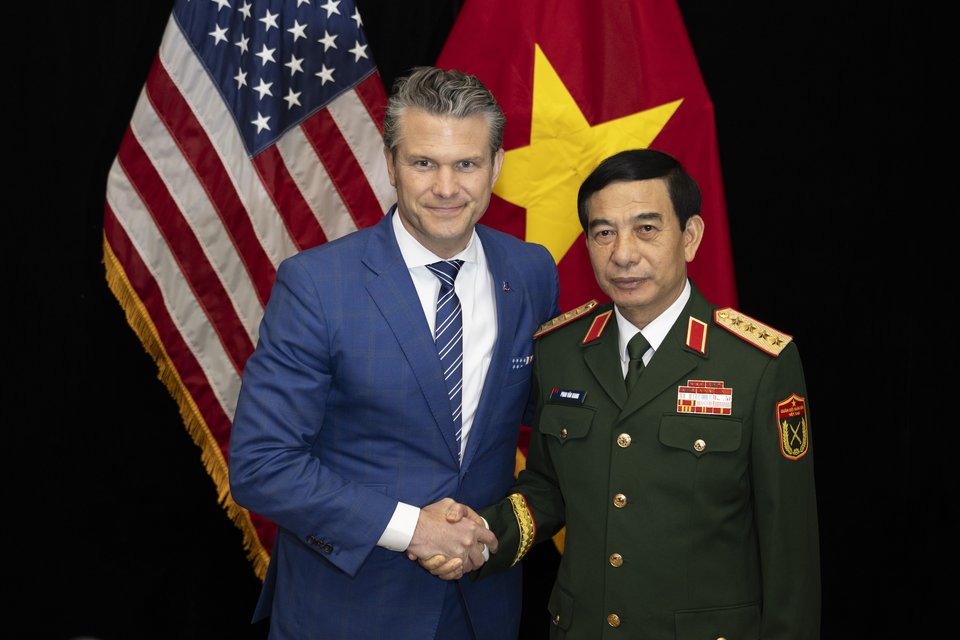
Image: U.S. Defense Secretary Pete Hegseth at Shangri-La Dialogue, Singapore, 2025. Credit: U.S. Department of Defense (Public Domain)