

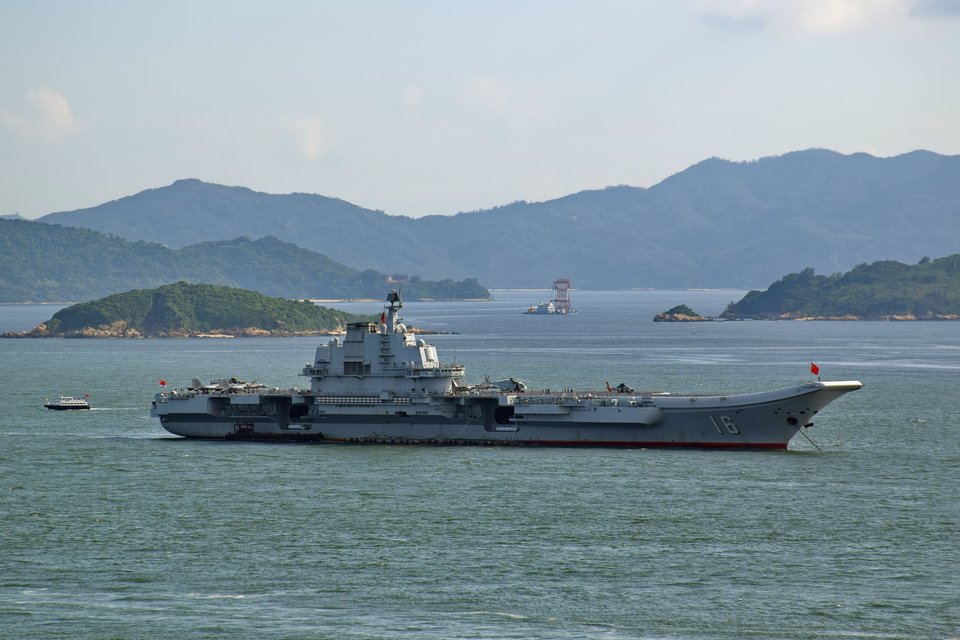
The Navy That Outgrew the Strait
For years, the argument about China’s navy followed a simple shape. The People’s Liberation Army Navy (PLAN) existed to intimidate Taiwan. Its ships stayed inside the First Island Chain. Its exercises were about a single piece of geography: the Taiwan Strait. That description is no longer true.
In May 2026, China carried out four “joint combat readiness patrols” around Taiwan — on the 1st, the 6th, the 19th, and the 25th, according to reporting in The Diplomat by Ying Yu Lin. That is roughly one patrol per week. It is a pace that would have been unthinkable five years ago. And yet none of these operations escalated into the kind of large-scale, Taiwan-specific exercises — Joint Sword, Strait Thunder — that the world has come to watch for. Beijing did not launch a big Taiwan exercise after the Trump-Xi meeting. It did something quieter and perhaps more significant: it normalized military pressure into a weekly routine.
But the real story is not what the PLAN is doing near Taiwan. It is what the PLAN is doing everywhere else.
What Happened
On May 25, the Japanese defence ministry reported that the aircraft carrier Liaoning was operating approximately 880 kilometres southwest of Okinotorishima, Japan’s southernmost point. With it sailed the Type 055 destroyer Wuxi, the Type 052D destroyer Kaifeng, the new Type 054B frigate Luohe, and the Type 901 fast combat support ship Hulunhu. That last vessel is worth pausing on. A Type 901 is a replenishment ship. It carries fuel, food, and ammunition for sustained operations far from home ports. Its presence in the formation means the PLAN is preparing for long missions in the open Pacific, not short sorties near the Chinese coast (SCMP, May 27, 2026).
The same week, a Type 075 amphibious assault ship formation transited the Miyako Strait. These are 40,000-ton vessels designed to land marines on hostile shores. They have no business in the Miyako Strait unless Beijing is thinking about operations east of Taiwan — in the Philippine Sea, toward Guam, or deeper into the Western Pacific.
In early December 2025, China ran a navy-centred exercise involving nearly 100 vessels operating across the East China Sea, the Taiwan Strait, and the South China Sea simultaneously. In late May 2026, Taiwan’s National Security Council reported more than 100 Chinese naval, coast guard, and other vessels deployed across waters stretching from the Yellow Sea to the South China Sea and the Western Pacific (The Defense Post, May 24, 2026). These are not Taiwan-specific operations. They are regional power projection on a scale that touches every navy in the Indo-Pacific.
Why It Matters
The PLAN is no longer a green-water navy that operates within reach of its own shore-based air cover. It is becoming a blue-water navy, and that changes the military geography of Asia.
Consider the Strait of Malacca. Roughly 23 million barrels of oil pass through it each day. Around four-fifths of China’s imported oil moves along this route (The Diplomat, “China and Maritime Chokepoints,” May 29, 2026). The strait is narrow, congested, and vulnerable. A single sinking in the wrong place could choke the energy supply of East Asia for weeks. For decades, the United States Navy has assumed it could control this chokepoint in a crisis. That assumption now has a question mark beside it.
The same logic applies to the Strait of Hormuz, where tensions with Iran cut daily shipping traffic from 130 vessels to fewer than ten earlier this year. The Horn of Africa, the Bab el-Mandeb, the South China Sea’s vital shipping lanes — every narrow waterway on which global trade depends is now within reach of Chinese naval power. The PLAN has a base in Djibouti, near Bab el-Mandeb. It maintains dual-use port facilities across the Indian Ocean — in Pakistan, Sri Lanka, Myanmar — what strategists call the String of Pearls. And its carrier groups are now operating routinely in waters where only the US Navy used to go.
The Indian Ocean is the prize. Australia’s Defence Minister Richard Marles put it bluntly at the Shangri-La Dialogue in Singapore last week: “The seabed is becoming a battlefield” (The Guardian, May 31, 2026). Ninety-nine per cent of Australia’s internet traffic flows through just 15 subsea cables. Those cables are exposed, immovable, and increasingly vulnerable. Marles cited five cables cut in the Taiwan Strait in the past 18 months and three in the Baltic Sea. Whether these were accidents or tests of the West’s response times, the vulnerability is real.
The Other Side
The United States and its allies are not watching this shift in silence. But their responses reveal as much about their own weaknesses as about China’s strength.
On May 26, the Quad foreign ministers — from the US, Japan, India, and Australia — met in New Delhi and announced the Indo-Pacific Maritime Surveillance Collaboration (IPMSC). The initiative, proposed by India, will focus on the Indian Ocean, using satellite tracking technology to provide real-time information on vessel movements. It builds on the existing Indo-Pacific Partnership for Maritime Domain Awareness (IPMDA), launched in 2022 (The Diplomat, “What Does Quad’s New Surveillance Initiative Mean for Indian Ocean Security?”, May 27, 2026). US Secretary of State Marco Rubio described it as a way to “leverage each of the Quad countries’ maritime surveillance capabilities to enhance information sharing.”
That sounds good. But the information being shared is unclassified satellite tracking data — the kind of thing commercial firms already sell. The initiative’s real value is normative: it makes maritime surveillance a routine habit among Quad members. Whether it can match the operational tempo of the PLAN is another question.
Then there is AUKUS. On May 30, the defence ministers of the US, UK, and Australia announced the first “signature project” under AUKUS Pillar Two: the joint development of payloads for uncrewed undersea vehicles (UUVs). UK Defence Secretary John Healey said Britain would contribute £150 million ($201 million) and acknowledged that “for too long in AUKUS, we talked too much and delivered too little” (BBC News, May 31, 2026). The underwater drone technology is expected to be ready by 2027.
US Defence Secretary Pete Hegseth called the project a suite of “highly adaptable multi-mission UUV payloads” for undersea operations, including protecting seabed infrastructure, conducting strikes, and running surveillance (The Guardian, May 31, 2026). It is a sensible response to the PLAN’s growing submarine fleet and its interest in underwater infrastructure. But it is not a quick fix. And it is not a carrier group.
Australia will also buy three secondhand Virginia-class submarines from the US, instead of a mix of old and new boats, in what Marles called a move to “simplify supply chain management.” These are useful additions, but they will take years to arrive.
Context
China’s naval expansion has accelerated beyond what most strategists predicted a decade ago. The PLAN now operates more than 370 ships, making it the largest navy in the world by hull count. The US Navy fields around 290 combat vessels and is shrinking under budget pressures (19FortyFive, April 2026; USNI News, May 11, 2026).
Size alone is not everything. The US Navy retains advantages in aircraft carrier tonnage, submarine quality, and combat experience. But China’s shipbuilding capacity is estimated at roughly 230 times that of the United States (19FortyFive, April 2026). When states can build warships faster than rivals can sink them, the arithmetic of naval conflict changes.
The PLAN now has three aircraft carriers — Liaoning, Shandong, and the newly commissioned Fujian, with its electromagnetic catapults — and a fourth under construction. It fields Type 055 destroyers, 13,000-ton vessels that some analysts compare to cruisers. It has four Type 075 amphibious assault ships and is building the Type 076, which may carry drones. Its submarine fleet includes both nuclear and conventionally powered boats armed with long-range anti-ship missiles.
This is a navy built for reach.
Bottom Line
The PLAN has outgrown the Taiwan Strait. That is the strategic reality of 2026. China’s navy can now project power across the Western Pacific, into the South China Sea, and down the chokepoints of the Indian Ocean. It can run carrier operations 880 kilometres from Japan. It can deploy 100 vessels from the Yellow Sea to the South China Sea in a single week. It can sustain those operations far from its own shores, protected by a support fleet that is growing faster than anyone in the West is building countermeasures.
The US and its allies are responding — with surveillance initiatives, underwater drone programmes, and submarine purchases. But these are incremental measures against a structural shift. AUKUS Pillar Two is serious, but it will not produce deployable systems until 2027 at the earliest. The Quad’s IPMSC is useful, but it tracks ships rather than stopping them. The US Navy is still the world’s most powerful fleet, but it is being asked to cover more ocean with fewer hulls.
The plain judgment is this: the Indo-Pacific is entering a period of contested maritime dominance for the first time since 1945. The PLAN is no longer a regional navy with regional ambitions. It is a global navy in training, and the waters between the Malacca Strait and the coast of Africa are its proving ground. The West can either match that ambition or learn to live with the consequences of not doing so.