

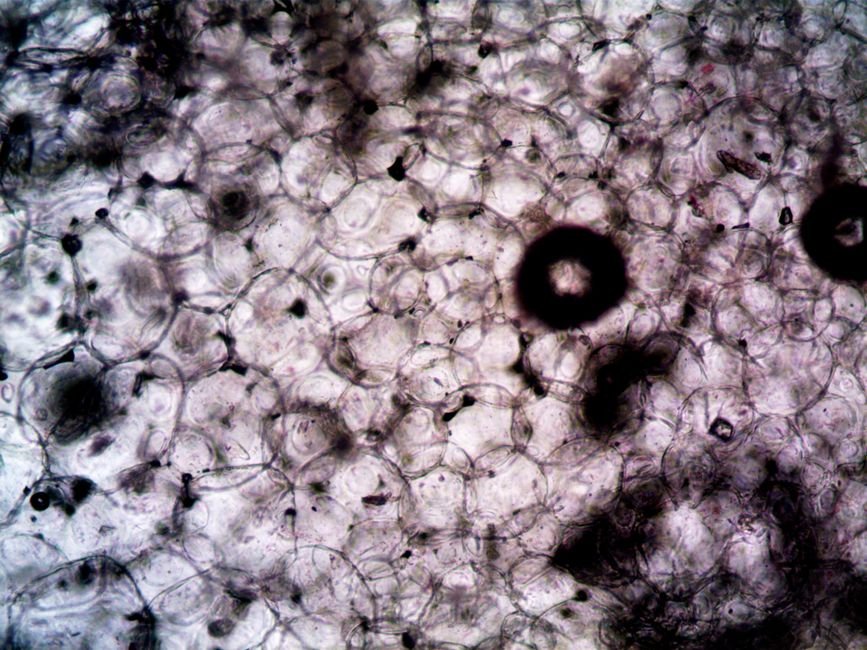
The boundary between chemistry and biology is becoming harder to draw. A team at the University of Minnesota led by biochemist Kate Adamala has built a cell from scratch, a system they call SpudCell, assembled entirely from purified chemical components, that can grow, replicate its genome, and divide. The preprint describing the work, rejected by the journal Cell after a reviewer argued the cells were “not real biology,” has nonetheless drawn praise from leading figures in the field as a landmark achievement in bottom-up synthetic biology.
What makes SpudCell different from every cell that has ever existed is not its function, but the way it was made. Every previous synthetic cell, including J. Craig Venter’s landmark 2010 JCVI-syn1.0, was built by taking an existing natural cell and replacing its genome with a synthetic one. That approach is “top-down”: it starts with a living chassis and modifies it. SpudCell is “bottom-up”: it starts with purified chemicals and assembles the entire system from scratch.
“I have a blueprint, I have a full chemical ingredient list of every component,” Adamala told Quanta Magazine. “We’ve replicated in chemistry what only used to be possible in biology: the complete set of behaviors of a cell. It proves that the most fundamental functions of life, like growth and replication, do not need a mysterious magical spark.”
How SpudCell Works
The cell body is a liposome, a microscopic bubble of fatty acids enclosing water. Inside, the team loaded a 90-kilobase-pair genome split across seven to nine separate DNA plasmids, carrying roughly 36 genes. That is just enough information to encode the functions needed for feeding, growth, replication and division.
The protein synthesis machinery is provided by the PURE system, a cocktail of 36 purified E. coli enzymes, including ribosomes, that can translate the synthetic genome into functional proteins. One of those proteins, alpha-hemolysin, inserts into the liposome membrane and acts as a gate: it binds to chemical tags on external “feeder liposomes,” triggering fusion that delivers fresh supplies of sugars, lipids, tRNAs, ribosomes, and enzymes.
Division happens without a cytoskeleton. Proteins crowding on the inner surface of the membrane build up mechanical stress until the liposome splits. For sustained replication over multiple generations, the researchers used streptavidin binding and a mechanical separating mesh.
After five division cycles, the cells retain a 12-hour division time, though only about 30 percent of daughter cells retain the full genome. The system cannot survive outside its controlled chemical environment, it needs a constant supply of feeder liposomes, cannot make its own ribosomes, and cannot metabolize.
“It’s inefficient, but you know exactly how it’s built,” Adamala told Science, comparing SpudCell to “the first bike frame with wings that flies 30 meters (100 feet)”, the Wright Flyer of synthetic cells.
Is It Alive?
The question has split scientists. Drew Endy, a synthetic biology pioneer at Stanford who co-founded the public benefit corporation Biotic alongside Adamala, put it carefully: “I would say Kate has constructed a cell. I don’t think she’s created life.”
John Glass of the J. Craig Venter Institute called it “a landmark event in the history of biology” and “a watershed event for the synthetic-cell field and biology in general.” Nobel laureate Jack Szostak of the University of Chicago said: “I don’t know of any other effort to put together an artificial cell from biological components that has progressed so far.”
Others were more measured. Seraphine Wegner of the University of Munster told Science: “It’s a very cool paper… But I don’t think it means we’re close to creating a fully synthetic cell.” Michael Lynch of Arizona State University cautioned that the cell is not self-sustaining.
Elizabeth Strychalski of the U.S. National Institute of Standards and Technology said SpudCell “straddles the line” between a pile of chemicals and a naturally evolved cell, an apt description for a system that is not alive in any conventional sense, yet does things only living systems were thought capable of.
The SpudCell Name
According to Science and Quanta, Adamala’s students suggested calling the cells “Adamala cells.” She replied: “Call it something that’s not my name, call it a potato for all I care.” A deliberate echo of Sputnik, the first artificial satellite, gave the project its name.
Biotic: An Infrastructure for Open Synthetic Cells
Adamala, Endy, Jan Jedryszek, and biotech entrepreneur Chris Raggio have founded Biotic, a U.S. 501(c)(3) nonprofit public-benefit corporation that raised approximately $10 million in seed funding. Biotic will begin disbursing research grants in September 2026, with the goal of building shared technical infrastructure for synthetic cell engineering and keeping the tools open.
“Any engineering discipline needs modularity,” Adamala said in a university press release. “In our case, we believe those modules must be built in the open: an infrastructure foundation built privately just gives someone a toll booth.”
The paper, titled “A Chemically Defined Synthetic Cell Capable of Growth and Replication,” runs 190 pages. After its rejection by Cell, the authors plan to submit it to a new journal. Under prepublication embargo, Adamala shared the manuscript with journalists, an unusual move that her colleagues defended. “I think Kate’s being quite courageous, and I think she’s giving everybody a gift,” Endy told Science. “It’d be a lot easier for her to hold this close.”
What Comes Next
SpudCell cannot yet evolve, its genome replication enzyme is so accurate that spontaneous mutations do not accumulate. It cannot eliminate waste. It cannot divide without periodic mechanical help.
But it demonstrates, for the first time, that a complete cell cycle can be run on a defined chemical recipe. The next steps, Adamala said, are to improve the efficiency of genome inheritance during division, add metabolic capability, and eventually make the system self-sufficient enough to operate without feeder liposomes.
“If somebody is going to synthesize a minimal cell,” Adamala said, “it’s going to be a community effort.”
Disclosure: Based on a preprint that has not undergone peer review. The manuscript was rejected by Cell and has not yet been accepted at another journal.
Sources
- Gaut, N.J., Deich, C., Cash, B., Hoog, T., Engelhart, A.E., Adamala, K.P. “A Chemically Defined Synthetic Cell Capable of Growth and Replication.” Preprint, Biotic.org and bioRxiv.
- Matthew Herper, “Synthetic biology researchers think they’ve made a cell. Is it alive?” STAT News, July 1, 2026.
- University of Minnesota Twin Cities, College of Biological Sciences press release, July 1, 2026.