

CoRoT-2 b Hotspot Anomaly Challenges Tidal Locking Assumptions
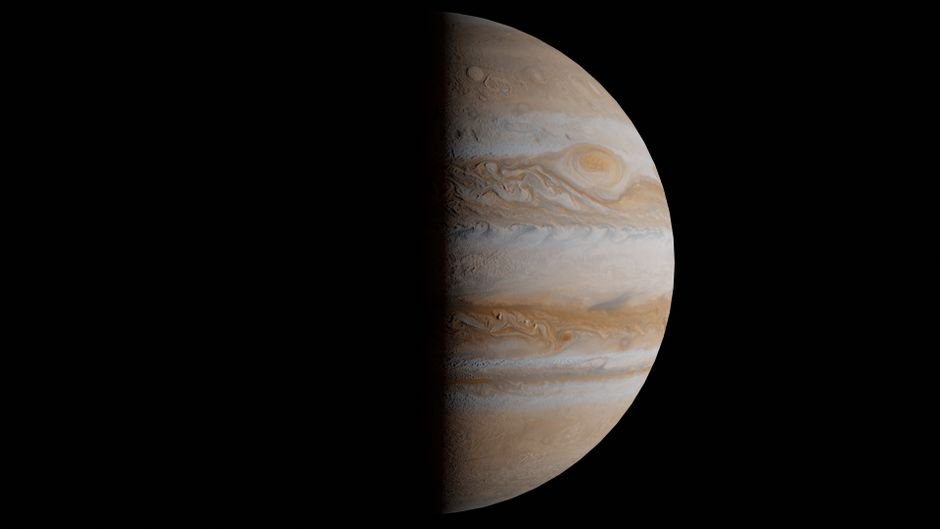
Featured image: Artist’s impression of a hot Jupiter exoplanet with atmospheric glow; credit: NASA/JPL-Caltech
Hot Jupiters are some of the most extreme planets in the universe: gas giants that orbit so close to their stars that they complete a full lap in a matter of days. Astronomers have long assumed these worlds are tidally locked, with one hemisphere permanently baked by starlight and the other frozen in eternal darkness. A new study of the exoplanet CoRoT-2 b, presented at the 248th meeting of the American Astronomical Society and published on arXiv, has challenged that assumption.
The planet, located 696 light-years from Earth, has a mass 3.5 times that of Jupiter and a radius 1.5 times larger. It orbits its host star every 41 hours. By measuring the planet’s velocity and rotation rate, researchers led by Aurora Kesseli of the NASA Exoplanet Science Institute determined that CoRoT-2 b rotates once every three Earth days, meaning it completes nearly two orbits for every single rotation. The planet is not tidally locked, and its hottest point is shifted in the opposite direction from where standard models predict.
For most hot Jupiters, the hottest region sits at the sub-stellar point, directly facing the star, or is shifted slightly eastward by powerful atmospheric winds. CoRoT-2 b defies both expectations. Three hypotheses were tested to explain the anomaly: failure of tidal locking (the planet simply never synchronized), atmospheric wind circulation shifting the hotspot, and magnetic or other exotic effects. The data clearly pointed to the first explanation: the planet never became tidally locked in the first place.
The finding has implications beyond this single world. Tidal locking is a key factor in models of planetary habitability, especially for planets orbiting M dwarf stars, where the habitable zone coincides with the tidal locking zone. If some worlds can resist synchronization, the prospects for temperate conditions on their surfaces become more complex and potentially more varied.
The study appears in The Astrophysical Journal Letters and was conducted using velocity measurements from ground-based observatories. Future telescopes such as the Habitable Worlds Observatory and the Extremely Large Telescope will enable deeper measurements of rotation and atmospheric dynamics for a larger sample of exoplanets, including potentially habitable ones.
Source: 1ban.news – Space Desk