

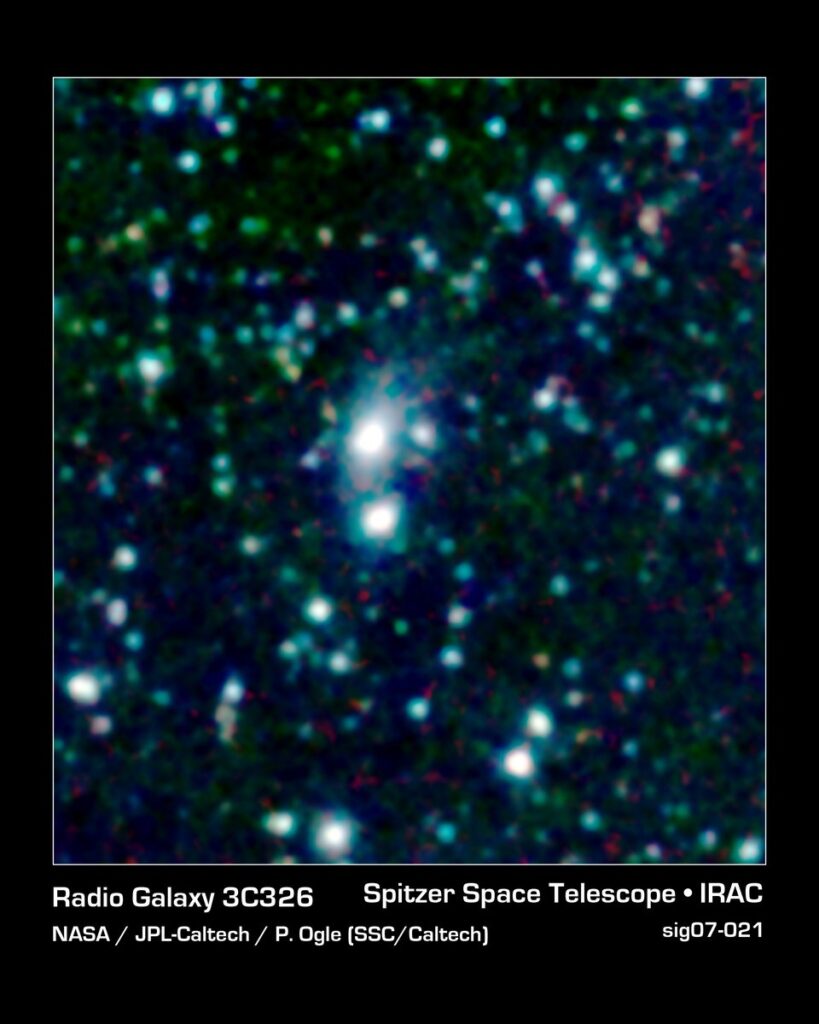
Featured image: LOFAR radio image of RAD-BAARG, showing the bow-and-arrow structure spanning 1.8 million light-years; credit: LOFAR / RAD@home / Hota et al.
A volunteer citizen scientist working through the RAD@home Astronomy Collaboratory has spotted a never-before-seen structure in deep space: a giant radio galaxy that looks like a bow and arrow, spanning approximately 1.8 million light-years, nearly 18 times the width of the Milky Way.
The object, designated RAD-BAARG (Radio Bow-And-Arrow Radio Galaxy), is unlike any known radio galaxy. Its extreme asymmetry and distinctive shape may be the clearest radio signature ever observed of a galaxy falling at supersonic speed through the hot gas of a galaxy cluster, generating a massive bow shock that reshapes its radio-emitting plasma.
“The structure of this source is unlike that of any radio galaxy I have seen in the last 25 years,” said Ananda Hota of the University of Mumbai, who led the follow-up analysis.
A Radically Asymmetric Radio Galaxy
Radio galaxies are powered by supermassive black holes at their centers, which launch powerful jets of relativistic plasma. In most cases, these jets form two roughly symmetrical lobes extending in opposite directions. RAD-BAARG is dramatically different.
In the newfound galaxy, one jet feeds a wedge-shaped region that curves backward into an enormous arc. The other jet twists into an S-shaped structure before fading into a long, diffuse tail. The overall appearance resembles a bow with an arrow drawn across it.
The extreme lopsidedness immediately caught the attention of researchers. “LOFAR allows us to see this faint, low-surface-brightness emission in remarkable detail,” said Pratik Dabhade of the National Center for Nuclear Research in Poland, co-lead author of the study published June 22 in the Monthly Notices of the Royal Astronomical Society: Letters.
A Supersonic Plunge Through a Galaxy Cluster
The team used follow-up observations from the Low Frequency Array (LOFAR) Two-meter Sky Survey (LoTSS), one of the deepest low-frequency radio surveys available. Low-frequency radio observations are particularly sensitive to faint, diffuse emissions from aged electron populations, which remain invisible at optical or higher radio frequencies.
The analysis suggests that RAD-BAARG’s bizarre shape is caused by the galaxy’s supersonic motion through a dense galaxy cluster. As the galaxy falls toward the cluster center, it generates a bow shock: the same phenomenon that creates the sonic boom of a jet breaking the sound barrier, but on cosmic scales. This shock compresses magnetic fields and charged particles, sculpting the radio-emitting plasma into the observed bow-and-arrow shape.
The galaxy resides in a complex “multi-halo” environment, where several overlapping reservoirs of hot gas create conditions particularly favorable for shaping radio plasma. If confirmed, RAD-BAARG could become a key example of how extreme cluster environments reshape radio galaxies and their jets.
Citizen Science in Action
The discovery was made through the RAD@home Astronomy Collaboratory, a citizen science initiative based in India that enlists volunteers to review astronomical survey data for unusual or interesting features. A volunteer identified RAD-BAARG’s unique structure in LOFAR data, prompting the professional follow-up that confirmed the object’s extraordinary nature.
The finding highlights the value of human pattern recognition in an era of massive automated surveys. Computers excel at finding known types of objects, but unusual and unexpected structures often require the human eye. “With LoTSS DR3 and the future Square Kilometre Array Observatory (SKAO), we may find many more systems where radio galaxies reveal otherwise invisible interactions between jets, galaxies, and their environments,” Dabhade said.
What Comes Next
The RAD-BAARG discovery opens a new window onto galaxy cluster dynamics. By studying how extreme environments bend and reshape radio jets, astronomers can infer properties of the invisible hot gas that fills galaxy clusters: its density, temperature, and motion. Each radio galaxy acts like a natural probe of its surroundings, with the plasma jets serving as tracers of forces otherwise invisible to telescopes.
Future surveys with LOFAR’s full third data release and the Square Kilometre Array Observatory (SKAO), expected to begin operations later this decade, will likely uncover many more such objects. Each one adds a piece to the puzzle of how galaxies evolve within the densest environments in the universe.
For the citizen scientist who spotted the strange bow and arrow, it is also a reminder that the universe still holds surprises that no algorithm predicted. Sometimes, the most extraordinary discoveries begin with a volunteer simply noticing that something in the data does not look quite right.