

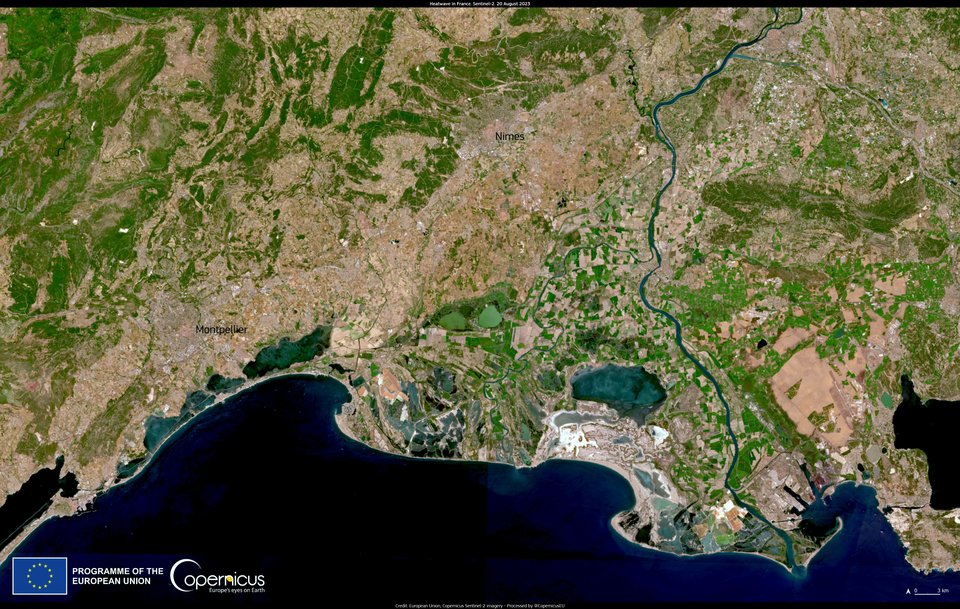
On June 22, the village of Pissos in southwestern France recorded a temperature of 44.3 degrees Celsius, the hottest measurement ever confirmed in the country. It was not an isolated reading. Across Europe, from Portugal to Poland, an unprecedented heatwave had breached records in at least 22 countries, and the World Weather Attribution consortium was already running the numbers.
Their conclusion, published June 26, was stark: a June heatwave of this intensity would have been virtually impossible in 1976. The same event today is driven almost entirely by fossil fuel emissions.
“This event would not have been possible without climate change,” said Theodore Keeping of Imperial College London, lead author of the WWA analysis.
The heatwave, the second to strike Europe in as many months (the first hit in late May), peaked between June 17 and 23 over Iberia and France before spreading eastward. The combination of extreme daytime heat and unprecedented humidity, measured as wet-bulb globe temperature, which accounts for the body’s ability to cool itself through sweating, made it the hottest and most humid June heatwave ever recorded in Europe.
What the data show
The WWA analysis compared the current event to historical baselines using observational data and climate models. The results:
- Daytime temperatures in this June heatwave are approximately 3.5 degrees Celsius hotter than they would have been in 1976, and about 2 degrees Celsius hotter than in 2003.
- Nighttime temperatures are 2.4 degrees Celsius warmer than in 1976, a critical difference, as sustained heat overnight prevents the body from recovering and is a major driver of mortality.
- A June heatwave of this intensity was roughly 10 times less likely in 2003, and more than 100 times less likely at night.
- El Nino played “no role” in the event, the researchers found. The driver is anthropogenic climate change, pure and simple.
The analysis examined wet-bulb globe temperature across 854 cities in 30 European countries. Approximately 45 percent of those cities broke or are forecast to break all-time WBGT records during the 18-29 June period. Every city in the Czech Republic, Lithuania, and Luxembourg experienced unprecedented combined heat and humidity.
A continental emergency
The temperature records themselves are staggering. Pissos, France, reached 44.3 degrees Celsius (111.7 degrees Fahrenheit), confirmed by Meteo-France as an all-time national record. In Spain, Andujar hit 42.7 degrees Celsius in June, following a May that already set records. The United Kingdom recorded its hottest June day ever, surpassing the previous record of 35.6 degrees Celsius set in Southampton in 1976. Switzerland recorded 37 degrees Celsius at four locations, an all-time high for June. Germany breached 40 degrees Celsius. Austria, Portugal, and the Netherlands all set national or local June records.
The human toll is still being tallied, but preliminary data from the ERCC reports at least 290 heat-related deaths across affected countries, including 212 in Spain and approximately 58 in France. The WHO Europe called the event a “health emergency,” noting that Europe has recorded an estimated 200,000 heat deaths over the past four years.
In the UK, London Ambulance Service reported its busiest-ever day for life-threatening emergencies. East Surrey Hospital declared a critical incident. Only 5 percent of British buildings have air conditioning.
In France, 845 schools closed entirely, with another 1,800 operating shortened hours. The national rail operator SNCF canceled 71 long-distance trains due to risk of air conditioning failure. Nuclear plants along the Rhone and Garonne rivers reduced output because water temperatures were too high for cooling.
Has Europe entered a new climate regime?
The question, posed by a Nature analysis published alongside the WWA report, is whether scorching summers are now the permanent baseline. The answer from climate scientists is nuanced.
“These heatwaves are not yet the permanent new normal, but they are becoming decisively more frequent, intense, and longer,” said Erich Fischer of ETH Zurich, who described the rate of record-breaking as a high-jumper “on steroids.”
Several compounding factors are at play. The North Atlantic cold blob, a region of anomalously cool water south of Greenland, is trapping Saharan air over the continent. Soil drying from earlier heatwaves reduces evaporative cooling. Declining cloud cover from reduced aerosol pollution allows more solar radiation to reach the surface. On top of all this sits the underlying trend: global temperatures have risen approximately 1.3 degrees Celsius since the preindustrial era, making every natural variability pattern more extreme.
Zeke Hausfather of Berkeley Earth noted that the warming trend since 1980 has been “an enormous spike,” with European summer temperatures rising roughly twice as fast as the global average.
WWA co-founder Friederike Otto put the challenge plainly: “As long as we continue to burn fossil fuels, these events will become more frequent and more intense. The choice is not whether to adapt, it’s whether to prevent the worst.”
Sources:
- Keeping, T., Otto, F.E.L., et al. (2026). Fossil fuel emissions have rapidly worsened European heatwaves in just a few decades. World Weather Attribution Scientific Report No. 85. June 26, 2026.
- Luhn, A. (2026). Europe’s heatwave is the hottest and most humid ever. New Scientist, June 26, 2026. https://www.newscientist.com/article/2531992-europes-heatwave-is-the-hottest-and-most-humid-ever/
- Chen, E. (2026). Europe’s record heatwave: does the continent have a new climate? Nature, June 26, 2026.