

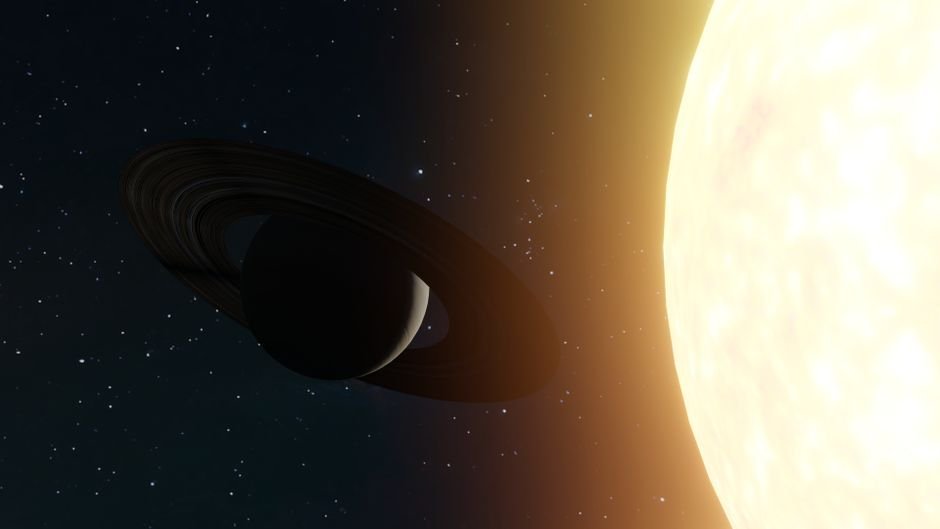
Finding an Earth-like planet around another star is one of the hardest problems in modern astronomy. The planet may be only ten millionths of a degree away from its star on the sky, and a hundred million to ten billion times fainter. A standard telescope cannot separate the two: diffraction blurs them into a single blob of light, and a conventional detector cannot tell which photons came from the planet and which from the star.
A new theoretical framework, described in a preprint posted to arXiv in early July, proposes a way around both obstacles. Hyunsoo Choi at Hanyang University in South Korea, with colleagues at Sungkyunkwan University, Purdue University, and Hanyang University, developed an adaptive measurement system that sorts photons by their quantum-mechanical wave shapes rather than simply counting how many arrive. In computer simulations, the method reconstructed complete scenes containing a star and two very dim companions with a success rate above 70 percent, operating at brightness contrasts the authors describe as five orders of magnitude beyond what existing quantum imaging techniques can manage.
Direct imaging of exoplanets is limited by two physical facts. The first is the Rayleigh criterion: when two light sources are closer together on the sky than about half the telescope’s resolution limit, their images blur into one. Almost every potentially habitable exoplanet orbiting a nearby star sits well inside that limit. The second is contrast: a telescope pointed at a Sun-like star with an Earth-like planet receives roughly 10 billion photons from the star for every one from the planet.
Current coronagraphs (instruments that physically block the star’s light) can suppress starlight by a factor of about 10 billion in space, but they struggle at the small angular separations where Earth-like planets are expected. Quantum imaging approaches, which use the wave nature of light to extract extra information, have so far been limited to contrasts of only about 1,000 to 1, far too low for terrestrial exoplanets.
The method described in arXiv:2607.06931 works differently. Instead of just measuring how many photons arrive at each pixel, the system first sorts incoming photons by their spatial mode: the shape of their wavefront. A photon carries more information than its brightness alone; its wave pattern encodes where it came from on the sky. The challenge is extracting that information efficiently, especially when one source is orders of magnitude brighter than the other.
The algorithm starts with an overcomplete set of guesses about where planets might be, then iteratively refines them. At each step it projects the incoming light onto a carefully chosen set of spatial modes, records the photon counts, and updates its estimate of the positions and brightnesses of all sources. The measurement basis is recomputed each iteration to maximize the quantum Fisher information per detected photon, a quantity that describes the maximum information any measurement can extract about a set of unknown parameters.
To handle brightness ratios spanning eight orders of magnitude, the algorithm works in log-brightness space. Maximum likelihood estimation then determines the best fit for each candidate position. After the iterative refinement converges, the method uses the Bayesian Information Criterion, a statistical model-selection tool, to decide how many sources are actually present. The process requires no manually tuned detection threshold; the model selection emerges from the photon-count statistics alone.
In 12,000 Monte Carlo trials simulating a star with two planets at brightness ratios of 1, 10,000, and 100 million, all within sub-Rayleigh separations, the algorithm correctly identified all three objects 72.5 percent of the time. When it identified the correct number of sources, the median localization error was about 0.1 pixel, well below a single resolution element. For the dimmest planet, 100 million times fainter than the star, 99.7 percent of successful trials returned a brightness estimate within a factor of two of the true value.
The method proved resilient to one type of experimental imperfection. When the authors simulated misalignment by shifting the telescope by up to six pixels, the success rate dropped only slightly, to 71.3 percent. The paper notes that robustness to other kinds of real-world noise (atmospheric turbulence, detector read noise, thermal variations) has not been tested and remains unknown.
Several important caveats separate these results from a working instrument. The entire system exists only as a computer simulation. The authors outline a path for building such a system: spatial mode sorters compatible with existing coronagraphs are within reach of current photonics technology, but physical implementations of quantum-optimal measurement systems typically follow theoretical advances by years or decades. The paper also tests a simple three-source scene; real observations would involve scattered light, multiple background sources, and instrument artifacts the simulation does not model.
Despite these limits, the framework represents a conceptual advance in how astronomers think about the problem. Directly imaging an Earth-like planet requires detecting a signal roughly 10 billion times fainter than the light it sits next to, at separations that push telescopes to their fundamental physical limits. The preprint shows that the quantum-information limits of exoplanet detection are far from exhausted and provides a concrete design for a measurement strategy that approaches them.
If built and tested on a real telescope, such a system could open a window to planets that current instruments cannot reach. An Earth analog around a nearby M dwarf, the most promising targets for atmospheric biosignature searches, produces a contrast of about 10 million to 100 million. The proposed method operates in that regime. The gap between theory and hardware remains large, but the paper identifies a path across it.
Sources
- Hyunsoo Choi, Hyoung Won Baac, Zubin Jacob, Haejun Chung. Exoplanet Detection Using Adaptive Quantum-Optimal Measurement. arXiv:2607.06931 (July 2026). https://arxiv.org/abs/2607.06931
- Quantum Physics Could Help Us Find Earth 2.0. Universe Today, July 2026. https://www.universetoday.com/articles/quantum-physics-could-help-us-find-earth-20
- Could quantum physics help us find Earth 2.0? Phys.org, July 2026. https://phys.org/news/2026-07-quantum-physics-earth.html