

Putin Su 57 India Stealth Fighter Offer
Vladimir Putin used this month’s St. Petersburg International Economic Forum (SPIEF 2026) to renew a familiar pitch to India: buy our fifth-generation stealth fighter, build it together, and we will give you the crown jewels. The Russian president told New Delhi that Moscow is willing to cooperate without “limitations” — offering access to core software source codes, radar systems, and full production technologies. For a Indian Air Force that has not operated a single fifth-generation fighter and faces a widening technology gap with China, the offer is seductive. But two questions cut through the diplomatic noise. Is the Su-57 actually stealthy? And even if it is not, is it the plane India needs right now?
The Deal on the Table
Russia is no longer offering India the export Su-57E variant — a watered-down version with downgraded avionics and restricted software that Moscow typically sells to other foreign customers. Putin’s SPIEF proposal dangles joint production and comprehensive technology transfer at a level unprecedented in Russian defense export history. Hindustan Aeronautics Limited (HAL) is now awaiting Russia’s formal financial quotation, which it will present to IAF officials for evaluation. If the numbers make sense, India could be assembling Su-57s on Indian soil within years rather than decades.
The pitch revives a project that has been dormant since 2018. India and Russia launched a joint fifth-generation fighter program in 2007 under the name FGFA (Fifth Generation Fighter Aircraft), but New Delhi walked out a decade later. The reasons were multiple: spiraling costs, insufficient technology access, and persistent doubts about whether the aircraft could genuinely achieve the low-observability profile that defines a true fifth-generation platform. The FGFA’s collapse was a quiet strategic defeat for both sides — Russia lost a development partner and a major customer, while India lost a decade it could have spent closing the gap with China. (Defense News, Anjana Pasricha; Army Recognition)
Is the Su-57 Really Stealthy? No.
The short answer is no — at least not by the standards that define modern fifth-generation fighters. A senior IAF official confided to Indian defense media that the Su-57E’s exposed engine panels “severely compromise its stealth profile,” particularly from the rear. (idrw.org, Raunak Kunde)
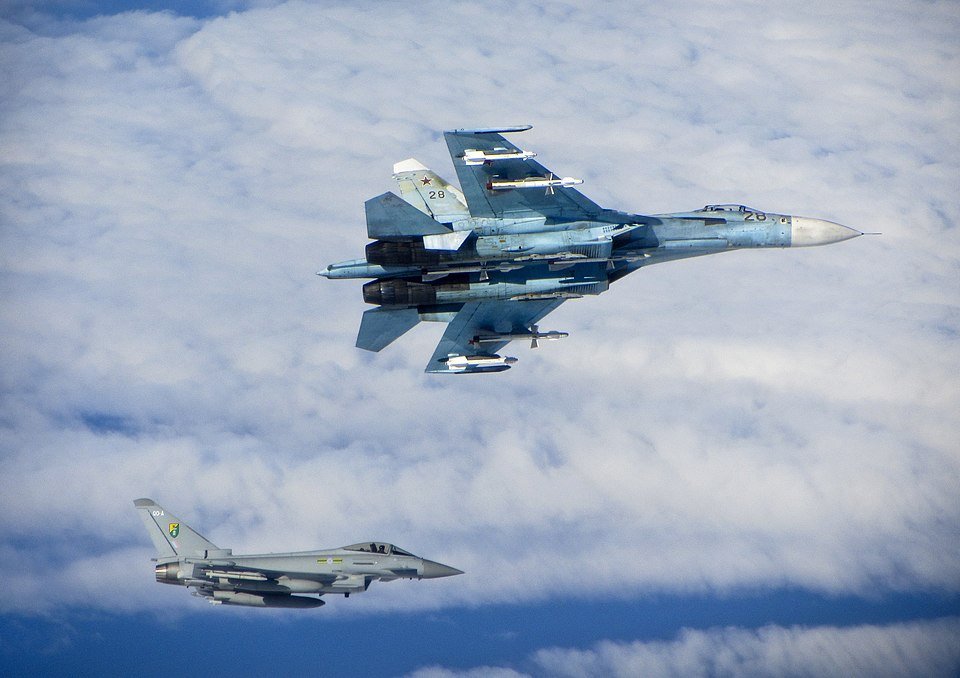
The problem is structural and baked into the plane’s DNA. The Su-57 is a derivative of the Su-27 Flanker lineage. Its exposed engine nozzles, sharp edges, and protruding components are design compromises that a true stealth aircraft would not tolerate. Compare the numbers. The Su-57’s frontal radar cross-section (RCS) is estimated at 0.1 to 1 square meter. The F-35’s frontal RCS is approximately 0.001 square meters. That is a difference of three orders of magnitude — the F-35 is roughly 1,000 times harder to detect.
Then there is the infrared signature problem. The Su-57’s AL-41F1 turbofans operate at 1,800 degrees Celsius, and there is direct line-of-sight to those engines from almost any rear-aspect angle. That makes the aircraft a thermal beacon for IR-guided missiles. Russia claims a “drop-in fix” of composite panels that would reduce the IR signature by 40 to 50 percent, but independent analysts remain deeply skeptical. Aviation Week has described the aircraft as “stealth lite at best.” (Asia Times, Gabriel Honrada)
The operational evidence reinforces the skepticism. Russia has deployed the Su-57 in Ukraine, but exclusively for standoff strikes launched more than 400 kilometers behind the front lines. It has never been used to penetrate defended airspace — the entire purpose of a stealth fighter. If the Kremlin believed in the Su-57’s low-observability, it would have used it over Kyiv or Kharkiv by now. It has not.
Is It the Plane India Needs? It’s Complicated.
India’s strategic position is worsening by nearly every measure. The country has no fifth-generation fighter in service — a capability gap it has not faced since the 1962 war with China, when the IAF was caught flat-footed by a technologically superior opponent. The indigenous Advanced Medium Combat Aircraft (AMCA) program, managed by the Defense Research and Development Organization (DRDO), will not reach operational status until approximately 2035 at the earliest. That projection assumes no further delays, which is optimistic for an Indian defense program of this complexity. Meanwhile, China is rapidly scaling its J-20 stealth fighter fleet past 200 airframes, and Pakistan is reportedly planning to acquire the J-35 from Beijing — a naval variant of the J-31 that could give Islamabad its own stealth capability within this decade.
The May 2025 Kashmir skirmishes drove the point home with grim clarity. India lost two to three fighters in the engagement, including a Rafale — its most advanced and expensive platform — shot down by a Chinese-made Pakistani J-10C armed with a PL-15 beyond-visual-range missile. (Asia Times) The Rafale is an excellent fourth-generation fighter, but it was outranged and out-detected by a Chinese radar and missile combination that India’s current arsenal cannot match at the electronic warfare level. The IAF currently operates with an 11-squadron deficit against its sanctioned strength. It can ill afford to wait another decade for the AMCA while its adversaries modernize at a faster clip.
This is where Putin’s offer becomes both strategically interesting and deeply risky. Russia is offering full technology transfer for the first time in any fighter export deal. Previously, only the downgraded Su-57E export variant was on the table — a version with restricted software access and reduced sensor capabilities. Now Moscow says India can access the source code, the radar software, and the full production line. India, for its part, has made clear it wants to swap the Russian radar with an Indian-made active electronically scanned array (AESA) system as a precondition for any deal. (idrw.org; Defense Security Asia) That would address one of the core complaints from the FGFA era: that Russia never gave India meaningful control over the plane’s electronic architecture.
HAL envisions an acquisition of 36 to 60 aircraft — two to three squadrons — as a bridge solution to cover the gap until the AMCA is ready. The logic is not unreasonable. A plane that is “stealth lite” is still more survivable in contested airspace than a Su-30MKI or a Rafale against Chinese J-20s and J-35s. A reduced RCS, even if not F-35 class, still complicates enemy radar lock and reduces engagement ranges for opposing fighters and SAMs. In the high-Himalayan environment where India and China face each other, every kilometer of detection advantage matters.
But the counterargument is equally serious and perhaps more persuasive. Buying the Su-57 — even with technology transfer — would drain billions of dollars from the AMCA budget and reduce the institutional pressure to finish India’s own fifth-generation fighter. If New Delhi commits billions to a Russian platform, the domestic program could lose its funding, its political priority, and its bureaucratic urgency. India has a long and painful history of imported weapons killing indigenous projects. The Arjun tank, the Tejas light fighter, the HAL Light Combat Helicopter — each suffered from the Indian military’s preference for proven foreign alternatives over homegrown platforms. The AMCA could become the next casualty of that pattern, and if it dies, India will have no fifth-generation fighter sovereignty for another generation.
The Bottom Line
The Su-57 is not a true stealth fighter by F-35 or J-20 standards. Its RCS is too large, its IR signature is too bright, and its combat record in Ukraine suggests even the Russian military does not trust it to penetrate enemy airspace. Calling it a fifth-generation fighter is generous.
Yet India’s problem is not that the Su-57 is imperfect. Its problem is that it needs an imperfect fifth-generation fighter today rather than a perfect one in 2035. The question is whether a “stealth lite” Su-57, produced with Indian systems and maintained under Indian control, would shift the operational calculus against Chinese and Pakistani air power.
Putin’s offer is the most generous Russia has ever made to any foreign customer. Generosity from Moscow, however, has always come with a price tag that extends far beyond the financial quotation HAL is waiting for.