

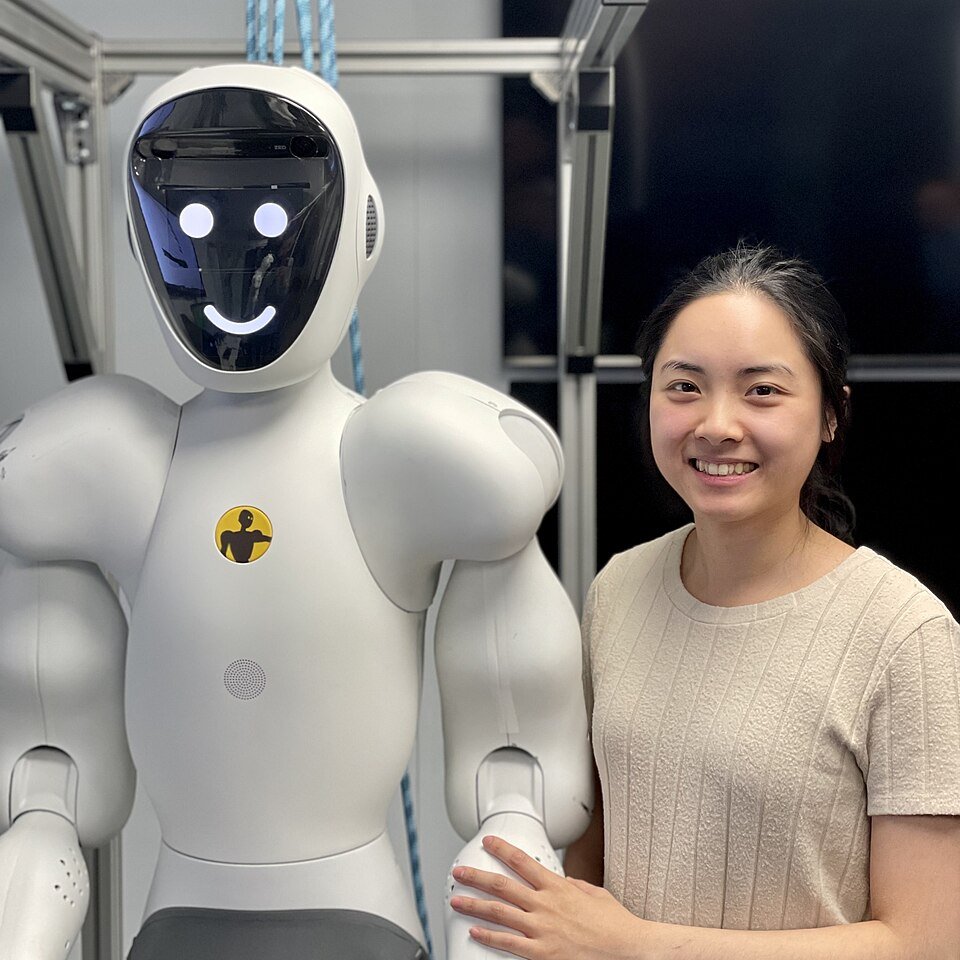
Getting a humanoid robot to perform agile, whole-body motions is harder than it looks. Most text-to-motion AI models train on captured human movement data, then retarget those motions onto robots. The problem: human biomechanics, mass distribution, and contact strategies differ fundamentally from a robot’s, so motions that look kinematically correct on a skeleton often violate physical feasibility in the real world.
A new framework called PhyGile, published as a preprint on arXiv by researchers from multiple Chinese institutions, takes a different approach: generate robot-native motions directly, bypassing the human-motion retargeting step entirely.
How it works
PhyGile operates in a 262-dimensional skeletal space native to humanoid robots, far beyond the roughly 50-to-70 degrees of freedom in typical human motion capture. At inference time, it uses physics-guided prefixes to constrain generated motion toward what is physically executable on real hardware.
The training pipeline has three stages:
1. Pre-training, A general motion tracking controller is trained using a curriculum-based mixture-of-experts scheme, progressively introducing harder motion patterns.
2. Post-training, The controller is fine-tuned on unlabelled motion data to improve robustness across a wide range of robot motions.
3. Physics-prefix adaptation, The controller is further fine-tuned with objectives derived from physics simulations, enabling stable execution of complex motions on real robots.
Beyond walking
The authors report that PhyGile “expands the frontier of text-driven humanoid control, enabling stable tracking of agile, highly difficult whole-body motions that go well beyond walking and low-dynamic motions typically achieved by prior methods.”
In both offline simulations and real-robot experiments, PhyGile demonstrated stable execution of motions that existing methods, which rely on retargeting human motion data, could not physically realise without falling or violating joint constraints.
Why it matters
Humanoid robots are attracting massive investment from companies including Tesla, Figure AI, and Agility Robotics, but a fundamental gap remains between what these robots can do in controlled demos and what they can do reliably in unstructured environments. Motion generation is one piece of that gap. By eliminating the retargeting step and generating robot-native motion from the start, PhyGile addresses a structural limitation in how today’s humanoids are taught to move.
The paper is a preprint and has not yet been peer-reviewed.
Source: PhyGile: Physics-Prefix Guided Motion Generation for Agile General Humanoid Motion Tracking (arXiv, March 2026 / revised June 24, 2026)