

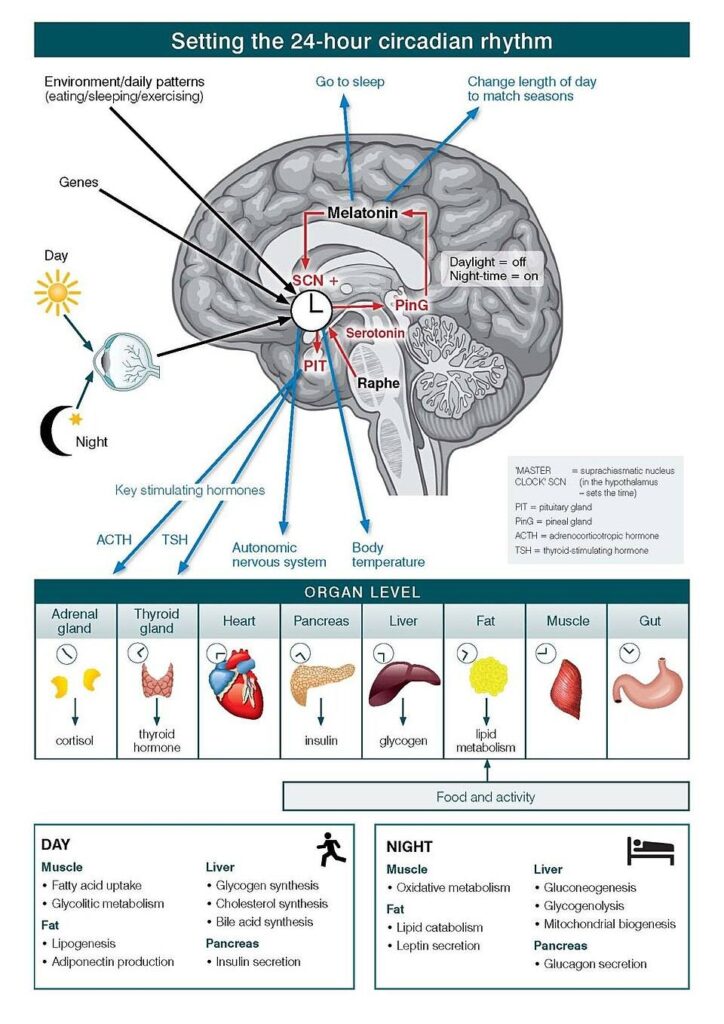
A new study reveals that the retina and the brain’s central circadian clock respond to light through surprisingly different molecular and neural mechanisms, with major implications for understanding how our internal timekeeping system works.
Light is the single most powerful signal for synchronizing the body’s internal circadian clock to the 24-hour day. But a study published June 25 in Cellular and Molecular Life Sciences shows that this process is far more complicated than previously understood. Researchers led by Ouria Dkhissi-Benyahya at the University of Lyon in France found that the retina and the suprachiasmatic nucleus (SCN), the brain’s master circadian pacemaker, process light through distinct molecular pathways and neural circuits.
What they found
The team exposed mice to 530 nanometer monochromatic light, a wavelength that falls in the green portion of the visible spectrum and preferentially activates rods and certain cone photoreceptors. They then analyzed gene expression changes in both the retina and the SCN using RNA sequencing.
Both tissues showed a shared cluster of immediate early genes that were rapidly turned on by light. These genes, driven primarily by rod photoreceptors, represent a conserved “first response” to photic stimulation across the two tissues.
But beyond that shared core, the transcriptional signatures diverged sharply. The retina activated a broad and diverse set of light-responsive genes, while the SCN displayed a much narrower and more selective transcriptional response. This divergence points to fundamentally different ways that each tissue interprets the same light signal.
The most striking finding came when the researchers tested whether these light-evoked transcriptional changes actually shifted the circadian clock. In the SCN, they did not. Despite measurable changes in gene expression, the SCN’s circadian phase remained stable. In the retina, however, the same light stimulus robustly shifted the clock’s timing.
The team then identified the neural circuit responsible. They pinpointed the OFF-cone bipolar cell pathway as both necessary and sufficient for light-induced phase resetting of the retinal circadian clock. These cells are a class of intermediate neurons in the retina that relay signals from cone photoreceptors to retinal ganglion cells, specifically encoding decreases in light intensity and contributing to contrast detection. When the researchers disrupted this circuit, light could no longer shift the retinal clock. When they selectively activated it, the clock shifted even without external light.
Why it matters
These results challenge a longstanding assumption in circadian biology: that light resets the brain’s master clock by the same mechanism it uses to influence peripheral clocks elsewhere in the body. Instead, the study reveals a fundamental split. The SCN appears to resist phase shifts from acute light exposure at the molecular level, perhaps as a stability mechanism. The retinal clock, by contrast, is directly and powerfully entrained by light through a dedicated circuit involving OFF-cone bipolar cells.
This divergence matters for several reasons. First, the retina is itself a circadian clock tissue with its own local timekeeping functions, including daily rhythms in visual sensitivity, photoreceptor turnover, and melatonin synthesis. Understanding how light sets the retinal clock independently of the SCN opens new questions about how these local clocks coordinate with central timekeeping.
Second, the finding that the SCN can experience molecular changes from light without shifting phase suggests that the brain’s master clock has evolved protective mechanisms against transient or noisy light signals. This could help explain why shift workers and frequent travelers experience such profound circadian disruption: the SCN may be slow to shift in response to light, while peripheral clocks in tissues like the retina respond rapidly, potentially creating internal desynchrony.
Third, the identification of the OFF-cone bipolar cell circuit as the conduit for retinal photoentrainment gives researchers a precise cellular target to investigate. This circuit could become a focus for future interventions aimed at managing circadian disruption.
Limits
The study was conducted entirely in mice, and while the mouse circadian system shares key features with the human system, direct translation cannot be assumed. Rodent and primate retinas differ in important respects, including cone density and the distribution of photoreceptor types. Human confirmation will be essential before any clinical applications can be considered. Additionally, the study used a single wavelength of light, and the responses to broad-spectrum white light or to different wavelengths may produce different patterns of entrainment.
Bottom line
The retina and the brain’s master clock do not march in lockstep when responding to light. They share some molecular machinery, but the SCN holds its phase stable even as the retina adjusts its own timing through a specialized circuit. This discovery refines our understanding of how light entrains the circadian system and highlights the retina not merely as a light sensor for the brain but as an independent circadian tissue with its own entrainment mechanisms.
Source
Jandot A, Calligaro H, Dianak-Shoori A, et al. Divergent molecular and circuit mechanisms underlie light entrainment of retinal and suprachiasmatic nucleus circadian clocks. Cell Mol Life Sci. 2025 Jun 25. doi: 10.1007/s00018-026-06298-8. PMID: 42347929.