

The standard Schrödinger’s cat thought experiment imagines a quantum superposition of two familiar states: the cat alive and the cat dead. Both components of the superposition are ordinary, everyday possibilities, just combined in a way that classical physics cannot describe.
A team at Oxford University has now created a fundamentally different kind of cat. Instead of superposing two ordinary states, they built superpositions where each component is itself a highly exotic quantum object, a squeezed, trisqueezed, or even quadsqueezed state of motion. The result is a cat that is strange in a way previous cats were not.
The platform
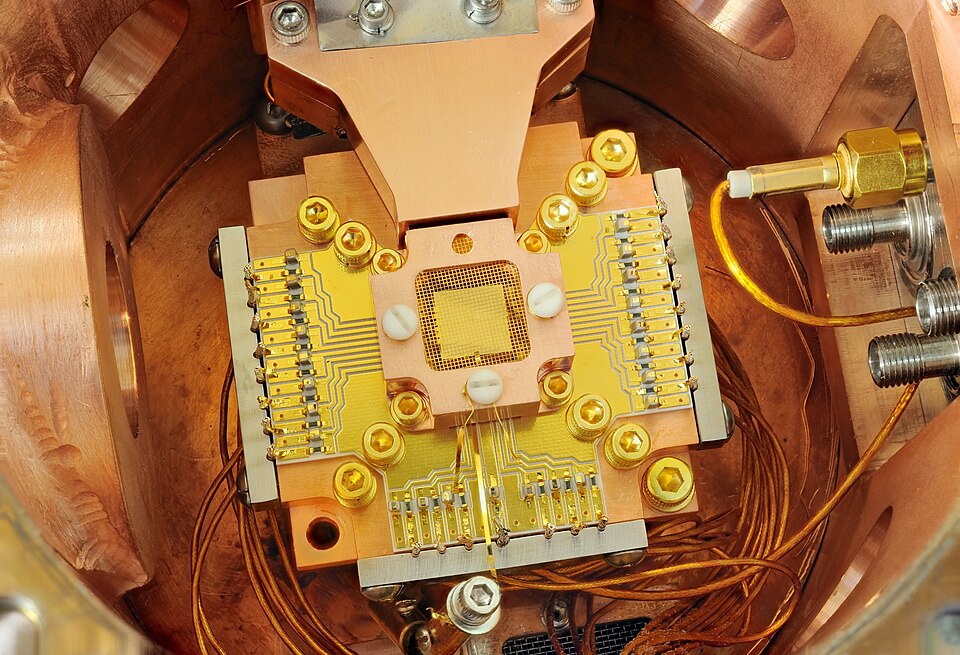
The work, published June 3 in Physical Review X and led by researchers at Oxford’s Clarendon Laboratory, uses a single strontium-88 ion trapped in an electromagnetic Paul trap. The ion’s internal electronic state serves as a qubit, while its vibrational motion along the trap axis acts as a harmonic oscillator, the “box” that holds the cat.
By engineering precise spin-dependent forces with laser pulses, the team could sculpt the ion’s motional state into almost any shape. They generated programmable superpositions of squeezed states (where quantum noise is reduced in one direction at the cost of increased noise in another), trisqueezed states (with threefold rotational symmetry in their quantum phase-space distribution), and quadsqueezed states (fourfold symmetry).
These are not classical wave packets. The Wigner function, a quantum analog of a probability distribution, showed clear regions of negativity, the hallmark of genuine quantum non-classicality. The superposition of two trisqueezed states, for example, produced a Wigner function with sixfold rotational symmetry, a signature impossible for any classical oscillator.
Why this matters
Standard cat states, superpositions of two coherent states, have been created in multiple systems for decades. They are well understood and their decoherence behavior is predictable. The Oxford work opens a new regime: superpositions where each branch is itself a highly nonclassical state with its own squeezing structure, phase-space topology, and decoherence channels.
This matters for quantum information processing. Non-Gaussian states are essential resources for fault-tolerant quantum computing with continuous variables. The GKP (Gottesman-Kitaev-Preskill) qubit, a leading candidate for quantum error correction, is itself a non-Gaussian state, and the Oxford team demonstrated they could generate GKP-like states using the same programmable approach.
The work also reveals how these higher-order quantum states interact with their environment. Non-Gaussian features such as Wigner negativity and higher-order squeezing decay through different channels than standard cat states. Understanding these novel decoherence dynamics is critical for designing quantum memories and processors that use these states.
The broader context
The PRX paper builds on a precursor study published by the same group in Nature Physics on May 5, 2026, which demonstrated the generation of individual squeezed, trisqueezed, and quadsqueezed motional states. The new work takes the crucial next step: combining them into programmable superpositions.
The approach is general. The same trapped-ion platform can generate binomial states, cubic phase states, and the GKP states needed for error correction. First author Sebastian Saner described the method as “a tool to sculpt the quantum superposition into almost any shape.”
The caveats
The superposition sizes remain at the phonon level, a few quanta of vibration, not the macroscopic scale of a real cat. These are among the most fragile quantum states ever created, existing only under highly controlled conditions with active cooling. The demonstration is on a single ion; scaling to multi-ion systems for quantum computing remains future work. And specific fidelity numbers would require reading the full paper text, which was not accessible from secondary sources.
Nevertheless, the work establishes a new family of quantum states, and a programmable method for creating them, that pushes the boundary of what kinds of superpositions are possible in the quantum world.
Source: Saner, S., Bazavan, O., Webb, D.J., Araneda, G., Lucas, D.M., Ballance, C.J., & Srinivas, R. (2026). Generating Arbitrary Superpositions of Nonclassical Quantum Harmonic Oscillator States. Physical Review X, 16, 021049. DOI: 10.1103/PhysRevX.16.021049. arXiv: 2409.03482
Funding: University of Oxford, Clarendon Laboratory. Related work: Nature Physics (2026), DOI: 10.1038/s41567-026-03224-4 (squeezed, trisqueezed and quadsqueezed states via spin-oscillator coupling).