

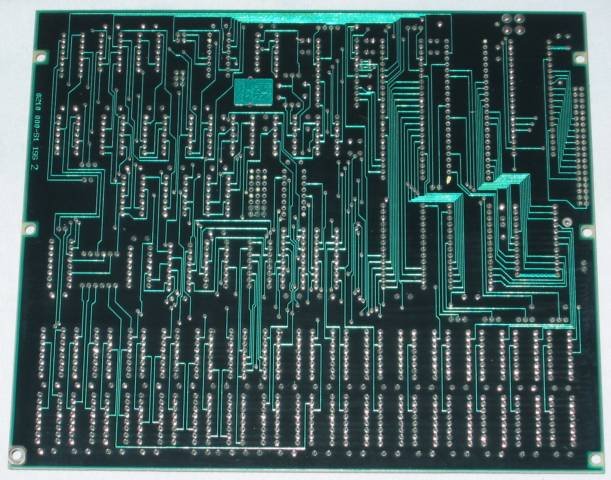
OpenAI and Broadcom have unveiled Jalapeño, the company’s first custom-designed inference processor, a chip built from the ground up for large language model workloads, marking a strategic shift into hardware for the AI company.
“Jalapeño was designed from scratch around its deep understanding of LLM fundamentals, informed by its roadmap of models, kernels, serving systems, and product needs,” OpenAI said in the announcement. Broadcom CEO Hock Tan handed the first wafer to OpenAI CEO Sam Altman and President Greg Brockman.
The chip was developed from design to production in just nine months, accelerated by OpenAI’s own models. Early testing shows that the first-generation accelerator delivers performance per watt “substantially better” than current state-of-the-art hardware, according to the company, though independent benchmarks have not yet been published.
Jalapeño is designed specifically for inference, the process of running pre-trained models in response to user commands, rather than for training frontier models, which OpenAI says will still rely on Nvidia hardware. The chip is the first in a multi-generation compute platform OpenAI and Broadcom are building together, with Celestica handling board, rack, and system integration and Broadcom contributing silicon manufacturing and Tomahawk networking chips.
Engineering samples of Jalapeño are already running machine learning workloads in the lab at production target frequency and power, including workloads based on GPT-5.3-Codex-Spark. OpenAI says the chip is designed with flexibility to work with all LLMs, not just its own.
Large-scale deployment is planned for late 2026 at gigawatt scale with data center partners. Broadcom has reportedly required Microsoft to guarantee it will buy approximately 40 percent of the chips to secure the first phase of production.
The chip represents OpenAI’s stated strategy of controlling the full stack, from chip architecture and kernels through memory systems, networking, scheduling, and product experience, to make its models faster, more reliable, and more affordable. The move mirrors similar strategies by Google (TPU) and Amazon (Trainium), both of which have built custom AI accelerators to reduce dependence on general-purpose Nvidia GPUs for inference tasks.
“This is part of our long-term full-stack infrastructure strategy to make compute more abundant,” OpenAI President Greg Brockman said. “By designing more of the stack ourselves, we can serve more intelligence with greater efficiency.”
Sources: OpenAI unveils its first custom chip, built by Broadcom (TechCrunch, June 24, 2026); OpenAI and Broadcom unveil LLM-optimized inference chip (OpenAI, June 24, 2026)