

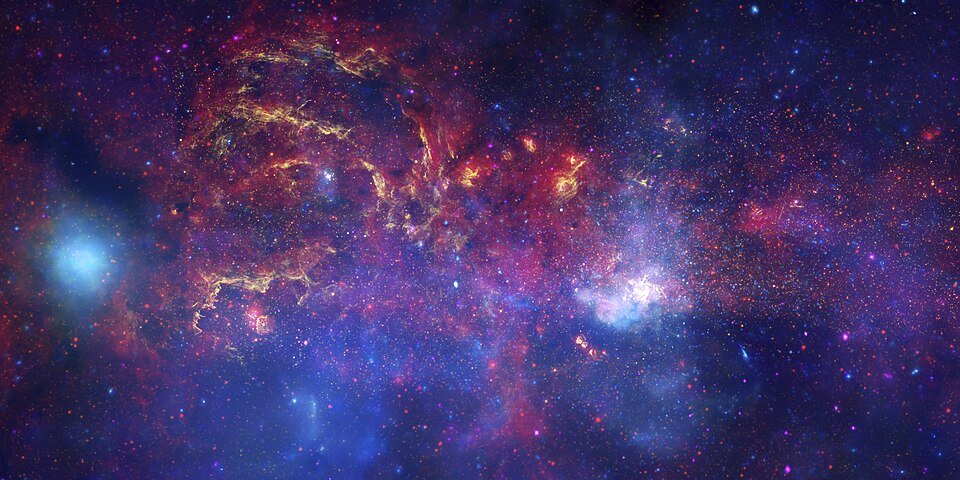
ESA’s dark universe detective has taken a break from mapping distant galaxies to produce the sharpest, largest visible-light image ever made of the heart of our own Milky Way. The result is a stunning mosaic of more than 60 million stars and at least 51 known exoplanet systems, captured in just 26 hours of observing time.
The image, released on June 24, 2026, is a composite of nine pointings from Euclid’s VIS (Visible) camera, each covering an area larger than the full moon. Together, they span roughly 5 square degrees of sky, equivalent to about 25 full moons side by side. The observation targeted the galactic bulge, the densely packed central region of the Milky Way where stars crowd together at far higher densities than in our solar neighborhood.
“Euclid’s sensitivity allows it to resolve individual stars even in the most crowded regions of the galactic center, where other telescopes are blinded by the sheer density of stars,” the ESA release noted.
A Unique Detour from Dark Energy Science
Euclid’s primary mission is to map the distribution of dark matter and dark energy across the universe by observing billions of galaxies out to 10 billion light-years. Launched in July 2023 to the Sun-Earth L2 Lagrange point, the telescope has been conducting its main survey since February 2024.
The Milky Way core observation was the only time Euclid paused its primary cosmology survey. Each Euclid pointing covers 270 times more area than Hubble’s WFC3 camera, and constructing the same mosaic from the Keck Observatory in Hawaii would require approximately 2,000 hours of telescope time.
“In 24 hours, Euclid has already captured the stars involved in all the future microlensing events that the Roman space telescope will detect, but before the stars and planets involved have aligned,” said Natalia Rektsini of the Institut d’Astrophysique de Paris.
Preview for the Roman Space Telescope
The observation was designed specifically as a preview and complement to NASA’s Nancy Grace Roman Telescope, which is scheduled to launch in summer 2026 and begin its Galactic Bulge Time Domain Survey in spring 2027.
Roman will observe a field of about 1.7 square degrees repeatedly over five years at infrared wavelengths, looking for microlensing events where a foreground star’s gravity bends and magnifies the light of a more distant background star. A planet orbiting the foreground star creates a tiny perturbation in the lensed light, revealing planets that other methods cannot detect.
Euclid’s earlier snapshot provides a crucial time-reference baseline: it shows how the stars appeared before any microlensing alignment occurred. By comparing the Euclid baseline with Roman’s later observations, astronomers can measure the masses of lensing objects more precisely, distinguish rogue planets from wide-orbit planets, and identify isolated black holes.
“Adding Euclid’s snapshot to Roman’s future survey will help us map our galaxy better and identify hard-to-find cosmic treasures like isolated black holes and rogue planets more easily,” said Jason Rhodes, U.S. Euclid science lead and Roman project scientist at NASA JPL.
The Known Planetary Systems in the Field
Among the 51 known exoplanet systems visible in the image are two particularly notable ones. OGLE-2005-BLG-390Lb, an icy planet sometimes compared to the fictional world Hoth from Star Wars, was discovered 20 years ago but Euclid may finally allow a precise mass measurement. OGLE-2013-BLG-341Lb is a rare system with two stars and one planet; combining Euclid, Keck, and Hubble data will help separate the stars and confirm the planet’s mass.
Microlensing is the only method that can detect cold exoplanets in wide orbits, the type of planets expected to be most common in the galaxy. Every star in the Milky Way is estimated to host at least one cold planet. In the past 20 years, roughly 300 exoplanets have been discovered via microlensing, all from ground-based telescopes pointed toward the galactic center.
The mosaic also enables studies of brown dwarfs, binary stars, stellar motions, galactic dust, and will help test and improve models of the Milky Way’s structure.