

Published: June 02, 2026, 00:37 UTC
Nine and Counting: Norway Joins the French Nuclear Umbrella as Europe Breaks With the American Guarantee
Nine European countries have now signed up to French nuclear deterrence in under three months. This is not a series of bilateral agreements — it is the systematic construction of a European nuclear architecture independent of the United States, and it is happening in plain sight.
On the morning of May 27, Jonas Gahr Store, the Prime Minister of Norway, walked into the Élysée Palace in Paris and did something that would have been unthinkable five years ago. He signed his country into a French-led nuclear deterrence scheme, becoming the ninth European nation to place itself, in effect, under a nuclear umbrella that has nothing to do with Washington.
Norway shares a 198 km (123 mi) border with Russia in the Arctic. It is a founding member of NATO. For seventy-seven years, its existential security guarantee has come from Article 5 of the North Atlantic Treaty and the American nuclear arsenal that backs it. That guarantee is now being hedged — carefully, explicitly, and with the full knowledge of everyone involved.
“This is the most serious security situation since the Second World War,” Store said in Paris, standing beside Emmanuel Macron. “In the past six months, we have entered into defense agreements with both Germany and the UK, and I am pleased that we have signed a comprehensive defense agreement with France today.”
The agreement is called the Narvik Agreement, a name borrowed from the 1940 Battle of Narvik, when Norwegian and French forces fought together to secure the Allies’ first victory of the Second World War. It was signed by Norway’s Defense Minister Tore O. Sandvik and France’s Armed Forces Minister Catherine Vautrin. The historical reference is deliberate.
But the centerpiece of the agreement is not history. It is nuclear.
Forward Deterrence
In March 2026, Macron stood in front of the nuclear submarine Le Téméraire at the Île Longue naval base in Brittany and announced a fundamental shift in French nuclear doctrine. For decades, France’s nuclear arsenal — some 290 warheads, the fourth-largest in the world — existed to protect France alone. The force de frappe was a national deterrent, untethered from alliance commitments. Macron changed that.
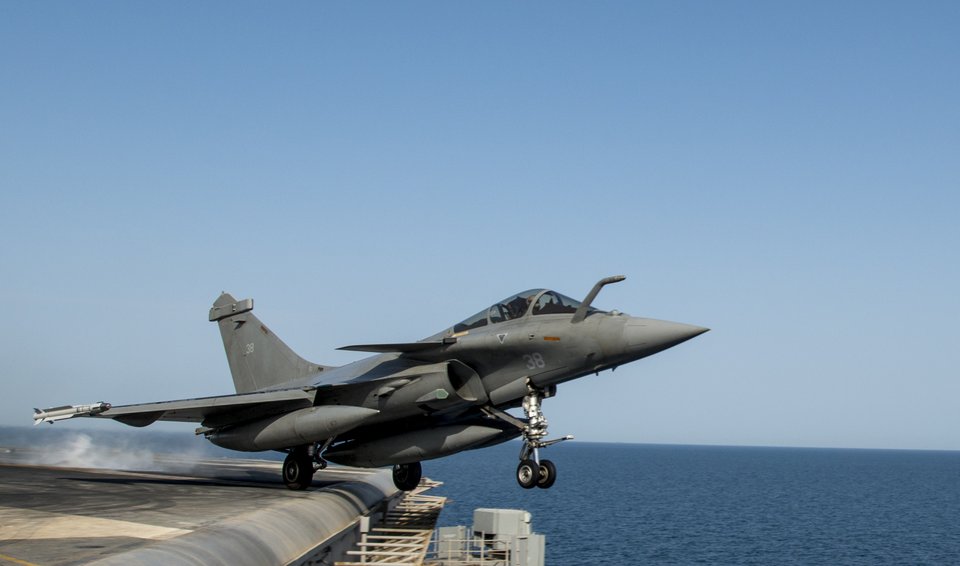
He called the new posture “forward deterrence.” Under the scheme, European partners can temporarily host French strategic air forces — Rafale fighters capable of carrying nuclear weapons — which would “spread out across the European continent” to “complicate the calculations of our adversaries.” In practice, an attack on a partner country could now trigger a French nuclear response.
Norway will not host nuclear weapons in peacetime. Store was explicit on this point. But the commitment is structural: Norway will participate in planning, exercises, and the prepositioning of equipment. French nuclear-capable aircraft can operate from Norwegian territory in a crisis, and French strategic thinking will now include the defense of Norwegian soil.
“Together with some of our closest partners and allies, Norway will be discussing in more detail how France’s nuclear weapons can further enhance European security and deterrence,” Store said. “At this point in history, it is both right and necessary that Europe takes greater responsibility for its own security.”
The Eight Before
Norway is the ninth country to join. The list reads like a map of European anxiety: Belgium, Denmark, Germany, Greece, the Netherlands, Poland, Sweden, and the United Kingdom.
Each came for its own reasons. Poland sees a direct land threat from Russia and wants French Rafales based on its territory. Germany — historically the most cautious about anything that could fracture NATO — has formed a steering group with France and will send officials to observe French nuclear exercises as soon as September. Sweden, a NATO newcomer, joined almost immediately after its accession. The United Kingdom, itself a nuclear power, signed up anyway — a gesture of political solidarity as much as military necessity.
Nine countries in three months. This is not a slow diplomatic process. It is a rush.
The speed tells you what European governments really think about the American nuclear guarantee. They are not abandoning it. No one in Paris, Berlin, or Oslo is saying that NATO is dead. But they are building a parallel structure — a European one — because they no longer trust that the American one will hold.
What It Means
France’s nuclear arsenal is modest by the standards of the superpowers. Russia has roughly 4,300 warheads. The United States has about 3,700. China has 600. France sits at 290, with more than 80 percent of its warheads submarine-launched — a classic second-strike capability designed to survive a first strike and retaliate.
The question is whether 290 warheads, backed by a doctrine that is deliberately “strategically ambiguous” (the French phrase, confirmed by their own ministries), can credibly deter Russia across an arc stretching from the Arctic to the Black Sea.
The ambiguity is by design. Unlike the NATO nuclear-sharing arrangement, where American-owned B61 bombs sit in European vaults and allied aircraft are certified to deliver them, the French model keeps all decision-making in Paris. No European partner will have a finger on the button. No joint custody arrangement exists. The French President decides — alone.
That is both the scheme’s strength and its weakness. It is unambiguous in its sovereignty — France controls its own nuclear destiny, independent of Washington — but ambiguous in its commitment. A potential adversary cannot be certain where France’s red lines are drawn. But neither can France’s allies.
Store was careful to frame the move as complementary to NATO, not a replacement for it. “Our deterrence will continue to be provided by NATO,” he said. “The US has made it clear that its nuclear guarantee to Europe remains unchanged. French capabilities are part of NATO’s overall deterrence capability.”
This is the official language. The reality is blunter.
Europe is building a backup plan because it no longer fully trusts the primary one. The American political system has become unreliable in ways that European defense planners cannot ignore. The signals from Washington — the withdrawal from Afghanistan without consulting allies, the transactional approach to NATO burden-sharing, the erosion of democratic norms, the rhetoric that treats European security as a favor rather than a shared interest — have accumulated into a settled judgment: the United States may or may not be there when it counts.
The Shape of Things to Come
The Narvik Agreement covers more than nuclear deterrence. It includes provisions on hybrid warfare, maritime security, space cooperation, cybersecurity, support to Ukraine, and defense industrial cooperation. The nuclear dimension is the headline, but the architecture being built is comprehensive.
France and Norway will hold joint exercises. Equipment will be prepositioned. Planning structures will be integrated. Over time, these concrete mechanisms will produce something real: a European defense capability that exists independently of the NATO command structure, even as it remains nominally inside it.
Germany’s role is especially telling. Chancellor Merz’s foreign policy and security advisor attended the Paris meeting alongside the Norwegians. The next steering group meeting is scheduled before the summer break. German officials will visit French nuclear weapons facilities. The Bundeswehr may eventually play supporting roles in the French nuclear mission — not touching the weapons themselves, but providing the infrastructure, intelligence, and conventional forces that make the nuclear deterrent operational.
This is incremental, but it is deliberate. Each step is small. Each step is deniable as a challenge to NATO. But the direction is unmistakable.
The Closing
Norway’s decision completes a turn that began in March. Nine countries are now part of a European nuclear framework that did not exist ninety days ago. The speed is the story.
No one is saying that the transatlantic alliance is dead. But it is being supplemented — quietly, methodically, and with the full awareness of everyone in Washington. The American guarantee is still the foundation of European security. But foundations can crack. And European governments, looking at the political convulsions across the Atlantic, have decided to pour their own.
The Narvik Agreement is called an agreement. It is really an insurance policy — taken out against the possibility that the guarantor of last resort might one day decide it has better things to do.