

Published: June 02, 2026, 00:15 UTC
In the darkness between galaxies, astronomers have long searched for a living fossil — a galaxy so chemically primitive that its stars must be among the first that ever formed. Using the James Webb Space Telescope, an international team led by Kimihiko Nakajima at Kanazawa University has found one.
The galaxy, designated LAP1-B, existed just 800 million years after the Big Bang (redshift 6.625). Its gas-phase oxygen abundance is 4.2 ± 1.8 thousandths of a percent of the solar value — roughly one 240th of the Sun’s oxygen content. That is the lowest metallicity ever measured in a star-forming galaxy, smashing the previous record by a wide margin.
The findings were published on May 13, 2026 in Nature (DOI: 10.1038/s41586-026-10374-1).
How to find a primordial needle
LAP1-B is extraordinarily faint — so dim that no stellar continuum light is detectable at all, which itself constrains its stellar mass to less than 3,300 solar masses. For comparison, the Milky Way weighs in at roughly 100 billion solar masses. This is a galaxy barely assembled, caught in its infancy.
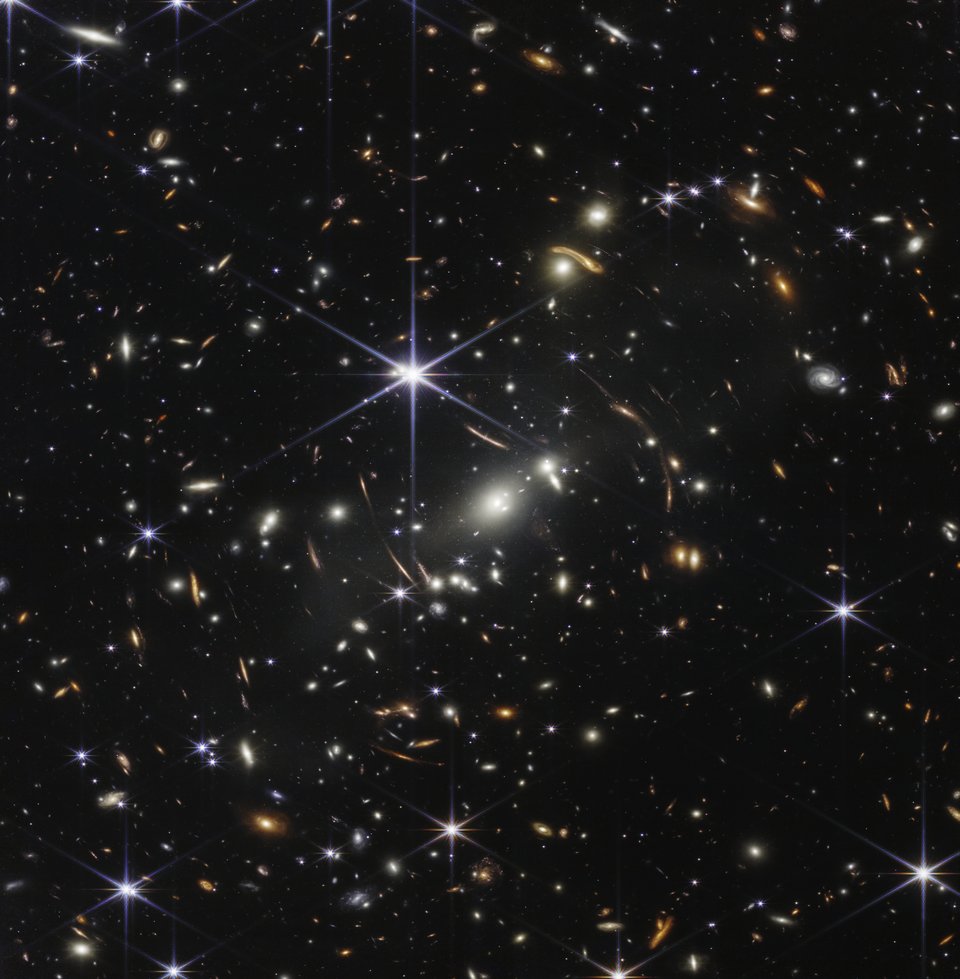
To detect it at all, the team relied on a cosmic magnifying glass: the foreground galaxy cluster MACS J0416, whose immense gravitational field bent and amplified LAP1-B’s light by a factor of approximately 100×. JWST’s NIRSpec instrument (Near-Infrared Spectrograph) then stared at the magnified image for over 30 continuous hours on November 4–5, 2024, capturing the faint emission lines of hydrogen, helium, carbon, and oxygen.
The fingerprint of Population III
What makes LAP1-B more than a record-breaking metallicity score is the detailed chemical fingerprint it reveals. The ratio of carbon to oxygen is elevated relative to what astronomers see in more evolved galaxies — and that ratio matches the theoretical predictions for nucleosynthesis in Population III stars, the hypothetical first generation of stars thought to have formed from pristine Big Bang material.
In the standard model, Population III stars were enormous — hundreds of solar masses — and their explosions ejected different elements in a distinctive pattern. Carbon, synthesized in the outer layers, was expelled into space, while oxygen, produced deeper in the stellar core, was more likely to be trapped inside the collapsing remnants (black holes). The elevated C/O ratio in LAP1-B is exactly what this scenario predicts.
Three independent theoretical signatures converge in LAP1-B, making it the first galaxy to simultaneously satisfy all predictions for a Population III-enriched system:
- Record-low oxygen abundance — the gas is near-primordial
- Elevated carbon-to-oxygen ratio — matching first-star nucleosynthesis
- Exceptionally hard ionizing radiation field — inconsistent with chemically enriched stars or active galactic nuclei
Alexander Ji of the University of Chicago, writing a Nature News & Views article accompanying the paper, described LAP1-B as a “relic of the first stars” — a window into an epoch that has never been directly observed.
What this means
LAP1-B appears to be a direct high-redshift counterpart of the ultra-faint dwarf (UFD) galaxies found orbiting the Milky Way today. Those nearby dwarfs are known to contain some of the most metal-poor stars ever discovered, and they are widely believed to be surviving fossils from the early universe. LAP1-B may be the same type of object, caught in the process of forming — a UFD in the making, 13 billion years before its present-day descendants.
The galaxy’s dynamic mass (inferred from the broadening of its emission lines due to internal motion) far exceeds the mass of its stars and gas, indicating a dark-matter-dominated halo — consistent with theoretical expectations for the smallest galaxies at that epoch.
The team included researchers from the National Astronomical Observatory of Japan, the University of Tokyo, INAF Bologna (Italy), Caltech/IPAC, and the Kavli Institute for Cosmology in Cambridge (UK). A companion theoretical paper by Visbal, Hazlett, and Bryan (2025, Astrophysical Journal Letters) independently concluded that LAP1-B satisfies all three Population III diagnostic criteria.
The sober bottom line
LAP1-B is the best candidate yet for a galaxy whose gas carries the direct chemical imprint of the universe’s first stars. The convergence of three independent lines of evidence — record-low metallicity, elevated C/O, and hard ionizing radiation — makes a compelling case that this is indeed the long-sought “Pop III fossil.”
But the Population III interpretation, while consistent with all available data, is not yet a certainty. Alternative enrichment scenarios — for example, a single pair-instability supernova from a very massive early star — could produce similar chemical patterns. More observations, particularly of additional elements like iron and magnesium, will help distinguish between models.
What is not in doubt is that LAP1-B is the most chemically primitive star-forming galaxy ever observed. It is a galaxy so young and so tiny that it may still contain the chemical memory of its very first stars. In astronomy, that is as close to a time machine as we have.
Image: Webb’s First Deep Field — NASA, ESA, CSA, and STScI (Public Domain)
Sources:
- Nakajima K, Ouchi M, Harikane Y et al. “An ultra-faint, chemically primitive galaxy forming in the reionization era.” Nature 653, 363–367 (2026). DOI: 10.1038/s41586-026-10374-1
- Ji A. “Relics of the first stars spotted in a distant, ultra-faint galaxy.” Nature News & Views, 653, 357–358 (2026). DOI: 10.1038/d41586-026-01151-1
- arXiv: 2506.11846