

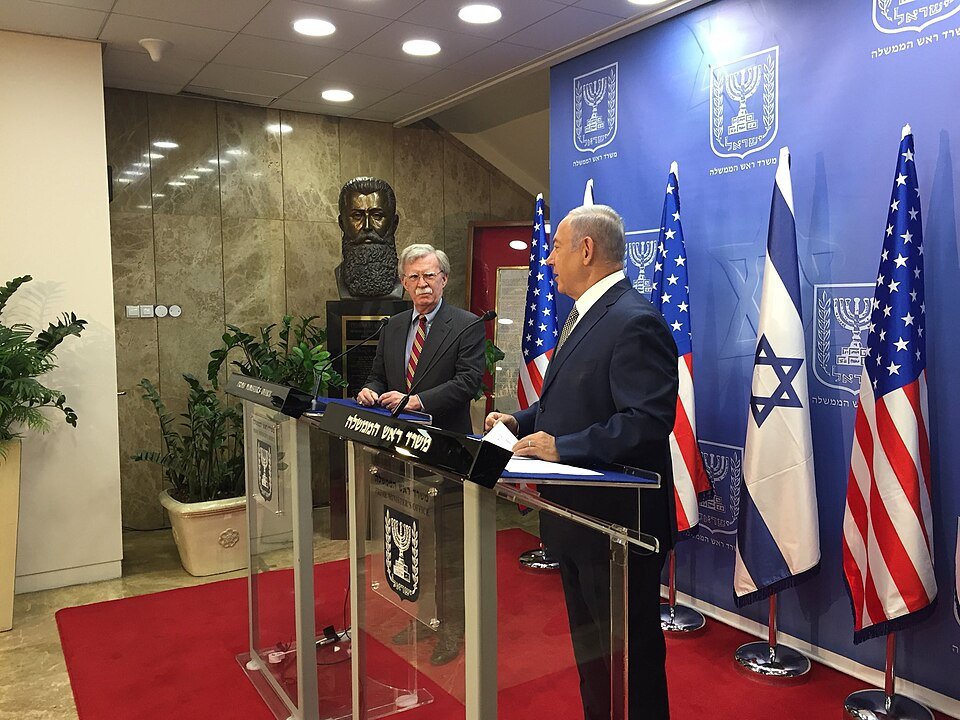
Netanyahu declares victory over Iran and rules out Israeli withdrawal from Lebanon, directly challenging Trump’s peace push at the G7 summit.
JERUSALEM. Israeli Prime Minister Benjamin Netanyahu declared a “historic victory” over Iran on Monday and ruled out any immediate withdrawal of Israeli forces from Lebanon, Gaza, or Syria, directly undercutting the U.S.-Iran ceasefire deal that President Donald Trump announced at the G7 summit in Evian, France.
In a televised press conference from Jerusalem, Netanyahu said Israel’s military would remain in the three theaters indefinitely, framing the continued occupation as a non-negotiable security requirement. “We established deep security zones around the State of Israel,” Netanyahu said. “We did this in Gaza, in Lebanon, and in Syria. Our forces will stay there for as long as necessary.”
The prime minister’s remarks came just hours after Trump confirmed that the United States and Iran had signed a memorandum of understanding to end military hostilities, with a formal signing ceremony scheduled for Friday, June 19, in Geneva. The deal is expected to reopen the Strait of Hormuz in exchange for a lifting of the U.S. naval blockade on Iran and establish a framework for further negotiations on Tehran’s nuclear program.
Netanyahu was blunt about the implications for Israel. He confirmed that he had made his position clear directly to Trump: Israel does not consider itself bound by any withdrawal provisions in the U.S.-Iran agreement. “Iran wanted us to withdraw as part of the negotiations. Those efforts failed,” Netanyahu said. “The struggle has not ended.”
Defense Minister Israel Katz reinforced the message in a separate statement, declaring that the Israel Defense Forces would remain in security zones in Lebanon, Syria, and Gaza “without any time limit” to protect Israeli borders and communities. Katz explicitly rejected any suggestion that the U.S.-Iran deal compelled Israel to change its military posture. “Prime Minister Netanyahu and I are leading a clear policy that determines that the IDF will remain in the security zones in Lebanon, Syria, and Gaza, without any time limit, to protect the residents,” Katz said.
The coordinated statements represent a direct challenge to the Trump administration, which had sought to present the Iran deal as the foundation for a broader regional peace. The agreement had reportedly included provisions for a permanent cessation of military operations in southern Lebanon, where Israeli forces have been engaged in ground operations against Hezbollah since the escalation of the broader conflict.
Israel’s categorical refusal to withdraw puts Trump in an awkward position at the G7, where European allies have pressed for a comprehensive settlement that includes Israeli compliance with the U.S.-brokered ceasefire terms. French President Emmanuel Macron, hosting the summit in Evian, has been among the most vocal advocates for linking the Iran deal to a broader de-escalation across the Middle East.
The White House has so far offered no public response to Netanyahu’s defiance. But the timing is particularly sensitive. The Geneva signing ceremony is three days away, and the credibility of the agreement hinges on whether all parties, including Israel, honor its terms. If Israel remains in southern Lebanon, the security buffer that Iran sought as a condition for the deal effectively collapses, raising questions about whether Tehran will follow through on its commitments.
Analysts noted that Netanyahu is operating from a position of domestic political weakness even as he projects strength on the security front. His coalition government remains fragile, and critics on both the right and left have accused him of mismanaging the war with Iran. The declaration of victory, several commentators observed, appeared designed as much for a domestic audience as for the international community.
“This is Netanyahu trying to have it both ways,” said Efraim Halevy, a former head of Mossad, in an interview with Israeli media. “He wants credit for defeating Iran while simultaneously refusing to accept the diplomatic consequences of that victory. You cannot claim you have won and then refuse to allow the peace to take hold.”
On the ground in southern Lebanon, there was no sign of an imminent Israeli withdrawal. Troops remained entrenched in positions captured during the campaign, and military engineers continued constructing fortified outposts along the security zone. Lebanese officials have condemned the Israeli refusal to withdraw as a violation of U.S.-brokered understandings and have threatened to refer the matter to the United Nations Security Council.
The broader implications for the U.S.-Iran deal remain unclear. The agreement, which Trump characterized as “all signed” during a joint appearance with Macron, was marketed as a comprehensive end to the Middle East war that began with Iran’s missile strikes and escalated into a full-scale conflict involving Israel, the United States, and Iranian-backed proxies across the region.
If Israel maintains its forces in Lebanon, Gaza, and Syria indefinitely, the architecture of the deal could face a serious stress test. Iran’s leadership has already signaled that it expects full implementation of the terms, including an end to military operations against its allies and proxies. A permanent Israeli military presence in southern Lebanon would be difficult to reconcile with that demand.
Netanyahu showed no signs of backing down. In his closing remarks, he struck a defiant tone that seemed aimed at reassuring a war-weary Israeli public. “We have achieved historic victories. We have established deep security zones. We will not abandon them,” he said. “The struggle has not ended. Neither has our resolve.”