

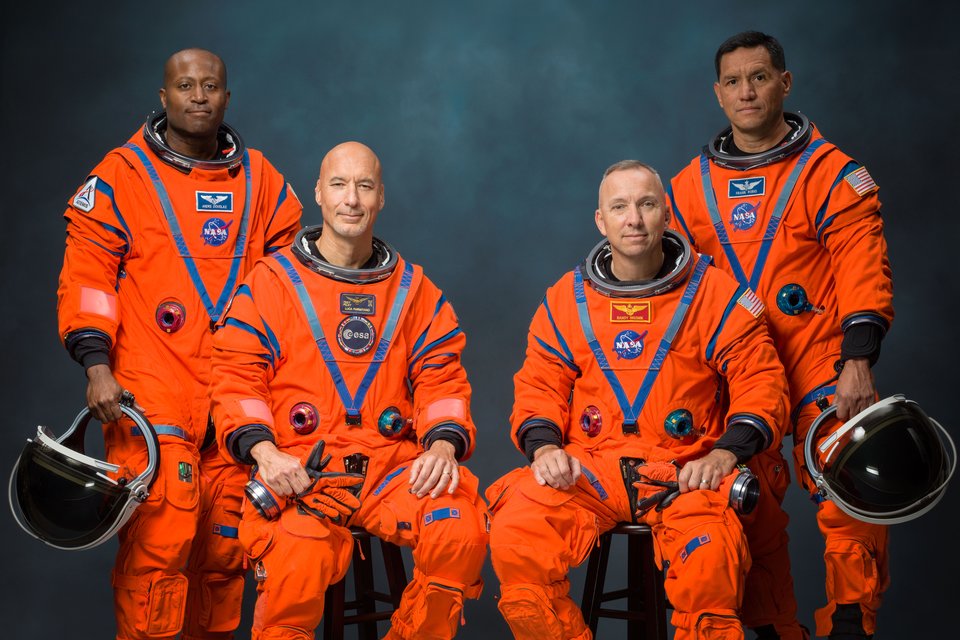
NASA names Artemis III crew in aggressive push toward Moon landing
NASA has named the four astronauts who will fly the Artemis III mission, a high-stakes orbital test flight designed to bridge the gap between last April’s lunar flyby and the first crewed Moon landing since Apollo. The crew announcement came Tuesday at Johnson Space Center in Houston, accompanied by an unusually aggressive timeline from the agency’s new administrator.
Commander Randy Bresnik, a NASA astronaut and Marine Corps veteran with 149 days in space across two flights, will lead the mission. European Space Agency astronaut Luca Parmitano serves as pilot, with NASA astronauts Andre Douglas and Frank Rubio as mission specialists. All four are military veterans, and the crew is all-male. They were introduced inside a packed Teague Auditorium as hundreds of family members and NASA employees cheered.
“The Artemis III test flight will serve as a bridge between the recent Artemis II lunar flyby mission, which was successfully completed in April, and a planned lunar landing with the Artemis IV mission,” Bresnik said. “We are the unifying link.”
A flight test, not a landing
Despite its name, Artemis III will not touch the Moon. The mission is a low-Earth orbit validation flight expected to last approximately two weeks, launching no earlier than summer 2027. Its purpose is to “buy down risk” before NASA commits to a lunar landing, a decision made by Administrator Jared Isaacman after he took the helm.
Isaacman, the billionaire who commanded the private Inspiration4 mission and was appointed NASA administrator in April 2025, has pushed the agency to move faster. “Americans should expect excellence from their space agency,” he said after the crew announcement, stating he is “extremely” confident in a 2027 launch for Artemis III and a 2028 Moon landing.
The mission plan involves three separate launches and two dockings in low-Earth orbit. First, a Blue Origin lander test vehicle will launch and loiter in orbit for up to 90 days. Then the four astronauts will launch inside the Orion spacecraft atop NASA’s Space Launch System rocket. They will rendezvous with the Blue Moon lander, dock, and test its life support systems.
Around that time, a third launch will send a SpaceX Starship into orbit. The crew will undock from Blue Moon, rendezvous with Starship, and dock. But the Starship vehicle will not include life support equipment, meaning the crew will not enter it. After all maneuvers, they will splash down in the Pacific Ocean.
If successful, the mission will demonstrate Orion’s ability to perform proximity operations with both lunar landers and validate the complex choreography needed for Artemis IV, when a crew will dock with a lander, descend to the Moon, and return to Earth.
Timeline questions
Industry experts have greeted the 2027 target with skepticism. NASA has historically moved at a slow pace on large programs, and the timeline was further clouded by the May 28 explosion of Blue Origin’s New Glenn rocket at its only launch pad at Cape Canaveral Space Force Station in Florida. The blast caused catastrophic damage to the launch complex, potentially delaying Blue Origin’s contributions to the mission.
Isaacman acknowledged the challenges but did not back away from the schedule. “Artemis III will be an extraordinary demonstration of what is possible,” he said at the crew event.
The bigger picture
The Artemis program represents NASA’s most ambitious human spaceflight effort since Apollo, but it has faced repeated delays, cost overruns, and technical hurdles. The Space Launch System rocket, originally intended to fly in 2017, did not launch crewed until Artemis I in 2022. Artemis II, a lunar flyby with crew, finally launched in April 2026.
Artemis III, even as an orbital test, carries enormous symbolic weight. If the 2028 lunar landing timeline holds, it would mark the first time humans walked on the Moon since Gene Cernan left the surface in December 1972. That gap would span 56 years.
The question is whether NASA can sustain the political will and the industrial momentum to get there, especially with a new administration in the White House and a Congress that has shown growing impatience with cost-plus contracts and schedule slips. Isaacman’s appointment signals a willingness to disrupt the agency’s culture, but the New Glenn explosion is a reminder that the hardware does not care about ambition.
Sources: Ars Technica (June 10, 2026); NPR (June 10, 2026); NBC News (June 10, 2026)