

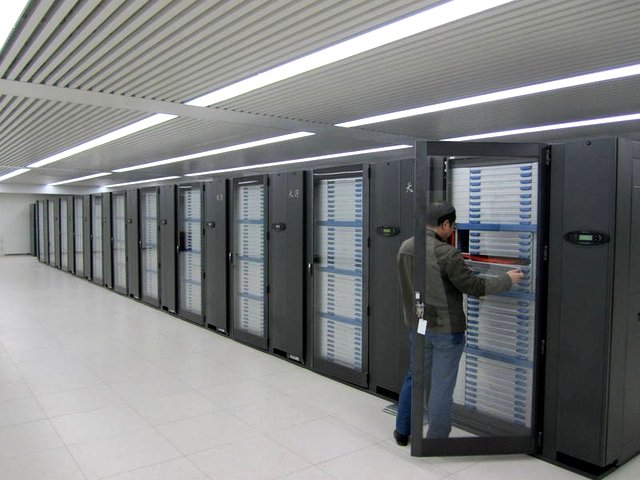
The world’s fastest supercomputer is now Chinese, and it contains not a single US-made chip. LineShine, installed at the National Supercomputing Center in Shenzhen, reached number one on the June 2026 TOP500 list with a sustained performance of 2.198 exaflops (double-precision) on the High Performance Linpack (HPL) benchmark. That is roughly 22% faster than El Capitan, the previous record-holder at Lawrence Livermore National Laboratory.
The system marks China’s return to the top of the global supercomputing ranking for the first time since 2017, when Sunway TaihuLight held the position at just 93 petaflops, LineShine is approximately 24 times faster. But the machine’s significance goes far beyond a benchmark score. LineShine is a direct challenge to US export controls designed to slow China’s advanced computing capabilities, and its architecture represents a fundamentally different approach to exascale computing.
All CPU, no GPU
Most of today’s top supercomputers, including El Capitan, Frontier, and the upcoming US systems, rely on GPU accelerators to deliver their peak performance. GPUs from Nvidia or AMD handle the massive parallelism of scientific calculations while CPUs orchestrate the workflow. LineShine does not use GPUs at all.
Instead, LineShine’s 92 cabinets house 40,960 custom LX2 processors, each containing 304 Armv9 cores running at 1.55 GHz, for a total of 13,789,440 cores, or roughly 14 million. The LX2 is widely attributed to Huawei, the Chinese telecommunications giant that was placed on the US Entity List in 2019. By licensing the Armv9 instruction set (from Arm Ltd, a UK company not subject to the same restrictions as US chipmakers) and integrating Scalable Vector Extension (SVE) and Scalable Matrix Extension (SME) units directly into each core, the LX2 can run both traditional scientific computing (FP64) and AI workloads (BF16, FP16, INT8) on the same processor, no data transfer between separate CPU and GPU memory spaces.
The approach eliminates what computer architects call the “memory wall”, the bottleneck of shuttling data between CPUs and GPUs over slow interconnects. Every one of LineShine’s 14 million cores can access the same coherent memory space. For workloads that mix physics simulation with machine learning, this unified architecture can be transformative.
The system also achieved number one on the HPCG (High Performance Conjugate Gradient) benchmark, a more realistic measure of memory-bound scientific computing, with 22.00 petaflops, and placed fourth on the mixed-precision HPL-MxP benchmark at 7.92 exaflops. The modest 3.6x speedup from HPL to HPL-MxP confirms this is fundamentally an all-CPU design; systems with dedicated GPU accelerators can show 10-20x speedups on mixed-precision tasks.
A political statement in silicon
China stopped submitting systems to the TOP500 ranking around 2023, amid concerns that disclosing performance data could inform US sanctions strategy. During that time, several Chinese exascale systems, Sunway OceanLight (estimated ~1.22 exaflops) and Tianhe-3 (~1.57 exaflops), appeared in academic publications but were never officially benchmarked. LineShine’s submission is therefore more than a technical announcement: it is a strategic signal that China can compete at the very top of global high-performance computing without US components.
“Made from Chinese parts, in part because the United States has restricted the export of its GPUs to China, citing national security concerns,” Nature reported, summarizing a central tension. US export controls from 2022 and 2023 specifically targeted advanced GPUs, Nvidia’s A100, H100, and B200, AMD’s MI250 and MI300, that are critical for both scientific computing and AI training. LineShine’s all-CPU design sidesteps these restrictions entirely.
Whether the LX2 processor was fabricated on a 7 nm or 5 nm process, and which foundry produced it, remains undisclosed, precisely the information that chip intelligence analysts most want to know.
Weather, materials, and the fusion of physics with AI
Haohuan Fu of Tsinghua University, quoted in Nature, described the system’s potential: “Systems like LineShine make it possible to study complex natural and engineered systems at larger scale, higher resolution and greater speed. More importantly, they allow us to bring together physical knowledge and data-driven AI in a much more integrated way.”
A preprint on arXiv (2605.24896) demonstrates the architecture in action, running CAPES, an exascale hybrid numerical-AI ensemble forecasting system for East Asian summer rainfall. CAPES combined 174 physics-based numerical weather model members with 1,600 AI-generated members, completing 10 years of hindcasts (2016 to 2025) in just 14.6 hours. This kind of tightly coupled numerical-AI workload, impossible to run efficiently on traditional CPU-GPU hybrid systems, is exactly what LineShine’s unified architecture was designed for.
Other demonstrated applications include atomic-scale simulations of magnetic materials, and the system’s designers note potential in climate modeling, computational fluid dynamics, and drug discovery.
The caveats
LineShine’s 42.2 MW power consumption is the highest among the top 10 systems, giving it an energy efficiency of 52.07 gigaflops per watt, compared with El Capitan’s 60.9 gigaflops per watt. This places it at number 50 on the Green500 list, behind both El Capitan and Frontier. The system is powerful but not efficient by top-tier standards.
For pure AI training workloads, large GPU clusters at Google, Meta, and OpenAI likely remain faster. As Jack Dongarra, a leading supercomputing expert at the University of Tennessee, told Nature: “Topping the ranking doesn’t necessarily make LineShine the fastest computer in the world for every scientific or AI application.” The TOP500 measures double-precision Linpack, not real-world AI training throughput, and LineShine’s fourth-place finish on mixed-precision benchmarks suggests its AI performance, while impressive, lags behind the largest GPU-based systems.
What comes next
LineShine represents a proof of concept for CPU-only exascale computing, an architectural bet that looks increasingly prescient as GPU supply to China is constrained. Whether this approach scales to the next generation zettascale systems remains an open question. The LX2’s 304-core processor pushes hard against the limits of silicon scaling, and further gains will require either more efficient packaging, advanced lithography that China may not yet have access to, or a hybrid architecture that reintroduces accelerators, this time, manufactured domestically.
For now, the number one spot on the June 2026 TOP500 belongs to Shenzhen. The machine is named LineShine. It has no American parts.
Sources:
[Nature News] “China’s LineShine just topped the global supercomputer ranking: what you need to know.” Nature, June 2026. https://www.nature.com/articles/d41586-026-02047-w
[TOP500] June 2026 list. https://www.top500.org
[arXiv] “CAPES: Exascale Hybrid Numerical-AI Ensemble Forecasting.” arXiv:2605.24896, 2026.