

Japan’s H3 Rocket Returns to Flight Successfully After Failure, Deploys 6 Satellites
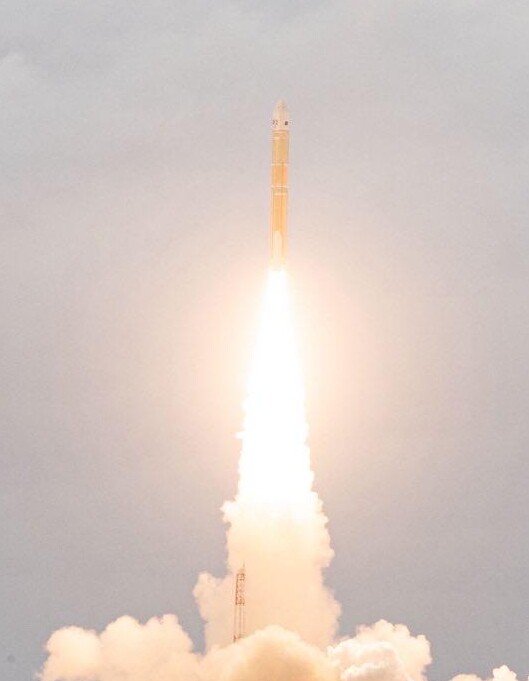
Japan’s H3 rocket returned to flight successfully on June 12, carrying six satellites to orbit and restoring the nation’s independent access to space after a six-month grounding caused by a December 2025 failure. The H3-30S variant, making its debut flight, lifted off from the Yoshinobu Launch Complex at Tanegashima Space Center at 09:53:59 JST (June 11, 00:54 GMT).
All six payloads were deployed to their target orbits, clearing the path for flagship missions later this year including the Martian Moons eXploration (MMX) sample-return mission and a second HTV-X cargo flight to the International Space Station.
### The Failure It Bounced Back From
The December 2025 failure (H3 Flight 8) resulted in the loss of Michibiki 5 (QZS-5), a navigation satellite for Japan’s Quasi-Zenith Satellite System. JAXA’s investigation traced the root cause to the payload fairing separation event at approximately T+225 seconds, where unusually large acceleration spikes were recorded over a 0.2-second window.
The carbon-fiber reinforced plastic (CFRP) payload adapter, bonded to an aluminum honeycomb interior, had suffered manufacturing deviations: drying and curing temperatures exceeded design tolerances, weakening the adhesive bond. When the fairing opened, the delaminated adapter could not support the satellite’s weight. Michibiki 5 shifted, severing the second-stage engine’s liquid hydrogen propellant lines and causing premature engine cutoff. The satellite was lost.
This was H3’s second failure in eight flights, following the maiden flight failure in March 2023 when the second-stage engine failed to ignite. The situation was compounded by the retirement of the H-IIA rocket in June 2025 after 25 years of service, leaving Japan without any operational heavy-lift launch capability for the grounding period.
### The Return to Flight Mission
For Flight 6, JAXA implemented an interim fix by improving the bonding of the satellite mount, while a redesigned payload support structure (PSS) is under development for future missions.
The rocket flew in the H3-30S configuration for the first time: three LE-9 liquid-fueled expander-bleed engines on the first stage and no solid rocket boosters. The configuration produces 4,416 kilonewtons (993,000 pounds-force) of thrust and is designed as a lower-cost option for smaller payloads.
The six satellites deployed were:
- PETREL and STARS-X: separated approximately 16 minutes after launch
- BRO-22 (Unseenlabs): a maritime vessel tracking satellite and the first non-Japanese-built payload to fly on H3, arranged by Japanese integrator Space BD
- VERTECS, HORN-L, and HORN-R: separated sequentially in the following minutes
Additional payloads identified by Kyodo News include Umitsubame (Institute of Science Tokyo), carrying a high-performance camera for ocean observation, and Shiraito (Shizuoka University), testing space debris removal technology. These may correspond to some of the six named payloads.
The second stage was subsequently controlled for reentry to limit space debris generation.
### Significance for Japan’s Space Program
The successful flight restores Japan’s independent access to space after the longest H3 grounding period to date. With the H-IIA retired and H3 grounded, Japan had zero operational heavy-lift capability for six months.
The mission also completes the H3 configuration lineup. The family now comprises four variants: H3-20S (two LE-9 engines, no boosters), H3-22S (two engines, two SRBs), H3-24S (two engines, four SRBs) and the newly proven H3-30S (three engines, no boosters). The booster-free 30S configuration is lighter and less expensive, improving H3’s competitiveness in the commercial launch market.
JAXA H3 Project Manager Makoto Arita said he felt “relieved” at the post-launch press conference. Mitsubishi Heavy Industries H3 Project Manager Osamu Kitayama said completing the H3 lineup provides an opportunity for accelerating rocket business growth, with the future challenge being “how to reduce costs without lowering quality.”
Chief Cabinet Secretary Minoru Kihara called the H3 “an essential core rocket” for ensuring Japan’s independent access to space and strengthening international competitiveness.
### Upcoming Missions
The return to flight unblocks two critical JAXA missions: the HTV-X cargo spacecraft (second flight to the ISS later this year) and the Martian Moons eXploration (MMX) sample-return mission. MMX arrived at Tanegashima on March 31 and has a launch window in October-December 2026. It will launch on an H3-24S configuration and aims to collect at least 10 grams (0.35 ounces) of material from the surface of Phobos, the larger of Mars’s two moons, and return it to Earth.
JAXA aims to eventually launch the H3 six to eight times per year.