

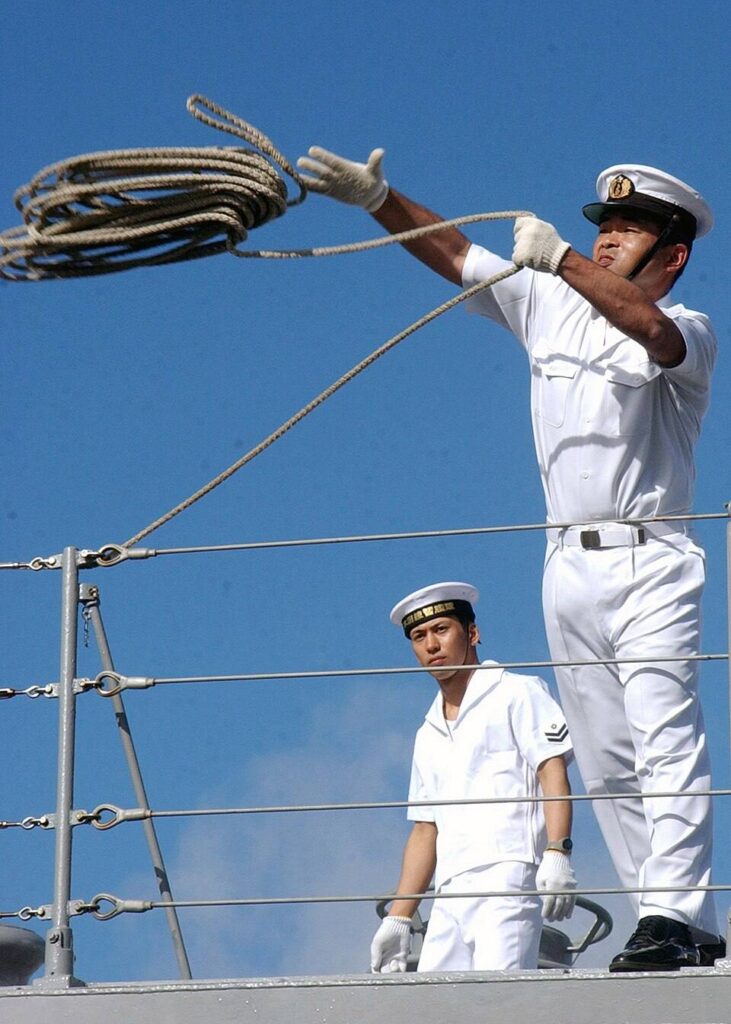
For the first time in centuries, the United States may rely on foreign shipyards to build its warships. The US Navy is considering an unprecedented step: procuring major naval vessels from allied shipbuilders in Japan and South Korea.
The Navy’s May 2026 Shipbuilding Plan requests legislative changes in the FY27 National Defense Authorization Act to authorize building up to two auxiliary ships overseas and fabricating combatant modules abroad. If approved, this would mark the first large-scale outsourcing of American warship construction to foreign nations since the age of sail.
America’s shipbuilding crisis is the driver. The US Navy today operates at its lowest hull count since before World War I. US shipyards simply cannot meet the fleet size the Pentagon says it needs. The reasons are well documented: aging facilities, a shuttered industrial base, and a critical shortage of skilled labor. Navy Secretary Phelan admitted in November 2025 that the service “can’t find workers to build warships.”
Meanwhile, China’s naval expansion proceeds at a pace the United States cannot match. Beijing’s shipyards produce vessels faster and cheaper than their American counterparts. The gap is not just about money. It is about physical capacity and workforce depth. The US industrial base that churned out hundreds of Liberty Ships and a thousand warships during World War II no longer exists. Decades of consolidation, offshoring of commercial shipbuilding, and underinvestment in defense manufacturing have hollowed out a capability that once defined American seapower.
Into this gap steps Japan. Japan’s shipbuilding industry is among the most advanced in the world. Japanese yards regularly build complex, high-tech vessels for commercial and defense applications. Mitsubishi Heavy Industries, Japan Marine United, and other major players have the facilities, the engineering talent, and the quality control systems that US yards currently lack. Japan also brings something the US cannot manufacture quickly: a disciplined, technically skilled workforce backed by a government committed to defense industrial cooperation.
The model under discussion takes two forms. Licensed manufacturing would see Japanese shipyards print established US designs under contract, building to American specifications. Co-development would go further, sharing research and development costs and co-designing next-generation platforms. The latter generates far more enthusiasm in Tokyo. Japanese officials have signaled that genuine partnership on R&D is more strategically and politically attractive than simply serving as a contract manufacturer.
But the barriers are substantial.
On the American side, Congress presents the first obstacle. Members from shipbuilding districts oppose offshoring defense manufacturing as a matter of political survival. Labor unions representing shipyard workers view overseas construction as an existential threat. The major defense primes that currently build Navy vessels have every incentive to lobby against any arrangement that shifts work overseas. The legislative language requested by the Navy is deliberately narrow, limiting foreign construction to auxiliary ships and modular components rather than full combatants. This is a foot in the door, not a wholesale transfer.
On the Japanese side, questions of security, technology transfer, and constitutional interpretation remain unresolved. Warships carry sensitive combat systems and stealth technology. Sharing those with a foreign partner requires a level of trust and security assurance that existing agreements may not fully cover. Japan’s pacifist constitution, while increasingly interpreted flexibly, still imposes political constraints on the direct export of weapons systems. Export control reform has progressed under recent administrations, but a major naval co-production program would test those frameworks in new ways.
The proposal does not exist in a vacuum. This week, the United Kingdom and Japan announced an 18 billion pound partnership covering offshore wind, artificial intelligence, nuclear energy, and defense industrial integration. The deal signals deepening strategic alignment between Tokyo and key Western capitals. Britain is already collaborating with Japan on next-generation fighter development through the Global Combat Air Program. Adding naval shipbuilding to the portfolio of shared defense industrial activity is a logical next step.
What this episode ultimately reveals is uncomfortable for Washington. The world’s largest navy, the force that has guaranteed freedom of navigation across the world’s oceans for three generations, can no longer build its own ships at the required scale. Turning to an ally for help is pragmatic. It is also a confession. The American industrial base, once the envy of the world, has eroded to the point where the nation must outsource the most tangible expression of its military power.
Japan is willing. Its shipyards are ready. Its government sees strategic advantage in binding its defense industrial base more tightly to the United States. But the political path on both sides of the Pacific is fraught. Congress, unions, defense primes, export control regimes, and security classification systems all stand in the way. The Navy’s May 2026 proposal is the opening bid in what will be a long negotiation, not a done deal.
If it succeeds, the alliance between Tokyo and Washington will enter a new phase, one built not just on basing agreements and joint exercises, but on shared industrial capacity and co-produced steel. If it fails, the US Navy will face a future of declining hull counts and an industrial base it cannot revive alone.