

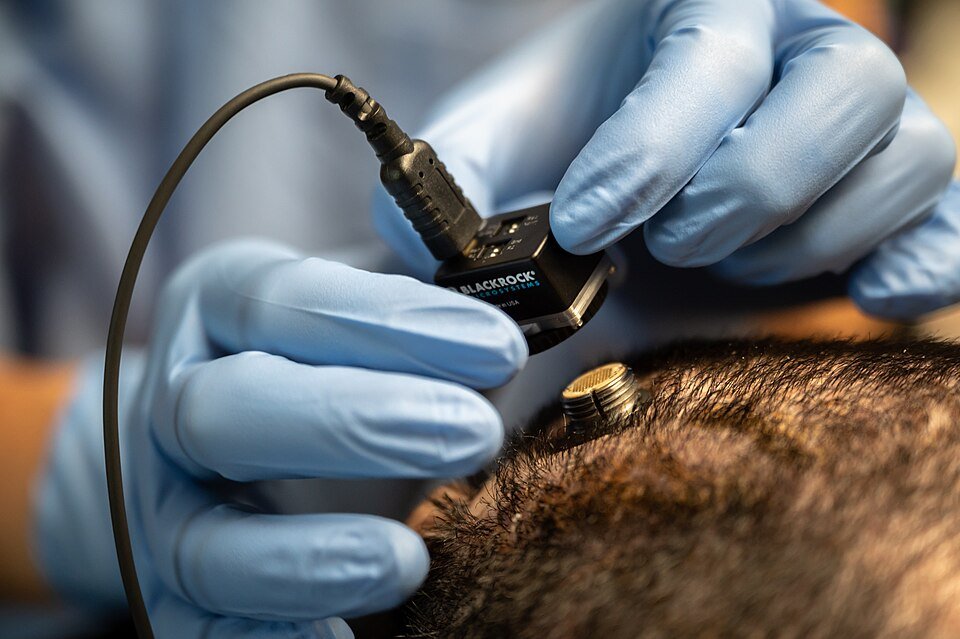
In July 2023, a 45-year-old environmental activist named Casey Harrell underwent a five-hour surgery at UC Davis Health. Four microelectrode arrays, each carrying 64 channels, were implanted into the speech motor cortex of his left precentral gyrus. Two titanium pedestals were secured to his skull. A USB cable would connect them to a computer every day, for as long as the device worked.
Nearly three years later, in June 2026, Harrell has used the implant to communicate more than 183,000 sentences, approximately two million words, across over 3,800 hours of independent home use. His speech decoding accuracy remains at 99%, and his average speaking rate is 56 words per minute. He has used the system on 364 of 397 days. Dr Sergey Stavisky, co-director of the UC Davis Neuroprosthetics Lab, described him as “the first power user of a speech BCI.”
The results, published in Nature Medicine on June 15, 2026, represent a milestone that the field of brain-computer interfaces has been working toward for decades: a speech neuroprosthesis that works reliably, at home, for years, without a research team in the room.
How It Works
Harrell’s implant is part of the BrainGate2 clinical trial (NCT00912041), a multi-institutional research platform that has been testing intracortical BCIs since 2009. The electrodes are Utah Arrays manufactured by Blackrock Neurotech, penetrating silicon microelectrode arrays, each a 10×10 grid of 64 needles that record neural activity directly from the cortical surface.
The system uses four arrays (256 electrodes total) targeting speech motor cortex. The decoding pipeline has three stages:
1. An RNN maps neural firing patterns to 39 phonemes of American English
2. A transformer-based language model assembles phonemes into words, correcting errors using English structure
3. A text-to-speech system reads the decoded text aloud using a synthesised version of Harrell’s own voice, trained on pre-ALS audio recordings
The system also supports cursor control through a separate neural decoder, enabling web browsing, email, and computer-based work. Harrell uses the device for his environmental activism, earning income and maintaining his professional identity.
The most remarkable technical detail is that the system achieved 99.6% accuracy on a 50-word vocabulary after just 30 minutes of training on the first day. When expanded to a 125,000-word vocabulary, initial accuracy was 97.5%, which subsequently improved to 99%.
The Power User
What makes Harrell a “power user”, a term Stavisky chose carefully, is the combination of factors that distinguish his case from earlier BCI demonstrations:
Independence. Harrell’s care partner can don and doff the device (connect and disconnect the USB cable) without any researcher present. Previous speech BCIs required a technician or research team to calibrate and operate the system each time.
Volume. 183,000 sentences, two million words, over 3,800 hours. Prior BCIs were demonstrated in laboratory sessions of hours or days. Harrell has been using his system as a daily communication tool for years. He reads to his seven-year-old daughter. He works. He has conversations. The system has become part of his life, not an experiment.
Durability. The Utah Array platform has a reputation for signal degradation over time as scar tissue forms around the penetrating electrodes. In Harrell’s case, no significant signal loss has been observed after nearly three years. The surgical team, led by Dr David Brandman, Associate Professor of Neurological Surgery at UC Davis, attributes this to precise placement in speech motor cortex and the stability of the array-tissue interface.
Feature evolution. Harrell has requested and received software updates over the life of the implant. The system now has a privacy mode that auto-deletes decoded text and a profanity filter that activates when he is talking to his daughter. Features were added remotely, without additional surgery.
The Field Context
Harrell’s BCI is one of several competing approaches to speech restoration, but it occupies a distinct position. Neuralink’s VOICE trial has demonstrated speech decoding in an ALS patient (Kenneth Shock) using its fully implantable, wireless N1 device. Synchron’s Stentrode requires only an endovascular procedure via the jugular vein (no craniotomy) but offers lower signal resolution. Paradromics’ Connexus BCI received FDA approval for first-in-human trials in November 2025 but has not yet demonstrated speech in patients.
The BrainGate/Utah Array approach is the most invasive, a full craniotomy, with electrodes penetrating the cortical surface, but it has produced the highest sustained accuracy (99%) over the longest period (nearly 3 years) with the greatest real-world independence. The trade-off between invasiveness and performance remains the central engineering tension in the field.
What It Means
For Harrell, the implant is not a research curiosity. It is the difference between being understood and being unable to communicate. ALS progressively destroys the motor neurons that control speech. At the time of implantation, Harrell could only be understood by his closest caregivers. Through the BCI, he can speak to anyone, about anything, at a rate approaching natural conversational speech (typically 120,150 words per minute for spoken English, but far faster than the 5,10 words per minute achievable with eye-tracking or other assistive technologies).
For the field, Harrell’s case provides the strongest evidence yet that intracortical speech BCIs can cross the threshold from laboratory demonstration to practical, daily-use assistive technology. The key question is no longer “can it work?” but “how many people can it reach?”, a question that turns on surgical risk, device cost, and the regulatory pathway for a technology that currently exists only in academic research trials.
Sources:
1. Hamzelou, J. “This man with ALS is ‘the first power user’ of a brain implant that lets him speak.” MIT Technology Review, June 15, 2026. https://www.technologyreview.com/2026/06/15/1138953/man-als-first-power-user-brain-implant-speak-bci/
2. Card, N. et al. “Long-term independent home use of an intracortical speech neuroprosthesis.” Nature Medicine, June 15, 2026.
3. BrainGate2 Clinical Trial. NCT00912041. https://clinicaltrials.gov/study/NCT00912041
4. Brandman, D. & Stavisky, S. UC Davis Health. Press briefing, June 15, 2026.