

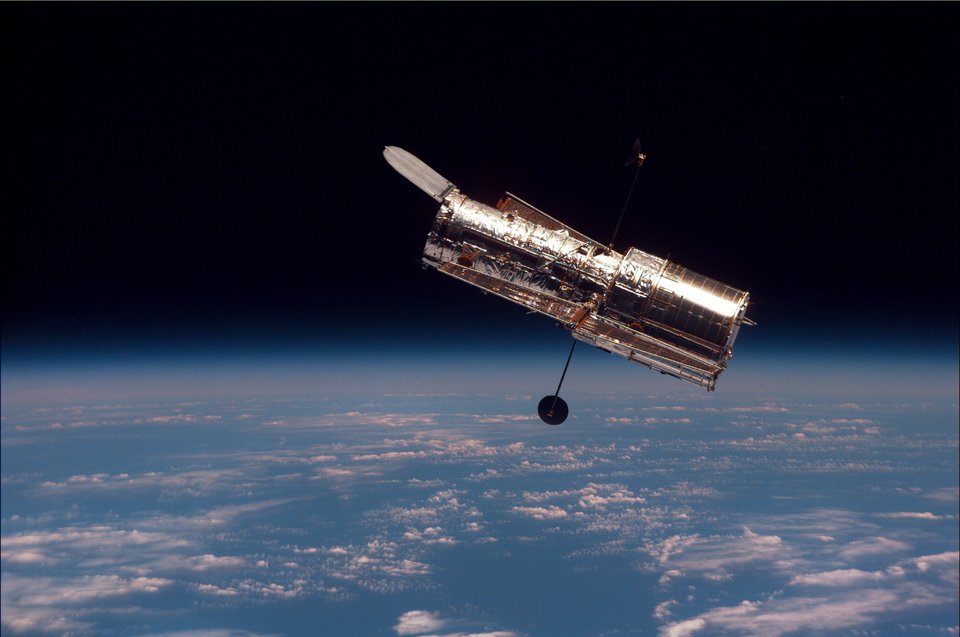
NASA Open to Hubble Reboost — But Only If Operations Costs Come Down First
Published: June 7, 2026, 14:26 UTC
NASA is open to extending the Hubble Space Telescope’s life with a commercially provided reboost, but the agency needs to first figure out how to reduce the observatory’s $98.8 million annual operating cost before signing off on any mission.
The comments came from Shawn Domagal-Goldman, director of NASA’s astrophysics division, during a June 1 meeting of the Astronomy and Astrophysics Advisory Committee. He framed the opportunity around an imminent proof-of-concept mission: the Link servicing spacecraft, built by Arizona-based Katalyst Space, which just arrived at the Wallops Flight Facility in Virginia for integration with a Northrop Grumman Pegasus XL rocket. Launch is expected later this month.
Link is Katalyst’s first mission. NASA awarded the company a $30 million contract last September to develop and launch the servicing vehicle, which will rendezvous with and reboost the Neil Gehrels Swift Observatory — a gamma-ray telescope whose low Earth orbit is decaying due to atmospheric drag. NASA has openly called it a high-risk effort.
“This has always been a long-odds effort. Any time you try to go from the boardroom to the launch pad in a year, you’re taking on a lot of risk, and we are here,” Domagal-Goldman said.
The payoff, however, extends well beyond Swift. If Link works, it would demonstrate that commercial orbital servicing is viable at far lower costs than NASA anticipated — and could serve as a template for reboosting Hubble.
“These reboost things are now not just available to us as an agency, but the costs are lower than I think I anticipated,” Domagal-Goldman said. “That does make that return on investment more enticing.”
The 2033 Countdown
Hubble’s orbit is steadily decaying. At an American Astronomical Society conference in January, Jennifer Lotz, director of the Space Telescope Science Institute, presented models showing a median reentry date of 2033 — just seven years from now. Without intervention, the telescope that revolutionized astronomy will burn up in Earth’s atmosphere.
Previous reboost proposals have come and gone. In 2022, Jared Isaacman’s Polaris program and SpaceX proposed using a Crew Dragon to boost Hubble. More recently, Astroscale and Momentus teamed up to submit a joint commercial proposal in response to NASA’s December 2024 Request for Information. None have advanced beyond the study phase.
The new variable is the Swift reboost mission, which gives NASA a real data point on commercial servicing costs — and a political signal to the market that the agency is a serious buyer for such services.
“Also, we think it’s a good way to signal demand to the commercial community that we are here to do things like this when they do make sense from that ROI standpoint,” Domagal-Goldman said.
The Operations Cost Hurdle
Here is the catch. Even if the reboost itself becomes affordable, Hubble costs $98.8 million per year to operate — second only to the James Webb Space Telescope in NASA’s astrophysics portfolio. That money goes to ground operations, instrument teams, data processing, and the aging spacecraft’s uniquely complex maintenance demands.
“It was built in a different era, and it’s more costly to maintain and to get the best science out of it,” Domagal-Goldman said.
NASA’s Science Mission Directorate is under mounting pressure to reduce spending on extended missions to free up funding for new planetary and astrophysics programs. Domagal-Goldman said the agency would need to find a way to cut Hubble’s operating costs before a reboost would make financial sense.
“We are open to a reboost of Hubble,” he said. “So we have to first figure out how we’re going to bring down the operations costs.”
He did not specify how large a reduction NASA is seeking.
A Bridge to HWO
If NASA can solve both problems — a commercially affordable reboost and lower ground operations costs — Hubble could keep working for many more years after its orbit is raised. Domagal-Goldman suggested the extended telescope could serve as a bridge to the Habitable Worlds Observatory (HWO), NASA’s next large optical and ultraviolet space telescope, targeted for launch in the 2040s.
For now, all eyes are on Wallops. If the small Katalyst spacecraft can pull off its high-risk reboost of Swift later this month, it could open a new chapter in NASA’s approach to managing its aging orbital fleet — and maybe save the most famous telescope in history.