

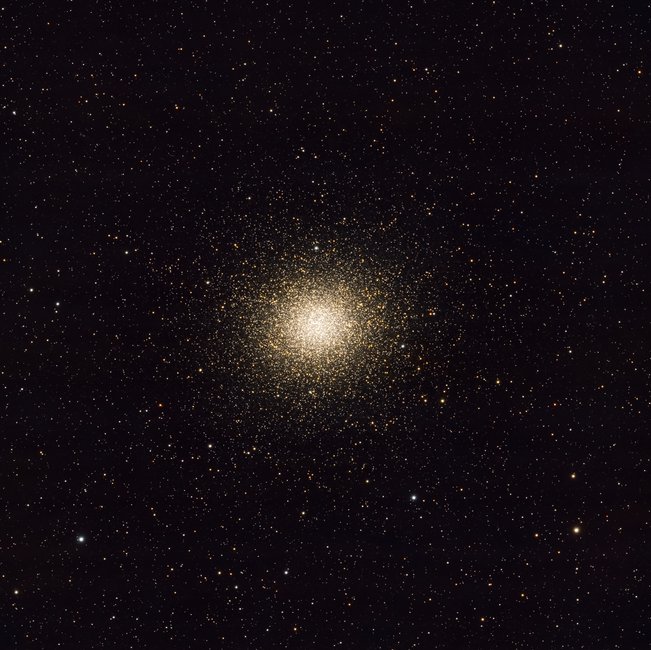
NASA’s Hubble Spots a Star-Spangled Cosmic Scene for July 4
NASA’s Hubble Space Telescope has marked America’s 250th anniversary with an appropriately patriotic image: a star-spangled view of the globular cluster Messier 3, a brilliant swarm of more than 500,000 stars in the constellation Canes Venatici.
Released on July 3, 2026, the image shows the globular cluster in red, white and blue hues, the result of standard Hubble image processing that assigns colors to represent different stellar temperatures. Blue stars are the hottest, while red stars are relatively cool.
Messier 3, also known as NGC 5272, is located roughly 34,000 light-years from Earth. It was first spotted by the French astronomer Charles Messier on May 3, 1764, the very first object he personally discovered for his famous catalog, though he initially mistook it for a nebula. Fellow French astronomers Pierre Mechain and Antoine Darquier independently noted it the same year, and William Herschel resolved its individual stars in 1784, confirming its true nature as a star cluster.
A cluster of scientific significance
The image is part of a Hubble Treasury program designed to survey roughly half of the Milky Way’s globular clusters, building a detailed chronology of our galaxy’s formation. The program uses Hubble’s Advanced Camera for Surveys and Wide Field Camera 3 to capture these ancient stellar city-states in unprecedented detail.
Messier 3 is particularly notable for containing more than 240 RR Lyrae variable stars, the most of any globular cluster in the Milky Way. These old, pulsating stars serve as standard candles for measuring cosmic distances, making the cluster an important calibration point for astronomers.
The cluster also hosts roughly 70 known blue straggler candidates, stars that appear unusually young and bright for their environment. Blue stragglers are thought to be rejuvenated by pulling mass from companion stars or by merging with them, and M3 was the first cluster where this class of star was ever identified.
A tale of two populations
The cluster is roughly 11.4 billion years old, placing its formation early in the universe’s history. Yet within it, astronomers have identified two distinct populations of stars, suggesting that Messier 3 may itself be the result of an ancient merger between two globular clusters, both originally members of a dwarf galaxy that was later swallowed by the Milky Way.
This makes M3 more than just a pretty picture. It is a fossil of galactic assembly, a relic from a time when the Milky Way was still growing by consuming its smaller neighbors. Studying its stellar populations in detail helps astronomers understand how galaxies like our own were built up over cosmic time.
Hubble’s Treasury program continues this work, with Messier 3 serving as one of the benchmark clusters in the survey. M3 is visible with binoculars under dark skies and has been observed across the electromagnetic spectrum, from X-rays through radio. The new Hubble image showcases the cluster in visible and near-infrared light, peeling back the layers of stellar ages and compositions that tell the story of its complex history.
Source: 1ban.news