

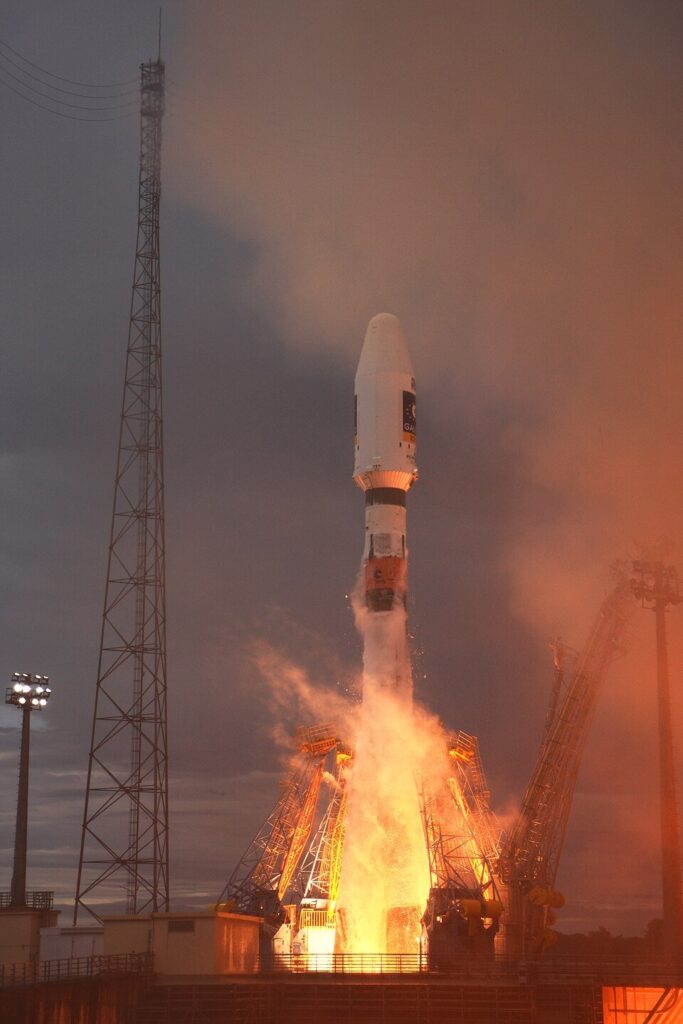
Galileo satellites learn to talk to each other as ESA tests intersatellite links
The European Space Agency has successfully tested intersatellite communication links for Europe’s Galileo navigation constellation, a milestone that will allow the next generation of satellites to talk directly to one another in orbit.
The capability is being developed for Galileo Second Generation (G2), the next iteration of Europe’s satellite navigation system. Each G2 satellite will carry two intersatellite link terminals, each equipped with a pointing mechanism that reorients its antenna every 40 seconds to aim at different satellites in the constellation.
“Millions of movements” over the lifetime of the satellite are required from the mechanism, which was developed by Thales Alenia Space. The units must maintain precise alignment while operating in the harsh thermal and radiation environment of medium Earth orbit.
Why intersatellite links matter
Current Galileo satellites rely on ground stations to monitor and control the constellation. Intersatellite links allow satellites to communicate directly with each other, reducing dependence on ground infrastructure and enabling the constellation to operate more autonomously.
The capability also improves resilience. If a ground station goes offline or is disrupted, satellite-to-satellite links ensure the constellation can continue functioning and even self-correct without waiting for instructions from the ground. This is increasingly important as navigation systems face threats from jamming and cyberattacks.
For users, the links will enable more accurate positioning by allowing satellites to share timing data and orbital information among themselves, providing corrections in real time without round trips to ground stations.
The G2 program
Galileo Second Generation represents a major step up from the current constellation. Twelve G2 satellites are being built in two families of six, one by Thales Alenia Space in Italy and the other by Airbus Defence and Space in Germany. The satellites feature fully digital reconfigurable payloads, electric propulsion, and enhanced atomic clocks offering improved timing stability.
The first pair of G2 satellites is scheduled to launch on an Ariane 6 rocket. The European Union Agency for the Space Programme (EUSPA) signed launch contracts with Arianespace earlier this year, with the second pair also booked on an Ariane 6.
Europe’s current Galileo constellation consists of 34 satellites in orbit (four In-Orbit Validation and 30 Full Operational Capability satellites), making it the world’s most precise civilian satellite navigation system. The G2 satellites are designed to ensure that lead continues through the 2030s and beyond.
The intersatellite link test campaign was conducted at ESA’s ESTEC Test Centre in the Netherlands, where the hardware was subjected to simulated space conditions. The successful tests clear the way for integration into flight-ready satellites.
Sources: ESA, June 12, 2026; Thales Alenia Space; EUSPA.