

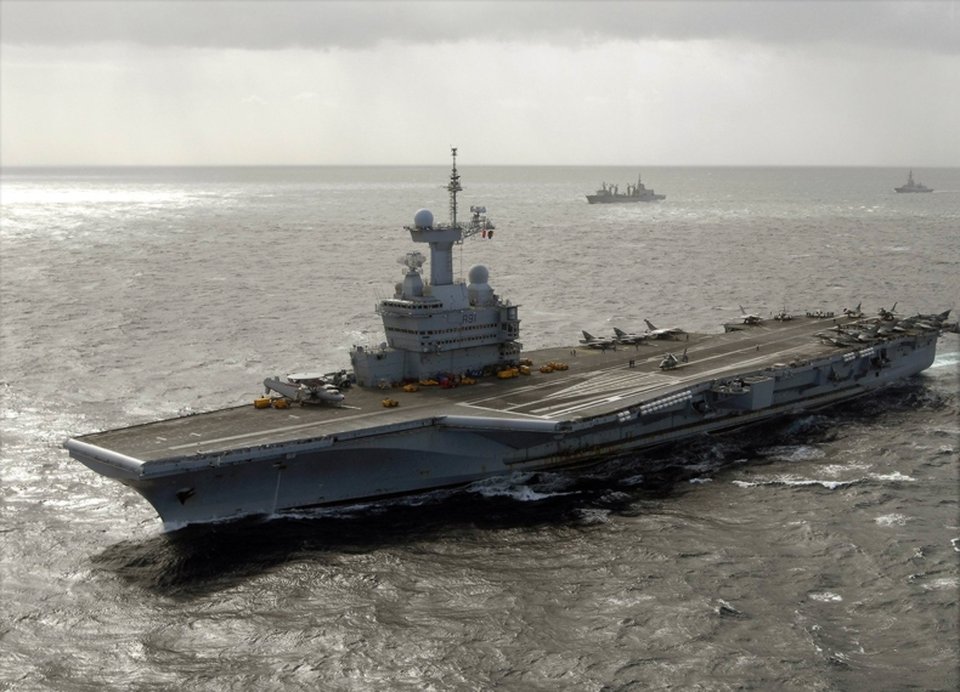
Macron offers France’s nuclear-powered carrier to patrol the reopened Strait of Hormuz, positioning Europe at the center of post-crisis maritime security.
French President Emmanuel Macron announced at the G7 summit that France stands ready to deploy the aircraft carrier Charles-de-Gaulle to the Strait of Hormuz, signaling a major European commitment to securing the critical waterway after the landmark US-Iran ceasefire brought a halt to months of escalating hostilities. In an interview with TF1, Macron said the carrier could be mobilized “in two to three days” to lead a European-led naval patrol mission in the strait, which has been at the center of a regional crisis that threatened global oil supplies.
“This is about showing that Europe can take responsibility for its own security and for the stability of regions that directly affect our interests,” Macron said. “France is prepared to act, and to act quickly.”
The Charles-de-Gaulle, France’s flagship and the only nuclear-powered aircraft carrier outside the US Navy, is currently moving south of the Suez Canal into the Red Sea, positioning itself for a potential Hormuz deployment. It would serve as the centerpiece of a broader European naval mission backed by France, the United Kingdom, Germany, and Italy, all of which have jointly endorsed the creation of a defensive maritime force to monitor and secure the strait.
The offer marks a significant escalation in Europe’s willingness to project military power beyond the continent and comes as a direct test of the transatlantic alliance under the Trump administration. Macron framed the deployment as a burden-sharing initiative that would complement, not replace, US security guarantees in the Middle East.
Burden-sharing in practice
For years, European leaders have debated the concept of strategic autonomy the idea that the EU should be capable of defending its own interests without relying entirely on Washington. Macron, the concept’s most vocal champion, now has the opportunity to translate rhetoric into reality.
Deploying the Charles-de-Gaulle to the Strait of Hormuz would be the most tangible expression yet of Europe’s capacity to lead a high-stakes military operation independent of direct US command. The carrier group, which typically includes a complement of Rafale fighter jets, frigates, a nuclear attack submarine, and support vessels, is capable of sustained independent operations and would provide significant air defense and surveillance coverage across the strait’s narrow shipping lanes.
“Europe has talked for years about taking more responsibility for its own defense. This is the moment to prove it,” said a senior French diplomatic official who spoke on condition of anonymity. “The United States cannot be expected to patrol every troubled waterway in the world indefinitely. Europe must do its part.”
The joint backing from London, Berlin, and Rome gives the mission a multilateral character that Macron was careful to emphasize. Rather than a purely French operation, the naval mission would be presented as a European coalition with shared command structures, though France would provide the most capable asset.
The Strait of Hormuz, a 21-mile-wide chokepoint at the mouth of the Persian Gulf, handles roughly 20 percent of the world’s oil shipments. Its closure during the recent US-Iran confrontation sent energy prices soaring and triggered emergency meetings of the International Energy Agency. The ceasefire agreement brokered by Oman and backed by the UN Security Council includes provisions for the strait’s reopening under multinational security guarantees.
A test for Trump’s commitment
Macron’s announcement also places the Trump administration in a position it has long demanded from allies: credible burden-sharing. Washington has repeatedly criticized European NATO members for insufficient defense spending and has pressed allies to take more responsibility for regional security.
Now that Europe has stepped forward, the question is whether the United States will support the initiative with intelligence, logistics, and command coordination or whether it will treat the deployment as an opportunity to reduce its own footprint in the region.
“There is a risk that Washington sees this as a chance to pull back entirely, leaving Europe to manage a volatile situation alone,” said Camille Grand, a former NATO assistant secretary general now at the European Council on Foreign Relations. “But the more likely outcome is that the US provides backstopping while Europe takes the lead on the water. That is exactly the kind of arrangement burden-sharing advocates have been calling for.”
The Pentagon has not issued an official response to Macron’s offer, but US naval forces remain present in the Persian Gulf and the Arabian Sea. Coordination between the Charles-de-Gaulle group and the US Fifth Fleet, based in Bahrain, would be a natural operational arrangement, though the terms of that coordination have yet to be negotiated.
Stakes for global shipping
For global markets, the prospect of a European naval presence in the strait is a welcome signal of stability. Shipping insurance rates for vessels transiting the Persian Gulf spiked during the crisis, and some major lines diverted cargo around the Cape of Good Hope, adding weeks to transit times and billions in costs.
A sustained European naval patrol would allow insurers to reassess risk levels, potentially bringing premiums down and restoring normal shipping traffic through the strait. The Charles-de-Gaulle’s air wing would provide surveillance coverage far beyond the horizon, detecting small boats, drones, and mines that pose asymmetric threats to commercial vessels.
“Having a carrier group on station changes the risk calculus entirely,” said retired French Navy Vice Admiral Arnaud de Tarlé. “It is one thing to have a few frigates running escort missions. It is another to have a nuclear carrier with combat aircraft ready to respond within minutes. That is a different order of deterrence entirely.”
Macron said the deployment would remain defensive in nature, focused on freedom of navigation and the protection of commercial shipping rather than any offensive posture against Iran. The mission would operate under a UN-endorsed mandate, with rules of engagement designed to de-escalate rather than provoke.
“France does not seek confrontation with anyone,” Macron said. “We seek stability, security, and the free flow of commerce that the entire world depends on. If we can contribute to that by putting our navy to work, we will do so.”
The offer remains conditional on final agreement among the European partners and coordination with Washington, but Macron’s timeline suggests action within days. For an administration that has often accused Europe of free-riding on American security guarantees, the Charles-de-Gaulle’s deployment represents an answer that Washington cannot easily dismiss.