

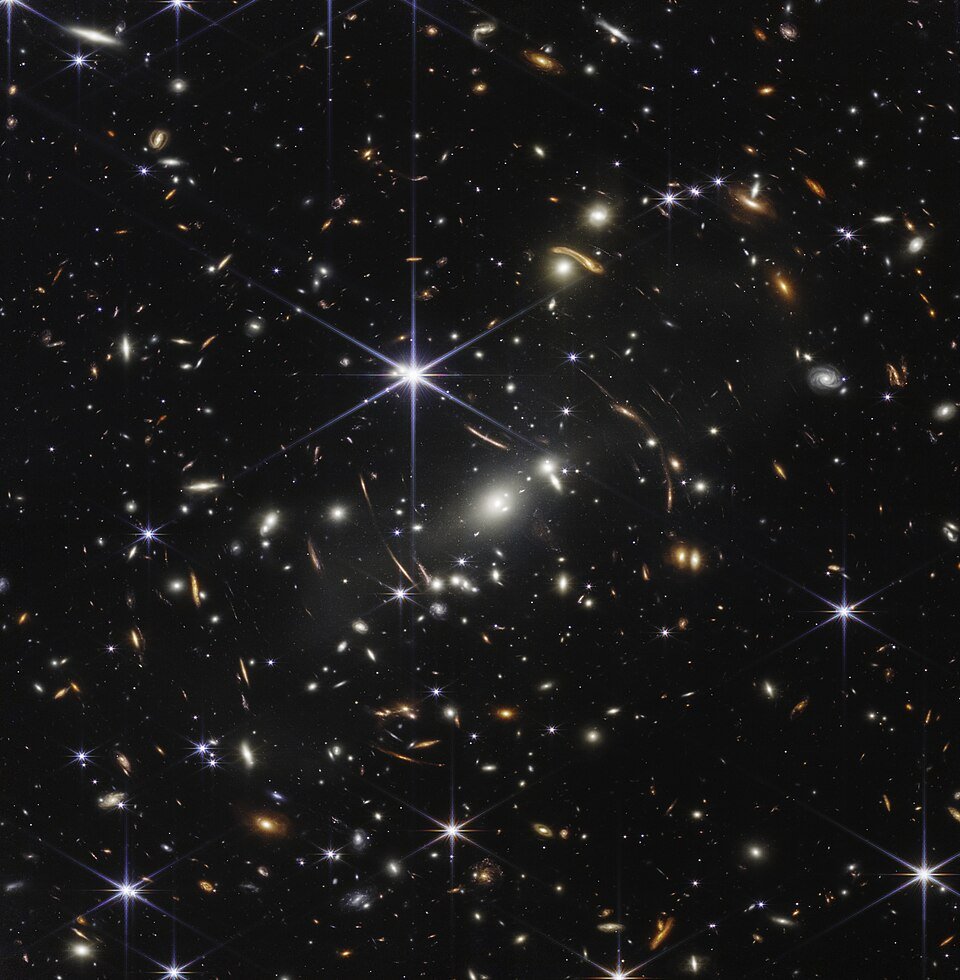
A new study combining James Webb Space Telescope observations of the earliest galaxies with cosmic microwave background data and baryon acoustic oscillation measurements from the Dark Energy Spectroscopic Instrument has resolved the long-standing Hubble tension to just 1.0 sigma — the closest astronomers have come to eliminating the decade-old crisis in cosmology.
The Hubble tension refers to a persistent and statistically significant mismatch between two methods of measuring the universe’s current expansion rate (the Hubble constant, H0). Measurements based on observations of the early universe — specifically the cosmic microwave background — yield a value of about 67 kilometers per second per megaparsec. Direct measurements using supernovae and Cepheid variables in the local universe consistently return a higher value near 73 km/s/Mpc. The discrepancy, which has grown more significant with each generation of instruments, stands at approximately 5 sigma in the standard cosmological model — equivalent to a one-in-a-million chance of being a statistical fluke.
### Early Dark Energy as a Solution
The paper, authored by Guo-Hong Du and colleagues from Northeastern University in Shenyang, China, investigates the early dark energy (EDE) model. EDE is a theoretical scalar field — often modeled as an axion-like particle — that behaves as a temporary source of dark energy in the early universe. It remains frozen at very early times, becomes dynamical around the epoch of matter-radiation equality (redshift z approximately 3,500), briefly contributes roughly 10 percent of the universe’s total energy density, and then decays away before the cosmic recombination era.
This brief pulse of extra energy increases the expansion rate of the early universe, which reduces the sound horizon — the maximum distance sound waves could travel in the primordial plasma. A smaller sound horizon at the time of recombination allows a higher value of H0 to be inferred from CMB data, directly addressing the Hubble tension by bringing the early-universe prediction closer to the local measurement.
### The Breakthrough: JWST Data
What sets this work apart from previous EDE studies is the inclusion of JWST’s ultraviolet luminosity function data at redshifts 7 to 12. These measurements — which count the number density of bright galaxies as a function of magnitude at the earliest cosmic epochs — provide an entirely independent cosmological probe that breaks degeneracies between EDE parameters and standard parameters.
When the team combined data from Planck, the Atacama Cosmology Telescope, and the South Pole Telescope for the CMB, DESI’s second data release for BAO measurements, and JWST’s galaxy luminosity functions, the results were striking. The axion EDE model delivered an H0 value of 71.58 plus or minus 1.05 km/s/Mpc, reducing the tension with local supernova measurements (from PantheonPlusSH0ES) to just 1.0 sigma — effectively eliminating the statistical significance of the discrepancy.
For comparison, the standard Lambda-Cold Dark Matter model using the same datasets yields H0 = 68.21 plus or minus 0.26 km/s/Mpc, maintaining a 4.5-sigma tension.
### Statistical Significance
The improvement is not marginal. Compared to the standard model, the axion EDE model achieves a chi-squared improvement of negative 18.26 across all datasets, with a Deviance Information Criterion difference of negative 11.89 — a value considered “decisive” in Bayesian model comparison.
Notably, the JWST data alone accounts for the majority of the improvement, contributing a chi-squared improvement of negative 13.49. JWST has consistently observed more bright galaxies at redshifts 10 to 12 than the standard model predicts. EDE naturally accounts for this excess by boosting the predicted abundance of early galaxies through an increased halo mass function, providing a unified explanation for two separate cosmological puzzles.
“The high-redshift JWST data play a crucial role in this reduction,” the authors write. “Using the Axion-EDE model as a representative case, the H0 tension is only reduced to 4.1 sigma when relying exclusively on CMB data. Upon incorporating DESI and JWST measurements, the tension is alleviated to 1.0 sigma.”
### What This Means for Cosmology
If confirmed, the results would represent the resolution of the most pressing problem in modern cosmology. The combination of CMB, DESI, and JWST data produces strong statistical evidence — a DIC difference exceeding negative 10 — that the axion EDE model genuinely fits the full modern dataset better than the standard model.
The results also carry implications beyond the Hubble tension. EDE models raise the scalar spectral index toward the scale-invariant Harrison-Zel’dovich value, with consequences for inflationary model building. And the compatibility of EDE with large-scale structure data means the model avoids the so-called “tension in the tensions” — solutions to H0 often worsen the separate S8 tension between CMB predictions and weak lensing surveys.
The findings, submitted to arXiv on June 18, add to a growing body of evidence suggesting that new physics beyond the standard cosmological model may be required to consistently describe the universe from its earliest moments to the present day.