

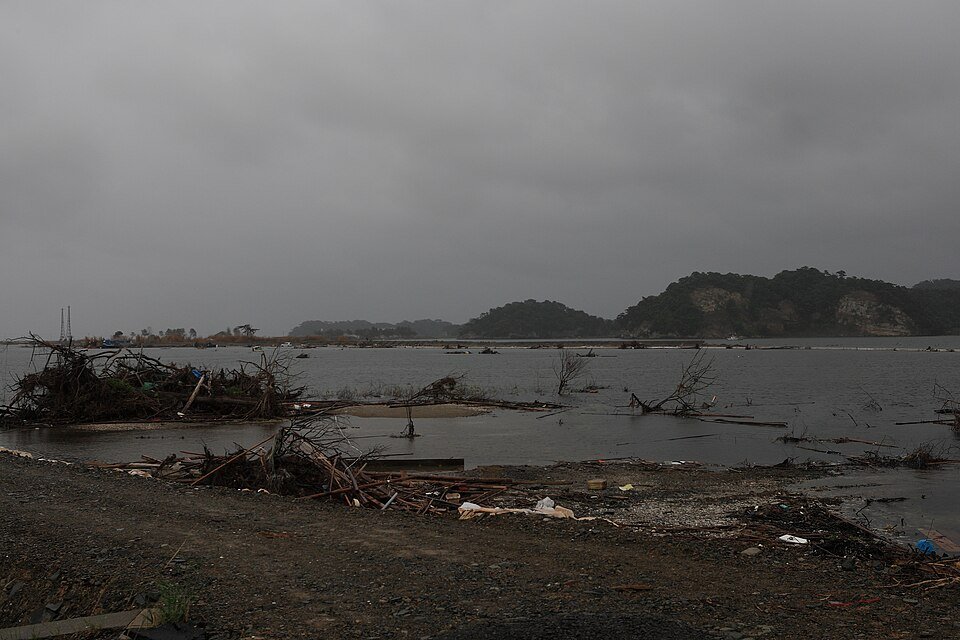
Fifteen minutes after the magnitude 9.0 Tohoku-Oki earthquake devastated Japan on March 11, 2011, an S-wave that had traveled through the Earth’s mantle, reflected off the liquid outer core, and returned to the surface arrived beneath the Japanese archipelago. Its amplitude, peak-to-peak, exceeded one centimeter. It set off a slow slip along the country’s plate boundaries, a rupture that extended at least 3,000 kilometers from Hokkaido to Kyushu and nudged Japan five to six millimeters eastward.
This previously unrecognized phenomenon, a seismic wave reflected off the Earth’s core triggering fault slip in the aftermath of a major earthquake, is described June 18 in Science by Sunyoung Park at the University of Chicago, Caltech’s Hiroo Kanamori, and Luis Rivera at the Université de Strasbourg.
“That’s a type of seismic hazard that we didn’t think about before,” Park said.
The wave in question is an ScS wave, a shear (S) wave that descends through the mantle, reflects at the boundary between the mantle and the liquid outer core approximately 2,900 kilometers down, and travels back up through the mantle. The total round trip in this case was approximately 5,800 kilometers.
The mainshock had already weakened the plate boundaries, the megathrust interfaces where the Pacific Plate slides beneath the Eurasian and Philippine Sea Plates. The returning ScS wave, arriving ~15 minutes after the initial rupture, was sufficient to release tectonic stress that had been building along those boundaries for decades or centuries.
The slip that followed was slow, about three minutes, and distributed across a vast area, making it imperceptible to people. But the GNSS data are unambiguous: the entire Japanese archipelago moved east by 5-6 millimeters.
A new kind of hazard
What makes the finding significant is not the amount of displacement, five millimeters is geologically trivial, but what it implies. If the same core-reflected triggering mechanism produced slip that is faster, or concentrated over a smaller area, the resulting ground motion could be far more severe.
“This reveals a seismic hazard that seismologists hadn’t recognized,” said Zachary Ross, a seismologist at Caltech who was not involved in the study. The possibility that strong waves from the initial earthquake can reverberate through the planet’s interior and reactivate the same fault system minutes later, or trigger slip on neighbouring faults, is not accounted for in current hazard models.
Kanamori, now 88 and one of the most influential seismologists of the modern era, is a co-creator of the moment magnitude scale used to measure earthquake size. His involvement underscores the significance of the discovery: a fundamental new observation about how the Earth’s interior and its surface interact during the largest earthquakes.
The wider picture
Park and her colleagues analysed GNSS data from Japan’s dense geodetic network to isolate the slow slip triggered by the ScS wave. The finding was possible only because Japan is among the most heavily instrumented seismic regions in the world, the same slow-slip event would have gone undetected in most other subduction zones.
The work raises the question of whether similar core-reflected triggering has occurred after other great earthquakes, the 2004 Sumatra-Andaman (magnitude 9.1) or the 1960 Valdivia (magnitude 9.5), for example, and whether the phenomenon is a universal feature of the largest subduction events or unique to the geometry of the Japan Trench.
Source: Park, S., Kanamori, H., and Rivera, L. (2026) “ScS-triggered slip on megathrust interfaces after the 2011 M_W 9.0 Tohoku-Oki earthquake.” Science 392(6804), pp. 1297-1301. DOI: 10.1126/science.aec4190.