

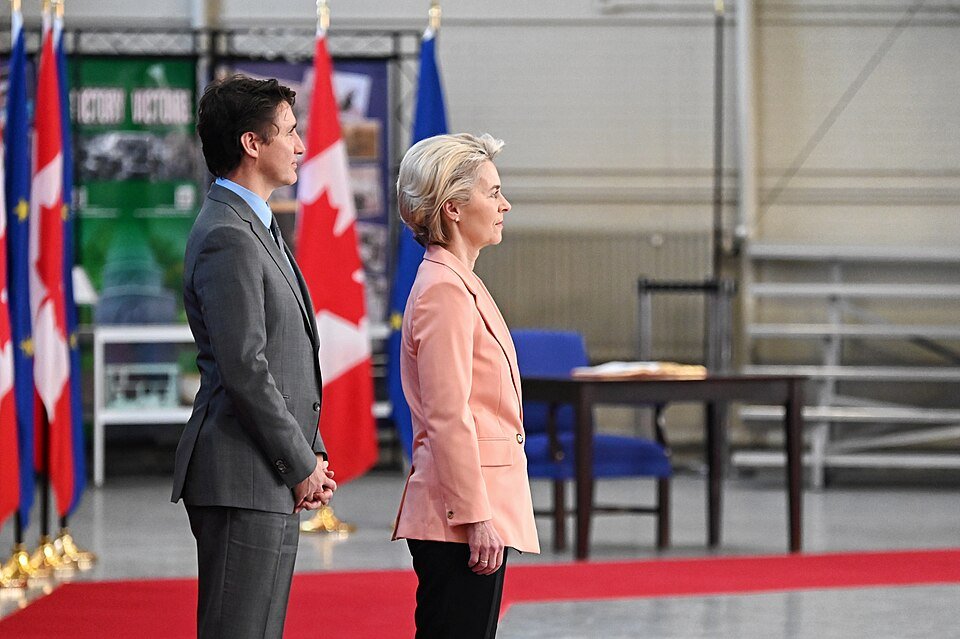
Canadian Prime Minister Mark Carney arrived at the G7 summit in Evian this weekend with a message that would have been unthinkable five years ago. Speaking before the meeting, he declared a “global rupture” and called for a united Canada-European Union front against the forces pulling the Western alliance apart.
The forces in question are largely American. President Trump’s tariffs, his unilateral management of the Iran war, his threats to cut NATO force commitments, and his open hostility toward traditional allies have left Canada and Europe asking the same question: if Washington can no longer be relied on, who can?
Carney’s answer is: each other.
Canada and the EU have been moving closer for years. In February, Canada became the first non-European country to join the EU’s Security Action for Europe (SAFE) initiative, unlocking billions in defense procurement and market access. Trade ties are deepening through CETA, the free trade agreement that has been in provisional force since 2017. On the eve of the G7, Carney signed a new joint declaration with European Council President Antonio Costa pledging closer coordination on critical minerals, artificial intelligence regulation, and supply chain security.
All of this raises a question that would have been dismissed as absurd a decade ago: could Canada join the European Union?
The short answer is no. Article 49 of the Treaty on European Union limits membership to “any European state.” Canada is not in Europe. The European Commission has confirmed that only European countries are eligible. When Morocco applied for membership in 1987, its application was declined on geographic grounds.
But the longer answer is more interesting than the short one.
“Being European is more of a state of mind,” Giselle Bosse, a professor of EU external democracy support at Maastricht University, told Politico. “Legally and formally a European state is not actually defined.” She pointed out that EU members have overseas territories in the Caribbean, the Pacific, and the Arctic — places that are no more geographically European than Halifax.
Frank Schimmelfennig, a professor of European politics at ETH Zurich, put it more directly: “Canada would certainly qualify. It is in very many ways probably closer to those European values, institutions and policies than many of the current candidate countries.”
Polls support the idea. A recent survey found that 44 percent of Canadians support joining the EU, compared with 34 percent who oppose it. The numbers are driven by the Trump factor: as the United States becomes less reliable, Canadians are looking for partners who share their values and their interests.
The pragmatic obstacles remain enormous. Full membership would require Canada to adopt the acquis communautaire — the body of EU law that runs to tens of thousands of pages — and to accept the jurisdiction of the European Court of Justice. It would mean opening Canadian fisheries, agriculture, and services to EU competition. It would require the approval of all 27 existing member states, any one of which could veto.
More fundamentally, Canada sits on the other side of the Atlantic. Its economy, its security architecture, and its political culture are shaped by proximity to the United States in ways that no treaty can change. Joining the EU would not relocate the country.
What is possible, and what Carney appears to be pursuing, is something short of membership but well beyond the current partnership. A deeper integration that gives Canada a seat at European tables — on security, on technology standards, on critical minerals — without the full weight of treaty obligations. The SAFE initiative is already a step in that direction.
The geopolitical implication is significant, even without full membership. A Canada that is functionally aligned with the European Union on security, trade, and technology represents a shift in the transatlantic balance. It creates a third pole — not the US, not Europe alone, but a Canadian-European axis that can act independently of Washington when necessary.
For the United States, this would mean losing not just an ally but a geographic rear flank that has been taken for granted since 1945. For the European Union, it would mean gaining a partner with Arctic territory, Atlantic ports, Pacific coastline, and a seat at the table in both NATO and Five Eyes intelligence sharing. For Canada, it would mean finally diversifying away from an economic and security dependence on the United States that has felt, in the Trump years, less like an alliance and more like a trap.
Carney is not asking for a marriage proposal. He is asking for a commitment to see each other more often, to share the burden, and to be ready for what comes next. The question is whether that commitment, over time, becomes something that looks very much like membership in all but name.