

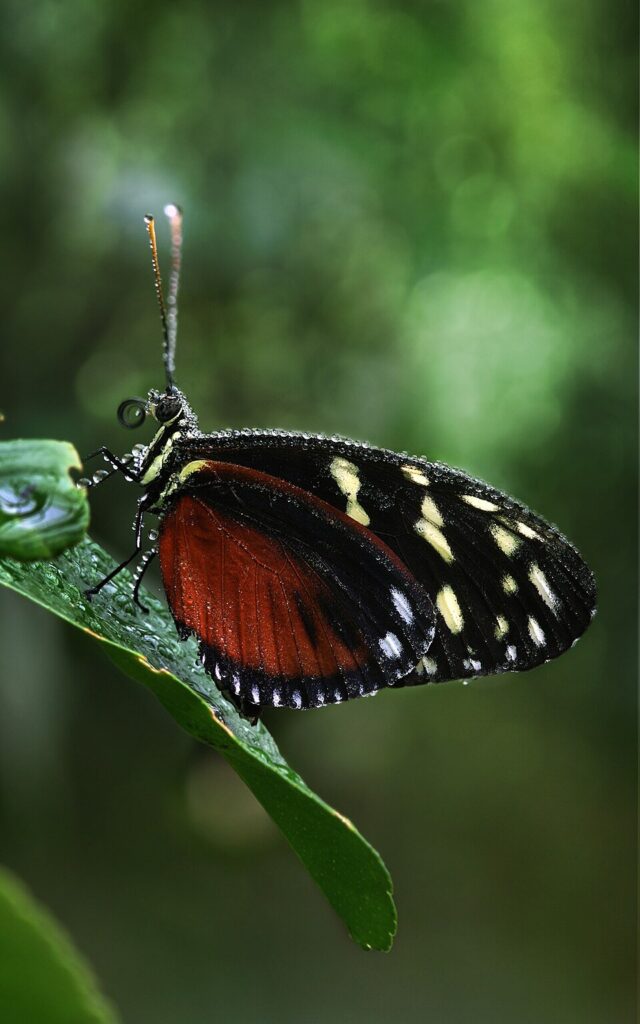
What if an animal could live 25 times longer than its closest relatives, and in old age show no sign of weakening? That is exactly what a team led by the University of Bristol and the Smithsonian Tropical Research Institute has documented in a genus of tropical butterflies, and the secret, it turns out, is in their diet.
In a study published June 16 in Nature Communications, Jessica Foley, Stephen H. Montgomery, and colleagues report that Heliconius butterflies, which actively collect and digest pollen, live radically longer than related species that feed only on nectar. Heliconius hewitsoni can survive up to 348 days in captivity, while its close relative Dione juno lives just 14 days. The 25-fold gap within the same insect tribe is among the largest lifespan disparities ever documented between related animal species.
“The lifespan range across this tribe is extraordinary, from two weeks to nearly a year in butterflies that share the same basic body plan,” said Foley, a researcher jointly affiliated with Bristol’s School of Biological Sciences and the Jean Mayer USDA Human Nutrition Research Center on Aging at Tufts University. “What we wanted to know was whether these long-lived butterflies also age more slowly, or whether they simply survive longer while deteriorating at the same rate.”
The science: measured ageing
The team conducted detailed physiological senescence assays across multiple species. The key comparison pitted Heliconius hecale, a pollen-feeding species living a median 119 days, against Dryas iulia, a nectar-only species with a median lifespan of 27-29 days.
The results were stark. Over five weeks, D. iulia lost 6.5 percent of its body mass per week and its grip strength declined by 25.67 percent, clear signs of rapid senescence. H. hecale fed on pollen lost just 1.06 percent of body mass per week and showed no significant decline in grip strength whatsoever, even over its much longer lifespan.
“This was the most surprising finding,” said Montgomery, the senior author. “The long-lived species doesn’t just postpone death, it postpones functional decline. There is negligible physiological ageing in these animals over the course of their adult lives.”
The researchers measured what demographers call the rate of ageing (beta), which captures how quickly mortality risk accelerates with time. They found that while pollen provides the nutritional resources to reduce baseline mortality (alpha), the rate of ageing itself is a heritable, genetically determined trait. When H. hecale was deprived of pollen, its baseline mortality rose but its rate of ageing remained unchanged, and the deprived individuals still outlived short-lived relatives by a median of 20 days.
“It tells us that there are two independent components to the longevity,” said Montgomery. “Pollen provides the fuel, but the engine of slow ageing is encoded in the genome.”
The context: a unique adaptation
Heliconius butterflies evolved pollen-feeding approximately 12-18 million years ago, a dietary shift that is unique among the approximately 18,000 species of butterflies worldwide. Most butterflies feed only on nectar, which is rich in sugars but poor in amino acids. Heliconius uses its proboscis to actively collect, moisten, and digest pollen grains, extracting essential amino acids, particularly proline, and lipids.
This nutritional bounty allows for two critical changes. First, females can produce eggs continuously throughout adulthood, rather than drawing down a finite store of larval-derived resources. Second, the amino acids from pollen can be redirected toward somatic maintenance, tissue repair, antioxidant defense, and cellular upkeep.
The evolutionary consequence is profound: when females reproduce continuously into old age, natural selection retains a stake in their survival. The “selection shadow”, the drop-off in evolutionary pressure after reproduction ceases, retreats, allowing longevity-promoting genes to persist and accumulate.
“The standard evolutionary theory of ageing says that selection weakens with age because fewer individuals survive to reproduce,” said Foley. “But if reproduction is truly lifelong, selection has a reason to maintain function at every age.”
The caveats
The study was conducted in captivity under controlled conditions. Maximum lifespans in the wild may differ substantially due to predation, disease, and environmental stress. The researchers note that Myscelia cyaniris, a non-pollen-feeding outgroup species, lived up to 380 days in their experiment, longer than any Heliconius, reminding us that other routes to extreme longevity exist in the insect world.
The study also does not identify the specific genes responsible for the reduced rate of ageing, only that it is heritable. “We have shown that the rate of ageing has an evolved, genetic basis independent of diet,” said Montgomery. “The next step is to find which genes are involved.”
What’s next
The Foley-Montgomery group is now pursuing comparative transcriptomics across the Heliconius tribe to identify gene expression patterns associated with slow ageing. They are also interested in whether the mechanisms, particularly the decoupling of reproduction from limited larval resources, have parallels in other long-lived organisms, including vertebrates.
The work was supported by the GW4 BioMed MRC DTP Studentship, a NERC Independent Research Fellowship, and an ERC Starter Grant.
Source: Foley, J. et al. (2026). “Evolution of increased longevity and slowed ageing in a genus of tropical butterfly.” Nature Communications, Vol. 17, Article 5077. DOI: 10.1038/s41467-026-73635-7