

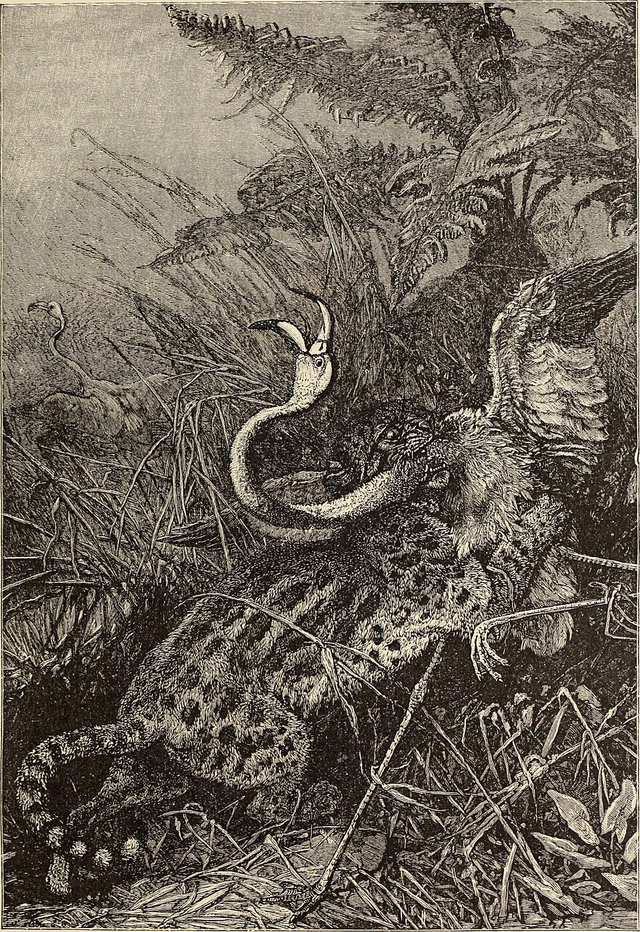
Some go there to read about the wood that Victorian manufacturers used to make walking sticks. Others want to see an illustration of a Tasmanian tiger, or marvel at the field diary of one of the first known botanists to explore the Antarctic. Over the past 20 years, the Biodiversity Heritage Library (BHL) has grown from a radical idea into the world’s largest open-access digital archive of biodiversity literature, making more than 64 million pages freely available to anyone with an internet connection.
Now that archive is fighting for its survival.
The BHL was born in 2006, at the dawn of web 2.0, when librarians at 10 prominent museums and institutions in the UK and US had an idea that was, at the time, genuinely revolutionary: what if they pooled their historic biodiversity collections into a single digital library that every scientist in the world could access for free? Two decades later, the consortium has grown to more than 680 museums, universities, libraries and scientific institutions from China, Singapore, Australia, New Zealand, Europe, Africa, Mexico, Canada and the US.
But earlier this year, the Smithsonian Institution — which has hosted the BHL’s administration, paid key staff, and supported its technical infrastructure since its founding — stopped doing so, after facing severe funding cuts under the Trump administration. The library is now scrambling to find a new institutional home and a sustainable funding model.
“We estimate we have funding only until the end of 2027,” said David Iggulden, who chairs the BHL executive committee alongside his role as head of data and digital at the Royal Botanic Gardens, Kew. “A tick-over budget, just to keep it running as it is, would ideally be about a million dollars a year. It would be just horrendous — devastating, really — to lose it after coming so far and unlocking so much.”
The BHL’s collections span published biodiversity literature, journals, letters, illustrations, climate records, field diaries, ecosystem profiles, distribution records, and manuscripts containing the original collecting stories of individual species. The oldest book in the collection is the Circa instans, a medieval pharmacopeia dating to approximately 1190 that helped standardise plant names across Europe and is considered a fundamental text in the development of modern botany.
One of Iggulden’s favourite finds is an 1892 illustrated exhibition catalogue by Henry Howell & Co, a Victorian firm in London that marketed itself as the world’s largest manufacturer of walking sticks. “It’s a really fascinating find — and quite different to what you’d expect in the BHL,” he said. Catalogues like this help scientists studying the economic uses of plants and the historical properties of wood.
The collection also includes Sir Joseph Hooker’s illustrated Antarctic journal, featuring watercolour sketches of two volcanoes first sighted in 1841 on his expedition with Captain James Clark Ross. Hooker’s personal account of the Antarctic is one of the most significant manuscripts in the library.
Science in the Field
Beyond its historical value, the BHL serves a practical scientific function. During the pandemic, historical journals uploaded to the library helped scientists document that the distribution and abundance of rare Australian orchids had changed dramatically during the “black summer” wildfires of 2019-2020. The evidence was used to reassess and upgrade the threatened species status of several orchids.
Nicole Kearney, who leads the Australian branch of the BHL based at Museums Victoria, recalled uploading a handwritten field diary about birds in Australia. A researcher studying river flooding contacted her: “You’ve just given me this incredible resource where I’m able to tell every time this river flooded between 1947 and 1957,” the researcher said. “I thought it was all about birds.”
Kearney often quotes Charles Darwin: “The cultivation of natural science cannot be efficiently carried on without reference to an extensive library.” She added: “I’m sure Darwin would agree that, in today’s world, it is essential that we can access the world’s biodiversity knowledge online. And that this knowledge is freely accessible for everyone.”
The AI Frontier
The library’s potential extends beyond its current use. The BHL contains vast quantities of taxonomic, geographical, ecological, and specimen-level knowledge that is locked in scanned page images and cannot be processed by modern computational workflows.
“AI is a real positive for BHL,” said Iggulden. “Unlocking this at scale would create new opportunities for biodiversity synthesis, collections linkage, historical ecological analysis, and AI-assisted scientific discovery.”
But the library lacks the resources to implement AI tools, improved optical character recognition, or a mobile-friendly and multilingual platform. Even additions to its popular Flickr page, followed by tens of thousands of people, have been paused.
“The BHL is fundamental to our understanding of all the species that we share this world with, and our ability to save them,” Kearney said. “We now have 64 million pages of knowledge at our fingertips, which we need to make more discoverable and accessible. There’s so much more we could be doing.”
Source: Ferguson D. A bonanza for fans of the natural world: the digital library sharing 64m pages of scientific knowledge with everyone. The Guardian. 18 June 2026. https://www.theguardian.com/environment/2026/jun/18/natural-world-digital-biodiversity-heritage-library-scientific-knowledge-free-access-aoe