

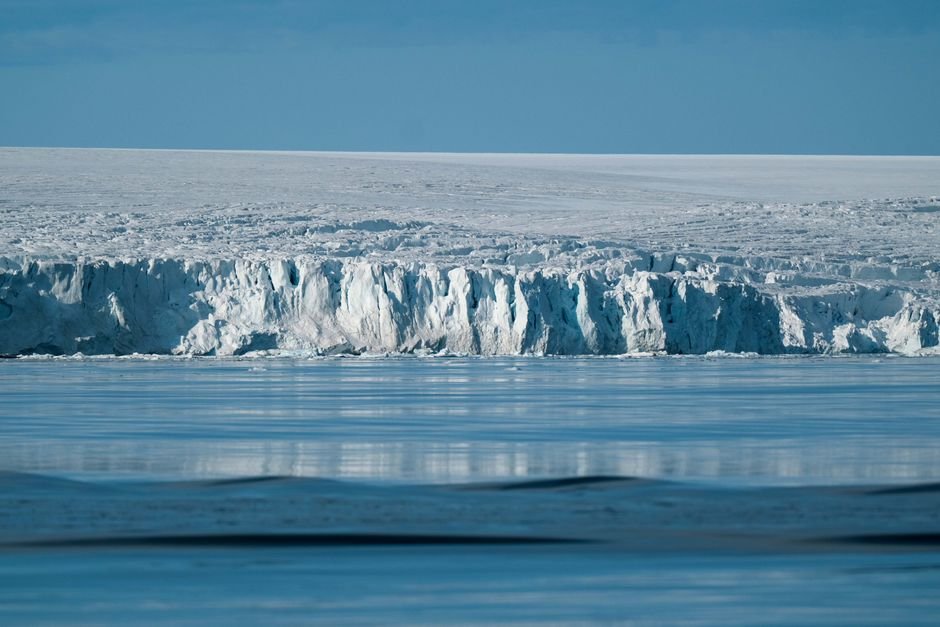
The apparent slowdown in Arctic sea ice decline that had puzzled climate scientists has vanished. Two consecutive record-low winters, 2025 and 2026, have erased what looked like a stabilizing trend, restoring the long-term downward trajectory with renewed force.
A new study published in the Proceedings of the National Academy of Sciences documents that the year-to-year winter decline between 2024 and 2025 was the largest ever recorded, a drop of nearly 6% in a single season.
“Our study suggests that conclusion was premature,” said the authors, referring to earlier studies that had suggested winter sea ice loss was slowing. “After two exceptionally low-ice winters in 2025 and 2026, the recent slowdown disappears.”
A pause that was not a pause
In the early 2020s, the rapid Arctic sea ice decline seen over the previous four decades appeared to ease. Several studies documented weaker trends, and some scientists asked openly whether winter sea ice loss had entered a new, slower phase. The question was consequential: if natural variability was dampening the ice loss, it would affect projections of when the Arctic would become seasonally ice-free.
The new analysis, using satellite data from the U.S. National Snow and Ice Data Center and the Japanese Aerospace Exploration Agency, shows that the apparent slowdown was a statistical mirage, a temporary lull within a longer declining trend.
“Arctic sea ice appeared to be entering a new phase,” the researchers wrote. “But a few unusual years can quickly change the overall picture.”
The winter of 2025 tied the record low for March maximum extent, according to NASA and NSIDC data. The 2026 winter was similarly low. Together, they restored a statistically significant downward trend that the early 2020s had temporarily obscured.
What the long-term record shows
Satellite observations have tracked Arctic sea ice continuously since the late 1970s. Over that period, sea ice has declined in every month of the year. The losses are largest at the end of summer. The September minimum has shrunk by about 13% per decade relative to the 1981–2010 average, but winter ice has also been shrinking steadily.
The new study reinforces a pattern that ice scientists have long emphasized: Arctic sea ice decline is not a smooth process. Year-to-year variability is high, driven by weather patterns, ocean currents, and atmospheric circulation. A few relatively cool years can produce a temporary slowdown that looks meaningful in short records. But the underlying trend, driven by rising global temperatures, remains entrenched.
“Low year or two don’t necessarily mean much by themselves,” NSIDC ice scientist Walt Meier said in a NASA article earlier this year. But viewed within the long-term trend, he added, they contribute to the overall picture of change.
Why it matters
The difference between a slowing decline and a steady one is not academic. The timing of the first ice-free Arctic summer, now projected by some models within the next 20 to 30 years, depends on understanding the rate of change. A slowdown would push that date further out; a resumption of rapid decline pulls it closer.
The consequences of an ice-free Arctic extend far beyond the region itself. Sea ice reflects sunlight; open ocean absorbs it, amplifying warming in a feedback loop. The loss of ice also affects weather patterns at mid-latitudes, though the exact mechanisms remain an active area of research.
Arctic amplification, the fact that the Arctic is warming three to four times faster than the global average, is already reshaping ecosystems, disrupting Indigenous communities, and opening new shipping routes. Each additional increment of ice loss accelerates the pace of those changes.
The study is a reminder that in climate science, short-term trends require cautious interpretation. The early-2020s lull was not evidence that Arctic ice had found a new equilibrium. It was a pause within a longer decline, and the data from 2025 and 2026 has now made that clear.
Reference: “Arctic sea ice decline seemed to be slowing, until two record-breaking low-ice winters.” (2026). Proceedings of the National Academy of Sciences. DOI: 10.1073/pnas.2614134123
News article: “Slowdown in Arctic ice melt ends after largest winter decline on record.” The Guardian, July 20, 2026. Available at: theguardian.com