

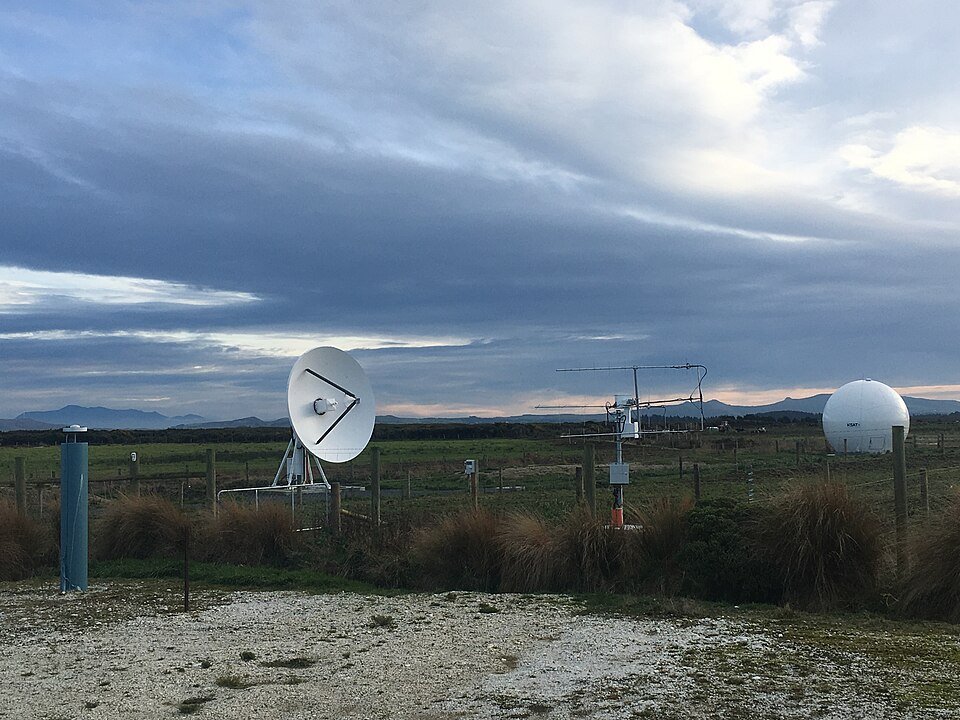
Featured image: Satellite ground station in Namibia handed over by China in February 2026. Credit: Xinhua/Reuters
The United States is on track to permanently lose influence over Africa’s rapidly expanding space industry to China, and the window for meaningful competition is closing, according to a stark new analysis published by SpaceNews.
Writing in the space policy journal, Philip Dackiw, a researcher at the American Foreign Policy Council, argues that Washington’s approach to Africa has been one-dimensional: treating the continent primarily as a recipient of foreign aid. The United States provided $14.3 billion in aid to Africa in 2023, more than triple the next largest donor. But aid creates narrow, fragile influence that evaporates when budgets are cut or administrations change — as the Trump administration’s recent aid reductions have demonstrated.
Meanwhile, China has been building durable economic ties through its “Going Out” policy and Belt and Road Initiative, embedding itself in Africa’s infrastructure and technology sectors at a scale the United States has not matched. Dackiw argues the only sector where America retains a decisive comparative advantage is space — and even that lead is shrinking.
“Washington should not try to match China’s infrastructure monopoly,” Dackiw writes. Instead, he proposes a comparative-advantage strategy focused on two specific opportunities: turn-key satellite service integration and capital-intensive space infrastructure projects.
Africa’s space boom
Africa’s space economy was valued at $24.95 billion in 2025 and is projected to reach $39.52 billion by 2030, according to the consultancy Space in Africa. More than 20 African countries now operate space programs or agencies, and the African Space Agency was formally established in April 2025. African governments are investing a combined $2.6 billion in space capabilities through 2030, with 84 percent of the satellite market remaining government-backed.
The United States has limited but not zero engagement. In December 2025, the U.S. convened its first-ever joint technical and regulatory space training meeting with African partners including Senegal, Angola, Mauritius, Djibouti, Nigeria, Kenya, Botswana, Gabon, Ethiopia, Namibia, Rwanda, and Egypt. NASA has funded an Angolan drought management system using satellite data and is in discussions with South Africa’s space agency (SANSA) about hosting a lunar exploration ground station. Starlink is available in 25 African countries.
But these efforts remain piecemeal and poorly coordinated with broader U.S. foreign policy, Dackiw argues.
China’s deep footprint
China’s space engagement in Africa is far more systematic. The scale is visible across the continent.
In Egypt, China built a satellite assembly, integration, and testing center in the new Space City near Cairo, operational since 2023. Egypt has launched nine satellites, with several built or launched with Chinese assistance including MisrSat-2 in December 2023 and the SPNEX satellite in December 2025. In total, China has 23 bilateral space partnerships across Africa.
In Namibia, a Chinese-built satellite ground data receiving station was handed over in February 2026, complete with training for 14 Namibian technicians. The station provides real-time remote sensing data for border monitoring, environmental protection, and disaster management — and, per a Reuters investigation published in February 2025, China maintains permanent personnel presence at facilities it builds abroad, gaining access to the surveillance data those stations collect.
In Ethiopia, China funded and built ETRSS-1, described as the first foreign-aid satellite provided at a cost of roughly $8 million, plus two ground stations. In South Africa, the world’s longest intercontinental quantum satellite link, spanning 12,900 kilometers (8,000 miles) using China’s Jinan-1 quantum satellite, was established in 2025. South Africa, Egypt, and Senegal have agreed to collaborate on China’s International Lunar Research Station.
Algeria launched AlSat-3A and AlSat-3B in January 2026 on Chinese Long March 2C rockets, launched 16 days apart. At the September 2024 Forum on China-Africa Cooperation summit in Beijing, President Xi Jinping identified satellites and lunar and deep-space exploration as priorities among $50 billion in Chinese loans and investment for Africa over three years.
Two windows of opportunity
Dackiw’s analysis identifies two strategic entry points for the United States.
The first is satellite service integration. Satellite services are a first-mover market: once a country adopts a provider for communications, Earth observation, or navigation, swapping providers is technically and politically difficult. Starlink, with its existing presence in 25 African countries, could serve as the entry point if the U.S. government facilitates regulatory approvals, subsidizes terminal deployment, and brokers telecom partnerships.
The second is capital-intensive infrastructure, which Dackiw argues is best suited for Africa’s most advanced space economies: Egypt, South Africa, and Nigeria. Building satellite development facilities and launch infrastructure generates sustained collaboration and gives the investing partner unprecedented access and long-term influence — precisely the dynamic China has exploited across the continent.
“The U.S. had decades to help Africa develop their space programs, but they never did,” Temidayo Oniosun, managing director of Space in Africa, told Reuters in a 2025 interview. “These countries are realizing that the U.S. doesn’t exactly have their best interests at heart.”
The question, Dackiw concludes, is whether Washington will act while it still has a credible alternative to offer — or whether Africa’s space industry will become another domain where American absence was met by Chinese presence.