

Five Years, 36 Flights: SpaceX Booster B1067 Shatters the Reusability Record Again
Featured image: A SpaceX Falcon 9 rocket soars near the Moon from the perspective of the Kennedy Space Center during the Starlink 10-42 mission on July 9, 2026. Credit: SpaceX/Spaceflight Now
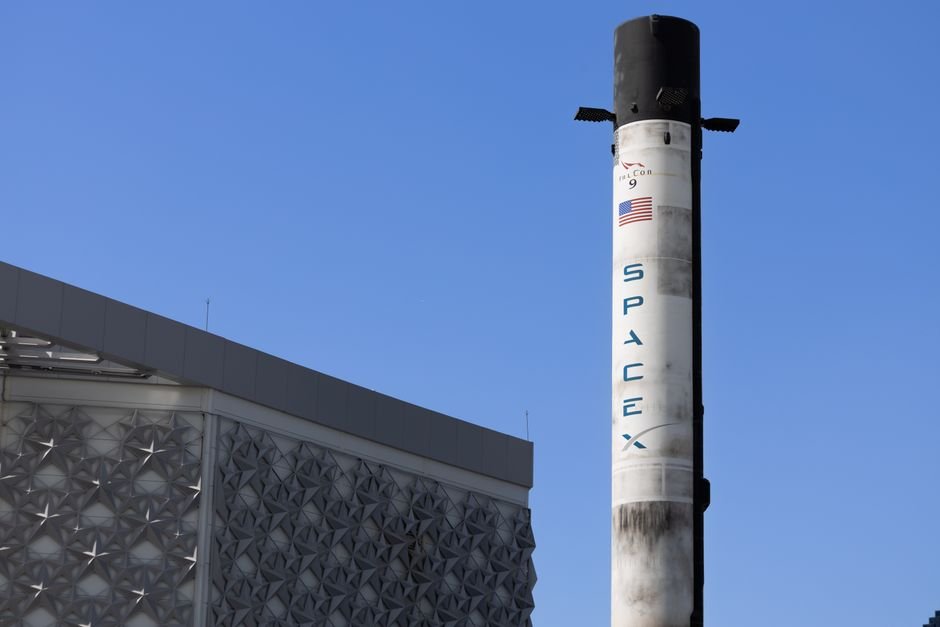
SpaceX’s booster B1067 launched for the 36th time on Thursday morning, flying 29 Starlink satellites to low Earth orbit from Cape Canaveral and landing on the droneship A Shortfall of Gravitas about eight and a half minutes later. It was a standard Starlink mission in nearly every respect: except that no orbital rocket in history has been reused this many times.
B1067 first flew in June 2021, carrying NASA cargo to the International Space Station on the CRS-22 mission. Five years later, the same piece of hardware has launched two NASA astronaut crews (Crew-3 and Crew-4), another NASA cargo run (CRS-25), a half-dozen high-value commercial and government communications satellites including Eutelsat HOTBIRD 13G and the European Union’s Galileo navigation satellites, and 25 Starlink batches. It has landed 36 times and never failed.
“It’s a testament to the engineering margins built into the Falcon 9 design,” said a SpaceX official during the launch webcast, noting that the booster was designed and tested for up to 40 flights. Thursday’s mission brings B1067 to 90 percent of that engineering limit.
The 40-flight design limit versus the 25-flight accounting limit
There is a revealing gap between what the hardware can do and what the books say. In its SEC prospectus for investors, SpaceX states a “maximum accounting useful life of 25 flights” for Falcon 9 boosters. The company has been upfront about why: it anticipates a strategic transition to Starship that will reduce future Falcon 9 demand, and some government contracts prohibit boosters flown more than five times.
The engineering reality, however, has blown past that accounting ceiling. B1067 is now 11 flights past the official “useful life” estimate and still landing reliably. The 36th flight demonstrates that the rocket equation margin built into the first stage back in 2021 was generous enough to accommodate three dozen missions without a failure. Each landing on A Shortfall of Gravitas adds data to the thesis that reusability is a solved problem for the Falcon 9 class.
Thursday’s landing was the 160th for ASOG and the 635th booster landing overall for SpaceX. The 36th flight also marked the 80th Falcon 9 mission of 2026, of which roughly 80 percent have been dedicated to Starlink.
A fleet of high-mileage boosters
B1067 is the fleet leader, but it is not alone. As of June, SpaceX had seven boosters that have flown more than 25 times: B1063 (32 flights), B1067 (now 36), B1069 (31), B1071 (33), B1077 (28), B1078 (28), and B1080 (26). The deep bench means SpaceX can sustain high cadence across multiple workhorse boosters while pushing one ahead as a reusability pathfinder.
The 31-day turnaround between B1067’s 35th flight on June 8 and its 36th on July 9 underscores how routine rapid reuse has become. The booster was recovered, inspected, refurbished, integrated with a new upper stage and payload, and rolled back to the pad in under a month.
How close to the Shuttle record?
The all-time orbital reuse record remains held by NASA’s Space Shuttle Discovery, which flew 39 missions. B1067 is now three flights shy of that mark. But comparing the two is not exactly apples to apples: Discovery was a crewed orbiter with wings, thermal protection tiles, and multi-billion-dollar price tag per flight. B1067 is an uncrewed first stage designed to be thrown away but caught instead. The fact that a booster originally built for a NASA cargo mission has reached 36 flights at a fraction of the Shuttle’s per-mission cost is a starker measure of progress than the number itself.
The broader industry implications are worth noting. With Falcon 9 boosters now routinely exceeding 25 flights, the procurement gap between what hardware can deliver and what government contracts allow is widening. As more boosters approach the 40-flight design limit, the pressure to reform flight-count restrictions on military and science missions will only grow.
B1067’s next flight has not been announced, but with the current launch cadence, it could reach 37 before the end of July. At some point, the booster will be retired: either voluntarily as SpaceX shifts focus to Starship or when engineering data shows the fatigue limits have been reached. For now, it keeps flying, one mission at a time, redefining what reusability means with every launch.
Draft for 1ban.news – Space Desk