

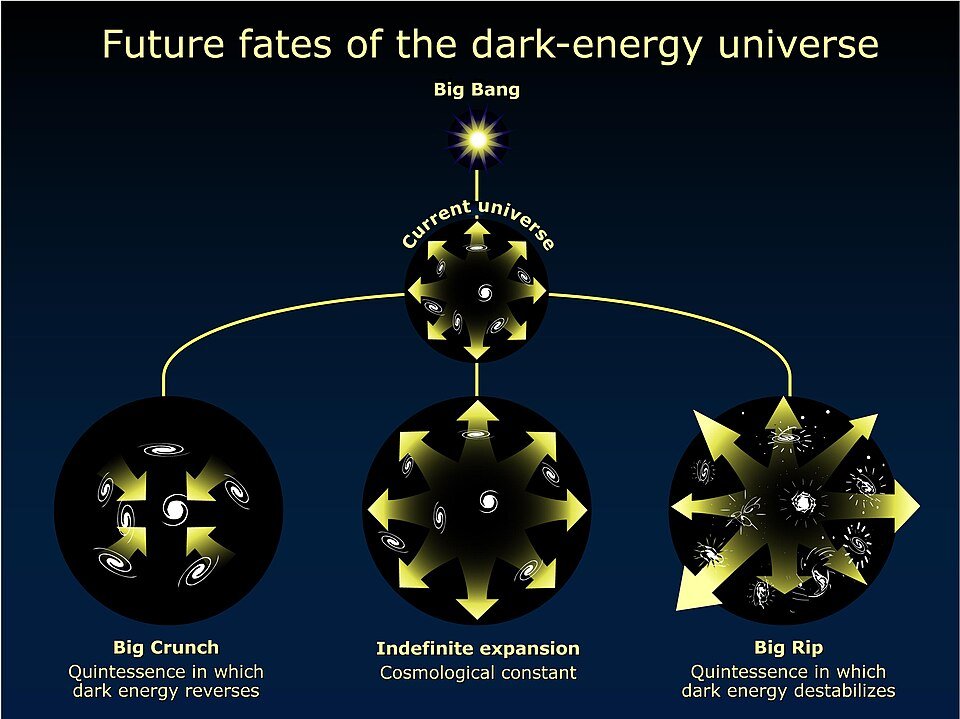
For more than two decades, the standard model of cosmology has relied on an invisible, repulsive force called dark energy to explain why the universe’s expansion is accelerating. But a new mathematical study published in Proceedings of the Royal Society A suggests the acceleration may have a simpler origin — a fundamental instability baked into the mathematics of the Big Bang itself.
“If you balance a pencil on its tip, it’s a valid solution to the equations of gravity,” said Blake Temple, distinguished professor emeritus of mathematics at UC Davis and corresponding author of the study. “But it’s unstable. The slightest perturbation makes it fall. The standard cosmological model, we argue, is like that pencil.”
The mathematics
The paper, authored by Christopher Alexander (University College London), Blake Temple, and Zeke Vogler (both at UC Davis), examines the stability of Friedmann spacetimes — the mathematical solutions to Einstein’s equations that describe a uniformly expanding universe. The standard model of cosmology (Lambda-CDM) assumes the universe is close to one of these solutions, with dark energy providing the extra kick needed to match observations of accelerating expansion.
Using the Einstein-Euler equations — which combine general relativity with the fluid dynamics of matter — the team transformed the problem into a set of self-similar variables (essentially, dividing spatial coordinates by time) and identified the critical Friedmann solution as an unstable saddle point in the mathematical landscape.
The key finding: all Friedmann spacetimes with non-zero spatial curvature are unstable within the mathematical space of possible solutions. The eigenvalues governing the system’s behavior at the Big Bang compel generic perturbations to evolve away from the Friedmann baseline.
Transient acceleration
This instability behaves in a specific and testable way. The team defines a set of solutions they call ℱ — those that agree with a slightly underdense (k<0) Friedmann universe at leading order near the Big Bang. Within this set, the generic behavior is striking: solutions "generically accelerate away from Friedmann spacetimes at intermediate times but decay back to the same leading order Friedmann spacetime asymptotically as t→∞."
In other words, the accelerated expansion we observe today — and attribute to dark energy — could be a temporary dynamical effect arising from the universe’s inherent instability at its birth, not evidence of an exotic new form of energy.
“Thus instabilities inherent in the Einstein-Euler equations provide a natural mechanism for an accelerated expansion without recourse to a cosmological constant or dark energy,” the authors write in the paper, received by the journal on October 27, 2025, accepted on March 12, 2026, and published online on May 27, 2026.
What this doesn’t mean
This is a mathematical proof of instability within the existing framework of general relativity, not an observational disproof of dark energy. The paper does not provide a complete alternative cosmological model — it does not attempt to fit supernova data, cosmic microwave background measurements, or baryon acoustic oscillation surveys within this new framework.
What it provides is a mathematically rigorous mechanism through which accelerated expansion could arise entirely within Einstein’s original theory of gravity, without requiring a cosmological constant or any new physics.
The authors acknowledge that the acceleration in their model is transient — it decays back toward the Friedmann baseline at late times. Whether the timing and magnitude of this transient acceleration matches observations from DESI, Planck, and supernova surveys remains to be tested.
The response
Mathematical cosmologists have long been aware that Friedmann solutions sit in a delicate balance, but this paper provides the first definitive local characterization of that instability. The work suggests that the accelerating universe may be like a spinning top that wobbles as it slows — not evidence of a hidden hand, but the natural consequence of how the system began.
Blake Temple has been developing this approach for years. The current paper, building on a long collaboration between the UC Davis group and Christopher Alexander at UCL, brings the argument to a new level of mathematical rigor by identifying the exact nature of the instability and the specific family of solutions that exhibit transient acceleration.
Funding for the research came from the UK Engineering and Physical Sciences Research Council, a European Research Council starting grant, and the American Institute of Mathematics SQuaRE program.
Sources: Alexander, C., Temple, B., Vogler, Z. “The instability of critical and underdense Friedmann spacetimes at the Big Bang as an alternative to dark energy.” Proceedings of the Royal Society A, Vol. 482, No. 2338, 20250912 (2026). DOI: 10.1098/rspa.2025.0912. Also on arXiv: 2510.14228 [gr-qc].